
 Figure 1: Measuring current with a clamp meter for accurate amps to kW conversion.
In my 15 years as a transformer technician at Transformer4U, I’ve seen countless engineers and
electricians struggle with the deceptively simple question: “How many kilowatts is this 30-amp circuit
drawing?”
The confusion usually comes down to one overlooked factor: the power factor (PF). I remember
troubleshooting a manufacturing plant where a 50-amp motor was only producing 8 kW instead of the expected 12 kW.
The culprit? A power factor of 0.65 due to an old, poorly maintained induction motor. After installing power factor correction capacitors, the same 50 amps
delivered 11.5 kW.
This guide gives you the amps to kW calculator you need, plus the formulas and real-world knowledge
to understand why the conversion works the way it does.
⚡ Quick Answer: Amps to kW Formula
- DC: kW = (Amps × Volts) / 1000
- Single-Phase AC: kW = (Amps × Volts × PF) / 1000
- Three-Phase AC: kW = (√3 × Amps × Volts × PF) / 1000 ≈ (1.732 × A × V × PF) / 1000
The power factor (PF) is the key
difference. For resistive loads (heaters), PF ≈ 1. For inductive loads (motors), PF typically ranges from 0.7 to
0.95.
Amps to kW Calculator (Interactive Tool)
Use our free calculator below to instantly convert amps to kilowatts. Select your circuit type and enter your values.
Understanding the Amps to kW Conversion
Before we dive into the formulas, let’s clarify why you can’t simply multiply amps by a single number to get
kilowatts.
What is an Ampere (A)?
An ampere (amp) measures the rate of electric current flow—how many electrons pass
through a point per second. According to Ohm’s Law, current (I) is related to voltage (V) and resistance (R) by:
I = V / R
What is a Kilowatt (kW)?
A kilowatt measures power—the rate at which electrical energy is consumed or
produced. 1 kW = 1,000 watts. Power is calculated differently depending on whether you’re dealing with DC or AC
circuits.
The Key Variable: Power Factor (PF)
In AC circuits, voltage and current don’t always peak at the same time. The power factor represents
the cosine of the phase angle between voltage and current:
- PF = 1.0: Voltage and current are perfectly in phase (purely resistive load, like a heater).
- PF < 1.0: Some reactive power is present (inductive loads like motors and transformers draw current that doesn’t produce
useful work).
Typical Power Factor Values by Load Type
| Load Type | Typical Power Factor |
|---|---|
| Resistive heaters, incandescent lights | 0.95 – 1.0 |
| Modern LEDs with PFC | 0.90 – 0.98 |
| Induction motors (loaded) | 0.80 – 0.90 |
| Induction motors (lightly loaded) | 0.50 – 0.75 |
| Fluorescent lights (magnetic ballast) | 0.50 – 0.70 |
| Welding machines | 0.60 – 0.80 |
| Air conditioners | 0.75 – 0.90 |

check the power factor with a clamp meter that measures kW and kVA. A PF below 0.85 usually means we recommend power factor correction capacitors to avoid utility penalty
charges.
Amps to kW Formulas: DC, Single-Phase, and Three-Phase
1. DC Amps to kW Formula
For DC circuits (batteries, solar panels, DC motors), the calculation is straightforward:
P(kW) = I(A) × V(V) / 1000
Where:
- P(kW) = Power in kilowatts
- I(A) = Current in amperes
- V(V) = Voltage in volts
Example: A 48V battery bank supplying 100A:
kW = (100 × 48) / 1000 = 4.8 kW
This calculation is common in solar battery systems and electric vehicle charging applications.
2. Single-Phase AC Amps to kW Formula
For single-phase alternating current (most residential circuits):
P(kW) = I(A) × V(V) × PF / 1000
Where PF = Power Factor (between 0 and 1).
Example: A 20A air conditioner on 240V with PF = 0.85:
kW = (20 × 240 × 0.85) / 1000 = 4.08 kW
If we assumed PF = 1.0 incorrectly, we’d calculate 4.8 kW—a 17.6% overestimation!


3. Three-Phase AC Amps to kW Formula (Line-to-Line Voltage)
For three-phase systems using line-to-line voltage
(most industrial installations):
P(kW) = √3 × I(A) × VL-L(V) ×
PF / 1000
Where √3 = 1.732 (approximately), and VL-L = Line-to-line RMS voltage.
Example: A three-phase motor drawing 30A at 400V L-L with PF = 0.88:
kW = (1.732 × 30 × 400 × 0.88) / 1000 = 18.29 kW
4. Three-Phase AC Amps to kW Formula (Line-to-Neutral Voltage)
When measuring line-to-neutral voltage (phase voltage):
P(kW) = 3 × I(A) × VL-N(V) ×
PF / 1000
Example: Using 230V L-N instead of 400V L-L:
kW = (3 × 30 × 230 × 0.88) / 1000 = 18.22 kW
Both formulas give the same result when the voltage relationship is correct: VL-L = √3 × VL-N.
Amps to kW Conversion Table (Quick Reference)
The following table shows common conversions at different voltages. Assumes Power Factor = 0.85 for AC
circuits.
Single-Phase AC (120V, 240V) at PF = 0.85
| Amps | kW @ 120V | kW @ 240V |
|---|---|---|
| 5 | 0.51 | 1.02 |
| 10 | 1.02 | 2.04 |
| 15 | 1.53 | 3.06 |
| 20 | 2.04 | 4.08 |
| 30 | 3.06 | 6.12 |
| 50 | 5.10 | 10.20 |
| 100 | 10.20 | 20.40 |
Three-Phase AC (400V L-L, 480V L-L) at PF = 0.85
| Amps | kW @ 400V | kW @ 480V |
|---|---|---|
| 10 | 5.89 | 7.07 |
| 20 | 11.78 | 14.14 |
| 30 | 17.67 | 21.21 |
| 50 | 29.44 | 35.35 |
| 100 | 58.89 | 70.70 |
| 200 | 117.78 | 141.40 |
Note: These values assume a power factor of 0.85. For
accurate calculations, always measure or verify your actual power factor.
Real-World Case Studies
Case 1: Solar Battery System Sizing
A customer wanted to run a 3 kW inverter from a 24V battery bank.
Question: How many amps will the battery need to supply?
Calculation (DC):
I = P × 1000 / V = 3000 / 24 = 125A
We recommended a battery system rated for at least 150A continuous to account for inverter efficiency losses.
Case 2: Motor Current vs. Actual Power
During a factory audit, I measured a 75 HP (55 kW rated) motor:
- Measured current: 85A
- Voltage: 400V, 3-Phase
- Measured power factor: 0.78
Calculated kW:
kW = (1.732 × 85 × 400 × 0.78) / 1000 = 45.9 kW
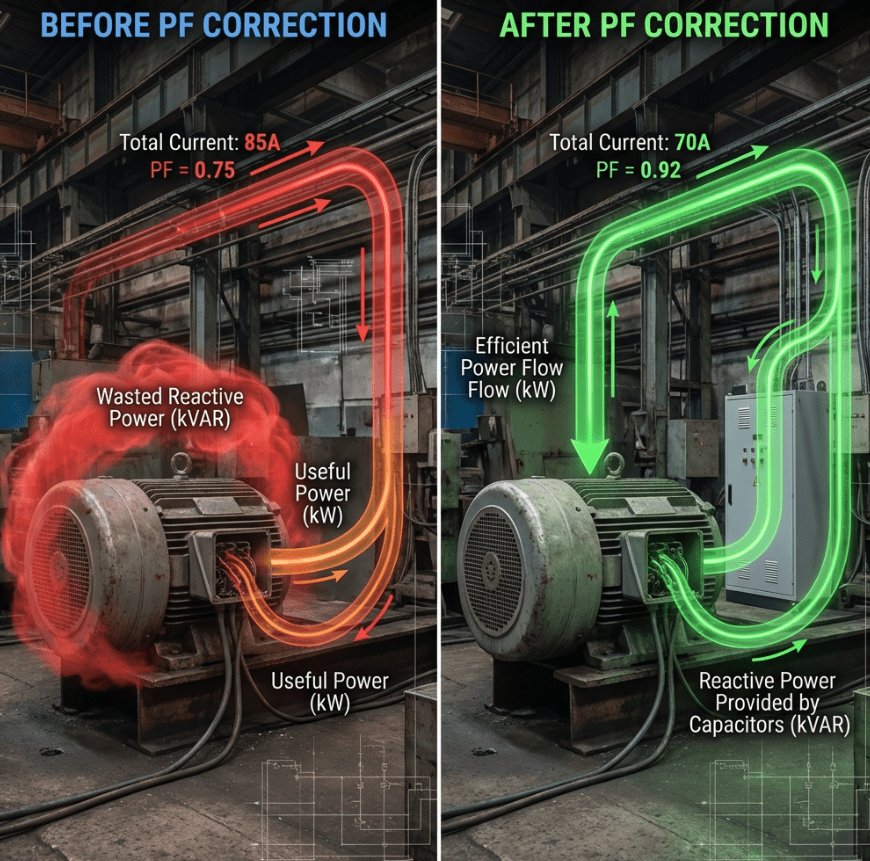
The motor was only running at 83% of rated capacity. After cleaning the motor windings and checking alignments, the
PF improved to 0.88, and current dropped to 77A while maintaining the same mechanical output. This reduced energy
costs significantly.
Case 3: The Transformer Sizing Challenge
A customer asked: “I have a 100A service panel at 240V single-phase. What size transformer do I need?”
Calculation:
kVA = (100 × 240) / 1000 = 24 kVA
We recommended a 25 kVA transformer to provide a safety margin. For a dedicated motor load with poor power factor,
we’d suggest an even larger transformer to handle the
reactive current without overheating.
Common Mistakes When Converting Amps to kW
| Mistake | Problem | Solution |
|---|---|---|
| Ignoring Power Factor | Overestimates real power for inductive loads | Always include PF for AC circuits |
| Using wrong voltage | Line-to-line vs. line-to-neutral confusion | Verify measurement point; VL-L = √3 × VL-N |
| Assuming DC formula for AC | Missing PF term | Use appropriate formula for circuit type |
| Using nameplate amps | Nameplate shows max, not actual | Measure actual current under operating conditions |
| Ignoring efficiency | kW input ≠ kW output | Account for motor/device efficiency (typically 85-95%) |
The Reverse: kW to Amps Conversion
Sometimes you need to go the other way. Here are the formulas:
DC:
I(A) = P(kW) ×
1000 / V(V)
Single-Phase AC:
I(A) = P(kW) ×
1000 / (V(V) × PF)
Three-Phase AC (L-L Voltage):
I(A) = P(kW) ×
1000 / (√3 × V(V) × PF)
Example: What current does a 15 kW three-phase motor draw at 400V with PF = 0.9?
I = (15 × 1000) / (1.732 × 400 × 0.9) = 24.06A
FAQ: Amps to kW Conversion
Related Electrical Conversions
For more electrical engineering calculations, visit our related guides:
- kVA to Amps Calculator
- Transformer Sizing Guide
- Power Factor Correction
- Three-Phase Transformer Connections
- Transformer overheating
Conclusion
Converting amps to kW is straightforward once you understand the role of voltage and power factor. Remember:
- DC circuits are simple: kW = A × V / 1000
- AC circuits require the power factor: kW = A × V × PF / 1000
- Three-phase adds the √3 multiplier for line-to-line voltage
- Always verify your power factor—don’t assume 1.0 unless you have a purely resistive load
- Use our calculator above for instant, accurate conversions
Need Help with Electrical Calculations?
Whether you’re sizing a transformer, selecting cables, or designing a power
distribution system, our engineering team at Transformer4U is here to help.
References
- Watt’s Law – Wikipedia
- IEEE Std 141-1993 (Red Book) –
Recommended Practice for Electric Power Distribution for Industrial Plants - IEC 60076-1 – Power Transformers – General
Written by Tan, Transformer Technician at Transformer4U with 15+ years of
experience in industrial power systems.