
Written by Tan, Electrical Engineer @ Transformer4U · Updated May 2026
Last month a data center contractor called us asking for a “500 kilowatt transformer.” We shipped a 500 kVA unit. A week later, his breaker was tripping under full load. The problem? His actual load drew 500 kW at a 0.85 power factor — meaning he really needed 588 kVA. That one misunderstood unit cost him two weeks of downtime and a return shipment.
This guide explains what kVA actually means for transformers, how it relates to MVA, and gives you the tables and formulas to get the right size the first time.
Quick Answer: kVA (kilovolt-amperes) measures apparent power — the total electrical load a transformer must carry. MVA = kVA ÷ 1,000. Transformers are rated in kVA (not kW) because their thermal limits depend on current and voltage, not power factor. See the kVA ratings table below to find standard sizes.
What Is kVA in a Transformer?
kVA stands for kilovolt-amperes. One kVA equals 1,000 volt-amperes (VA) — the product of voltage and current in an electrical circuit.
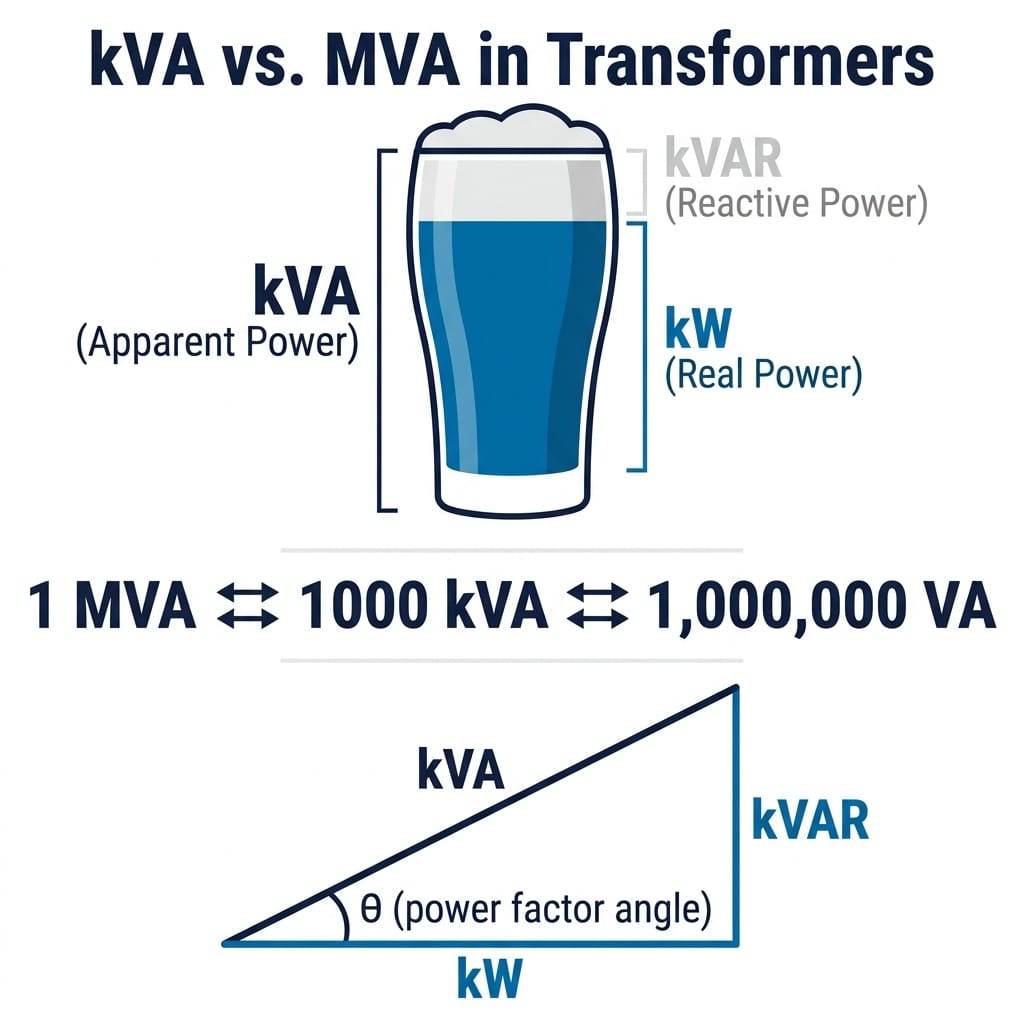
In a transformer, kVA represents the apparent power capacity: the maximum combined real power (kW) and reactive power (kVAR) the transformer can handle without exceeding its thermal limits.
Think of it this way: you’re ordering a beer. The entire glass is kVA (apparent power). The beer itself is kW (real power — the part that does useful work). The foam is kVAR (reactive power — it fills the glass but doesn’t quench your thirst). You pay for the whole glass, and so does your transformer.
Why Are Transformers Rated in kVA Rather Than kW?
This is the question I get asked most often at trade shows. The answer comes down to losses:
- Copper losses (I²R) — depend on current flowing through the windings
- Iron losses (core losses) — depend on voltage applied to the core
Neither loss type depends on the load’s power factor. Since kVA = V × I / 1,000, it directly reflects the thermal stress on the transformer regardless of whether the load has a power factor of 0.7 or 1.0. Rating in kW would understate the actual heating at low power factors.
From the factory floor: We once tested two identical 100 kVA dry-type units. One fed a purely resistive load at PF=1.0 (100 kW), the other fed motors at PF=0.8 (80 kW). After 4 hours, the winding temperature rise was nearly identical — 62°C and 64°C. The transformer doesn’t care about power factor; it cares about amps flowing through copper.
kVA and MVA: What’s the Difference?
Both kVA and MVA measure apparent power. The only difference is scale:
| Unit | Full Name | Equals | Typical Use |
|---|---|---|---|
| VA | Volt-Amperes | 1 VA | Small control transformers (<1 kVA) |
| kVA | Kilovolt-Amperes | 1,000 VA | Distribution transformers (5 – 2,500 kVA) |
| MVA | Megavolt-Amperes | 1,000 kVA = 1,000,000 VA | Power transformers, substations (2.5 – 1,000+ MVA) |
MVA to kVA Conversion
The conversion is straightforward:
MVA → kVA: Multiply by 1,000
kVA → MVA: Divide by 1,000
Example: 7.5 MVA × 1,000 = 7,500 kVA
MVA to kVA Quick-Reference Table
| MVA | kVA | Real-World Example |
|---|---|---|
| 0.5 | 500 | Small industrial substation |
| 1 | 1,000 | Large commercial building |
| 2.5 | 2,500 | Medium-scale manufacturing plant |
| 5 | 5,000 | Data center campus |
| 10 | 10,000 | Mining operation, steel mill |
| 25 | 25,000 | Utility distribution substation |
| 50 | 50,000 | City-level transmission substation |
| 100 | 100,000 | Major power plant step-up transformer |
| 500 | 500,000 | Ultra-high voltage grid interconnect |
How to Calculate the kVA You Need
Single-Phase Transformer
kVA = V × I ÷ 1,000
V = load voltage (volts) · I = load current (amps)
Example: A 240V lighting panel draws 83A.
kVA = 240 × 83 ÷ 1,000 = 19.92 kVA → Select a 25 kVA standard size (next size up + margin).
Three-Phase Transformer
kVA = V × I × 1.732 ÷ 1,000
1.732 = √3 (three-phase constant)
Example: A 480V three-phase motor system draws 180A.
kVA = 480 × 180 × 1.732 ÷ 1,000 = 149.6 kVA → Select a 225 kVA transformer (includes 25% growth margin per NEMA best practice).
Converting kW to kVA
kVA = kW ÷ Power Factor
Typical power factors: Resistive loads = 1.0 · Motors = 0.8–0.85 · Mixed commercial = 0.85–0.9
Real-world scenario: A warehouse has 200 kW of motor load at PF = 0.8.
kVA = 200 ÷ 0.8 = 250 kVA
If you sized this transformer based on kW alone, you’d pick a 225 kVA unit — and it would overheat within weeks. I’ve seen exactly this mistake twice in the past year. Always convert to kVA before selecting.
For more sizing calculations, use our free transformer kVA calculator — just enter your voltage and amps to get the right kVA rating instantly. You can also try our kVA to Amps Calculator to work backwards from a known kVA rating.
Transformer kVA Ratings: Standard Sizes
Standard transformer kVA ratings follow ANSI/IEEE C57.12.00 preferred ratings. Choosing a standard size avoids custom manufacturing lead times (often 30+ weeks) and reduces cost by 15–40%.
Single-Phase Standard kVA Ratings
| kVA Rating | Full Load Amps @ 240V | Full Load Amps @ 480V | Typical Application |
|---|---|---|---|
| 5 | 20.8 | 10.4 | Small HVAC control panel |
| 10 | 41.7 | 20.8 | Residential service, lighting |
| 15 | 62.5 | 31.3 | Small retail store |
| 25 | 104.2 | 52.1 | Medium commercial |
| 37.5 | 156.3 | 78.1 | Office building floor |
| 50 | 208.3 | 104.2 | Multi-family residential |
| 75 | 312.5 | 156.3 | Small factory |
| 100 | 416.7 | 208.3 | Industrial subpanel |
| 167 | 695.8 | 347.9 | Large pole-mount service |
| 250 | 1,041.7 | 520.8 | Pad-mount distribution |
| 333 | 1,387.5 | 693.8 | Utility distribution |
| 500 | 2,083.3 | 1,041.7 | Large distribution feeder |
Three-Phase Standard kVA Ratings
| kVA Rating | FLA @ 208V | FLA @ 480V | Typical Application |
|---|---|---|---|
| 15 | 41.6 | 18.0 | Small commercial HVAC |
| 30 | 83.3 | 36.1 | Retail store |
| 45 | 124.9 | 54.1 | Office floor |
| 75 | 208.2 | 90.2 | Medium commercial building |
| 112.5 | 312.3 | 135.3 | Small manufacturing facility |
| 150 | 416.4 | 180.4 | Medium industrial plant |
| 225 | 624.6 | 270.6 | Hospital, school campus |
| 300 | 832.8 | 360.8 | Large commercial complex |
| 500 | 1,388.0 | 601.4 | Heavy manufacturing, data center |
| 750 | 2,082.0 | 902.1 | Large industrial campus |
| 1,000 | 2,776.0 | 1,202.8 | Utility substation, mine |
| 1,500 | 4,164.0 | 1,804.2 | Steel mill, petrochemical |
| 2,000 | 5,552.0 | 2,405.6 | Major industrial facility |
| 2,500 | 6,940.0 | 3,007.0 | Large substation, utility grid |
Full load amps (FLA) calculated per NEC 450.3: FLA = kVA × 1,000 ÷ (V × √3) for 3-phase; FLA = kVA × 1,000 ÷ V for single-phase. Standard sizes per ANSI/IEEE C57.12.00.
How to use this table: Calculate your minimum kVA (see formulas above), then find the next standard size above your calculated value. For a 149.6 kVA requirement, select 225 kVA — not 150 kVA. The extra 50% headroom accounts for motor starting surge, future load growth, and altitude/temperature derating.
Power Factor: The Bridge Between kVA and kW
Power factor (PF) connects apparent power (kVA) to real power (kW):
kW = kVA × PF
kVAR = kVA × sin(arccos(PF))
kVA² = kW² + kVAR²
| Load Type | Typical PF | 100 kVA Delivers… | To get 100 kW, you need… |
|---|---|---|---|
| Resistive heaters | 1.00 | 100 kW | 100 kVA |
| LED lighting | 0.95 | 95 kW | 105 kVA |
| Data center (mixed IT) | 0.90 | 90 kW | 111 kVA |
| Commercial HVAC | 0.85 | 85 kW | 118 kVA |
| Induction motors (loaded) | 0.80 | 80 kW | 125 kVA |
| Welding machines | 0.60 | 60 kW | 167 kVA |
Practical takeaway: If your utility charges penalties for power factor below 0.9, consider power factor correction capacitor banks. We regularly see customers reduce their required transformer kVA by 20–30% after installing PFC — which can save $5,000–$15,000 on the transformer alone.
4 Sizing Mistakes to Avoid
After 15 years of shipping transformers, these are the errors I see most often:
- Sizing by kW instead of kVA. A 100 kW motor load at PF=0.8 needs 125 kVA, not 100 kVA. I see this mistake at least twice a month.
- Ignoring motor starting surge. Motors draw 6–8× their rated current at startup. If you have large motors starting frequently (more than once per hour), add a 125% start factor. A 100 kVA calculated load becomes a 125 kVA minimum. For DOL (direct on-line) motor starts, consider a 150% factor.
- Forgetting altitude/temperature derating. Above 1,000m elevation or 30°C ambient, transformers must be derated. A 500 kVA unit at 2,000m altitude and 40°C ambient effectively becomes ~425 kVA. Check our derating table for exact factors.
- Undersizing for future growth. Most transformer nameplates show a 20-year design life. Size for what you’ll need in 5–10 years, not just today’s load. The cost difference between a 225 kVA and 300 kVA unit is typically 12–18%, but replacing an undersized transformer mid-operation costs 5–10× more.
A lesson from the field: We supplied a 300 kVA unit to a packaging factory. Three years later, they added two 50 HP compressors without upgrading the transformer. During a summer heat wave (42°C ambient), the transformer oil temperature hit 115°C — well above the 105°C alarm threshold. The winding insulation degraded, and the transformer failed within 6 months. The replacement cost, including downtime, was over $35,000. A $4,000 upsize to 500 kVA would have prevented the entire failure.
FAQ
What is kVA in a transformer?
kVA (kilovolt-amperes) measures a transformer’s apparent power capacity — the total power it must handle, including both real power (kW) and reactive power (kVAR). Transformers are rated in kVA rather than kW because copper losses depend on current (not power factor), and iron losses depend on voltage, making kVA a more accurate measure of a transformer’s thermal limits.
How do I convert MVA to kVA?
Multiply MVA by 1,000. For example, 2.5 MVA = 2,500 kVA. To convert kVA to MVA, divide by 1,000.
Why are transformers rated in kVA instead of kW?
A transformer’s losses are independent of the load’s power factor. Copper losses (I²R) depend on current, and iron losses depend on applied voltage. Since kVA = V × I / 1,000, it directly reflects the thermal stress the transformer experiences regardless of what power factor the load operates at. Rating in kW would understate the actual thermal load.
What are standard transformer kVA ratings?
Common single-phase sizes: 5, 10, 15, 25, 37.5, 50, 75, 100, 167, 250, 333, and 500 kVA. Three-phase sizes: 15, 30, 45, 75, 112.5, 150, 225, 300, 500, 750, 1000, 1500, 2000, and 2500 kVA. These follow ANSI/IEEE C57.12.00 preferred ratings.
How do I calculate the kVA I need?
For single-phase: kVA = V × I / 1,000. For three-phase: kVA = V × I × 1.732 / 1,000. Then add a 20–25% margin for future expansion and inrush current. Always round up to the next standard size.
What is the difference between kVA and MVA?
Both measure apparent power. kVA (kilovolt-amperes) = 1,000 VA. MVA (megavolt-amperes) = 1,000 kVA = 1,000,000 VA. kVA is used for distribution transformers (up to ~2,500 kVA), while MVA is used for power transformers and substation equipment (typically 2.5 MVA and above).
How do I convert kW to kVA?
Divide kW by the power factor: kVA = kW ÷ PF. For a typical industrial power factor of 0.8, 100 kW = 125 kVA. For unity power factor (PF = 1.0), kVA equals kW.
Need Help Selecting the Right kVA?
Getting the kVA wrong is expensive — undersizing leads to overheating and premature failure, oversizing wastes capital and increases no-load losses. Our engineering team reviews every transformer order to catch sizing issues before manufacturing.
Contact Transformer4U for a free sizing consultation, or explore our product range: