
A transformer blows when an internal fault — such as a short circuit, insulation breakdown, or severe overload — generates extreme heat that vaporizes the insulating oil into gas. The rapid pressure buildup inside the sealed tank exceeds its structural limit, causing the tank to rupture violently. This is what most people call a transformer “explosion.”
Quick Answer: The most common causes of a transformer blowing are electrical overloading, short circuits, lightning strikes, insulation degradation, cooling system failure, tap changer malfunction, environmental damage, and animal or physical interference. In oil-filled transformers, the chain reaction from fault to explosion can happen in less than one second.
Whether you’ve heard a loud boom from a pole-top transformer during a storm or you’re an engineer investigating a substation failure, understanding the root causes helps prevent future incidents and protect both equipment and lives.
In this guide, we break down the 8 root causes of transformer explosions, explain the physics of how a transformer blows step by step, cover warning signs, repair timelines, safety procedures, and prevention methods backed by IEEE, IEC, and NEC standards.
What Is a Transformer and Why Can It “Blow”?
A transformer is a static electrical device that transfers energy between circuits through electromagnetic induction. It steps voltage up or down to match the needs of transmission lines, distribution networks, homes, and industrial facilities.
Most power and distribution transformers are oil-filled. Inside the sealed steel tank, copper or aluminum windings are wrapped around a laminated iron core, all submerged in mineral insulating oil. This oil serves two critical functions:
- Electrical insulation — preventing arcs between windings and the tank
- Heat dissipation — carrying heat from the windings to radiators or the tank surface
When something goes wrong inside this sealed system, the consequences can be dramatic. Unlike a simple fuse blowing, a transformer failure can involve fire, flying debris, oil spills, and widespread power outages.
What Causes a Transformer to Blow? 8 Root Causes
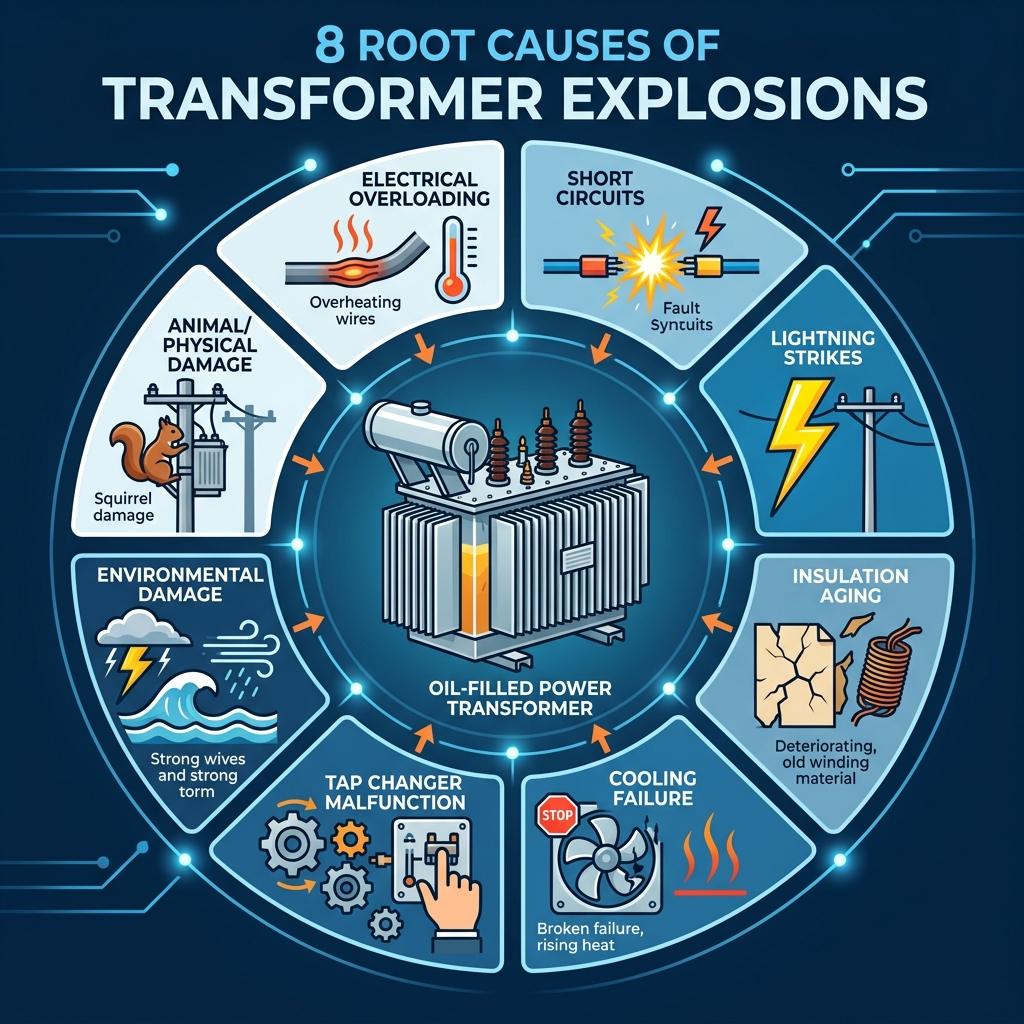
Transformer failures rarely have a single cause. Most blown transformers result from a combination of stress factors that degrade the system over time until a triggering event pushes it past the breaking point.
1. Electrical Overloading
When a transformer carries more load than its rated capacity for extended periods, the windings generate excessive heat. This heat accelerates insulation aging — what might last 20 years under normal conditions can degrade in just a few years under chronic overload.
According to IEEE C57.91, transformer insulation life follows a thermal aging curve: for every 6–8°C rise above the rated hottest-spot temperature, insulation life is roughly halved.
| Overload Level | Effect on Insulation Life | Typical Scenario |
|---|---|---|
| 100% rated load | Normal aging rate | Design operating point |
| 110% for 4 hours | Acceptable per IEEE C57.91 | Peak demand periods |
| 120% sustained | Insulation life reduced by ~50% | Undersized transformer |
| 150%+ | Rapid degradation, risk of failure | Emergency overload |
Overloading is especially common in growing neighborhoods where the original transformer was sized for fewer homes, or in industrial settings where new machinery is added without upgrading the electrical infrastructure.
2. Short Circuits and Internal Faults
Short circuits are among the most dangerous causes of transformer failure. When insulation between windings breaks down — or when an external fault sends massive fault current through the transformer — the current can surge to 20–30 times the rated value.
This extreme current creates enormous electromagnetic forces that physically distort and displace the windings. The mechanical stress can crack insulation, loosen clamping structures, and create new fault paths.
According to BSS 171:1936, the permitted duration of external short circuits depends on transformer reactance:
| Transformer % Reactance | Permitted Fault Duration |
|---|---|
| 4% | 2 seconds |
| 5% | 3 seconds |
| 6% | 4 seconds |
| 7% and above | 5 seconds |
If protective relays or circuit breakers fail to clear the fault within these timeframes, the transformer can suffer catastrophic damage.
The most common winding faults include:
- Turn-to-turn faults — insulation failure between adjacent turns, often starting as a small arc that progressively destroys more insulation
- Earth faults — winding-to-ground contact, especially near the neutral end of star-connected windings
- Phase-to-phase faults — relatively rare inside the transformer but can occur due to bushing flashover or tap changer failures
3. Lightning Strikes and Power Surges
Lightning is responsible for more than 30% of distribution transformer failures in areas with frequent thunderstorms. A single lightning bolt can deliver a voltage surge of 100 kV or more — far beyond what the transformer’s insulation is designed to withstand.
Even with surge arresters (lightning arresters) installed, a direct hit can overwhelm the protection. The surge punches through insulation, creates an internal arc, and in oil-filled units, the sequence from arc to explosion happens in milliseconds.
Grid switching operations can also produce transient voltage spikes. When large loads are switched on or off, or when capacitor banks are energized, the resulting oscillations can stress transformer insulation.
In rural areas where distribution lines span long distances through open terrain, transformers are particularly vulnerable because the overhead lines act as effective lightning collectors.
4. Insulation Breakdown and Aging
Transformer insulation is a system — not a single material. It includes:
- Mineral insulating oil — the primary liquid insulator and coolant
- Kraft paper — wrapped around windings, its cellulose structure degrades over time
- Pressboard — used for structural insulation between phases and to ground
Over decades of service, this insulation system slowly degrades through thermal aging, oxidation, and moisture absorption. The cellulose paper is the weakest link: as it ages, the long cellulose molecular chains break into shorter fragments. This is the same process that makes old book pages brittle.
Dissolved Gas Analysis (DGA) is the industry-standard method for monitoring internal insulation health. When insulating oil decomposes under thermal or electrical stress, it produces characteristic gases:
| Fault Type | Key Gas | Temperature Range |
|---|---|---|
| Corona / partial discharge | Hydrogen (H₂) | Low energy |
| Overheated oil | Methane (CH₄), Ethylene (C₂H₄) | 150°C – 300°C |
| Severe overheating | Ethylene (C₂H₄), Hydrogen (H₂) | Above 700°C |
| Arcing | Acetylene (C₂H₂) | Above 1,000°C |
| Cellulose degradation | Carbon Monoxide (CO), CO₂ | Varies |
When the CO₂-to-CO ratio in DGA results exceeds 11, it indicates poor paper insulation condition (per IEC 60599). Furan analysis provides even more sensitive detection of cellulose degradation — damage to just a few grams of paper is detectable in the oil, even in large transformers.
The minimum acceptable Breakdown Voltage (BDV) of transformer oil is 30 kV per ASTM D877. When moisture or contaminants reduce the BDV below this threshold, the oil can no longer prevent internal arcing.
5. Cooling System Failure and Oil Degradation
Transformers depend on continuous heat removal. In ONAN (Oil Natural Air Natural) designs, oil circulates by natural convection. Larger units use forced oil circulation (OFAF) or fans (ONAF).
When the cooling system fails — fans stop working, radiators become clogged, oil pumps malfunction, or oil levels drop due to leaks — the transformer temperature rises rapidly. Oil temperature above 90°C significantly reduces its dielectric strength and accelerates degradation.
Oil degradation is a vicious cycle:
- Heat and oxygen break down oil, forming acids
- Acids increase water solubility in oil
- Water further degrades oil and paper insulation
- Degraded insulation creates more heat from partial discharges
- The cycle accelerates until failure
The conservator tank with its silica gel breather is designed to manage oil expansion and prevent moisture ingress — but if the breather is saturated or the diaphragm seal is damaged, atmospheric moisture enters the system unchecked.
6. Tap Changer Malfunction
The tap changer — particularly the On-Load Tap Changer (OLTC) — is the only moving part in most transformers, making it the most mechanically vulnerable component.
Common tap changer failures include:
- Oil seepage exposing contacts to air, causing insulation degradation
- Poor contact quality — the movable contacts may not align correctly with the static contacts, reducing the insulation distance between taps
- Arcing between taps — the short-circuit current quickly burns out the tapped turns and can damage the entire winding
- Mechanical wear — after thousands of operations, springs weaken and contacts become pitted
According to CIGRE studies, tap changer problems account for approximately 20% of transformer failures in service. Regular measurement of DC winding resistance before and after tap changes — with phase differences not exceeding 4% — is essential for early detection.
7. Environmental Factors
External conditions significantly impact transformer reliability:
Storms and extreme weather:
– Lightning strikes (discussed above)
– Strong winds knocking trees onto power lines, creating short circuits
– Heavy rain and flooding — water entering the transformer causes immediate insulation breakdown
– Ice loading on overhead lines creating mechanical stress
Extreme temperatures:
– In hot climates, ambient temperature above 40°C reduces the transformer’s effective cooling capacity. The IEC 60076 standard rates transformers based on a 30°C weighted annual average ambient temperature.
– In extreme cold, oil viscosity increases dramatically, slowing natural convection and reducing cooling efficiency. Paraffin-based oils are especially affected, with high pour points that can halt oil circulation entirely.
Flooding:
The U.S. experiences approximately 2,000 transformer-related incidents each year, and flooding events contribute to a significant portion. When floodwater reaches transformer installations, it can compromise pad-mounted units, contaminate oil, and create external flashover paths.
8. Animal Interference and Physical Damage
This cause is more common than most people expect. Squirrels, raccoons, birds, and snakes frequently climb on pole-mounted transformers and create short circuits by bridging live connections.
Physical damage from vehicle collisions with utility poles is another frequent cause. A vehicle strike can snap the pole, bring down lines, and damage the transformer simultaneously.
Man-made damage also includes:
- Copper theft from transformer connections
- Improper field modifications or unauthorized tapping
- Galvanic corrosion at copper-aluminum junctions on lead wires — over time, copper and aluminum oxide films form, increasing contact resistance until the connection overheats and burns out
How Does a Transformer Blow? The Chain Reaction Explained
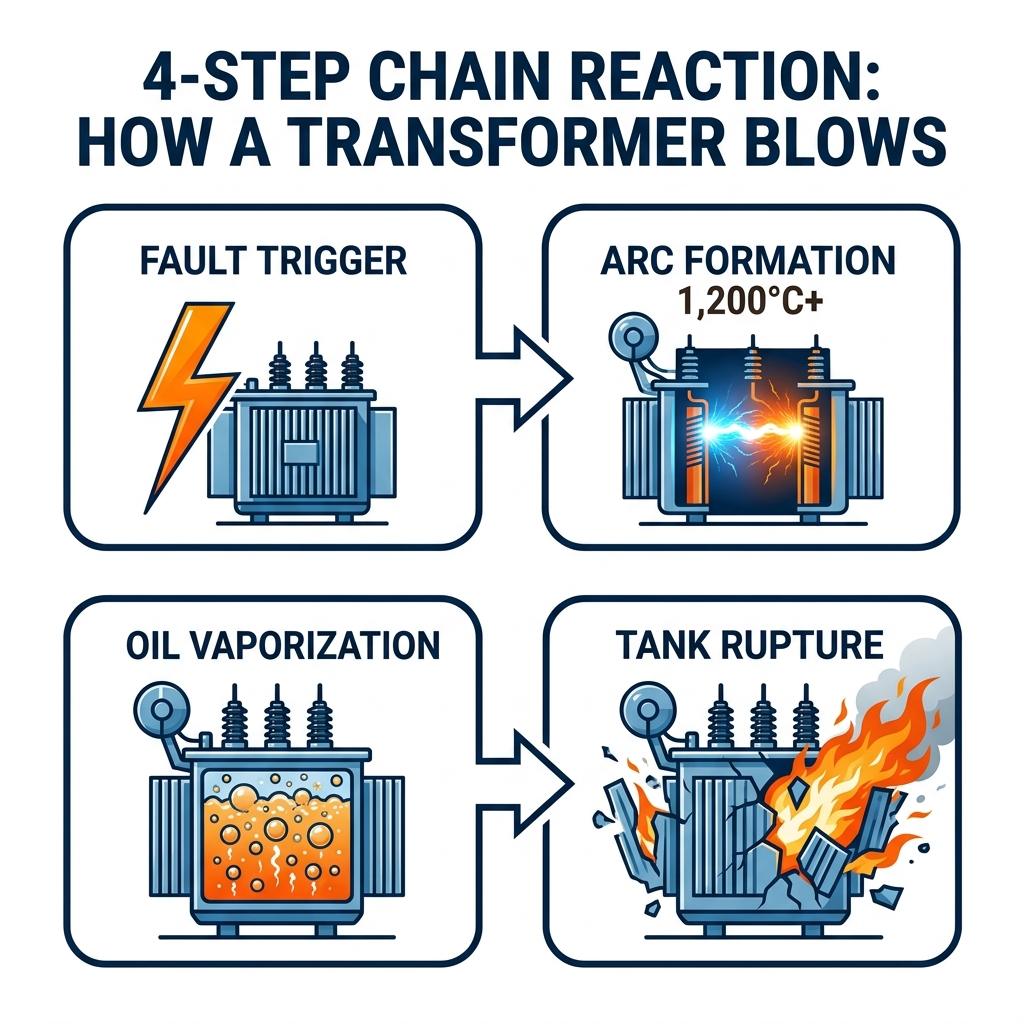
A transformer doesn’t explode randomly — it follows a predictable chain reaction that typically takes less than one second from fault initiation to rupture.
Step 1: Initial Fault Trigger
A triggering event occurs — a lightning strike, insulation breakdown, short circuit, or mechanical failure. This creates an abnormal current path inside the transformer.
Step 2: Arc Formation
The fault creates an electrical arc — essentially a channel of ionized gas (plasma) — between conductors. The arc temperature can exceed 1,200°C (2,200°F), far hotter than the surface of the sun’s visible photosphere.
Step 3: Oil Vaporization and Gas Formation
The extreme heat from the arc instantly vaporizes the surrounding mineral insulating oil. The oil decomposes into hydrogen, methane, ethylene, acetylene, and other hydrocarbon gases. This gas generation is massive and near-instantaneous.
Step 4: Pressure Surge and Tank Rupture
The rapidly expanding gas creates internal pressure that rises faster than the pressure relief device can vent it. Modern transformers are equipped with pressure relief valves designed to open at a set pressure threshold, but in a severe fault, the pressure rise rate (measured in milliseconds) can outpace the mechanical response of the valve.
When the internal pressure exceeds the tank’s structural limit, the steel housing ruptures. The released gas and superheated oil ignite on contact with atmospheric oxygen, producing the characteristic fireball and loud boom.
The Role of the Buchholz Relay
In transformers rated 0.5 MVA and above, a Buchholz relay is installed in the pipe between the main tank and the conservator tank. This gas-detection relay has two elements:
- Upper float — detects slow gas accumulation from minor faults (incipient faults) and triggers an alarm
- Lower baffle plate — detects the oil surge from a severe fault and trips the circuit breakers on both HV and LV sides, immediately isolating the transformer
The Buchholz relay is one of the most effective protective devices for oil-filled transformers. By collecting and analyzing the trapped gas, technicians can identify the type of internal fault without opening the transformer.
However, the Buchholz relay has a limitation: it cannot protect against faults that develop faster than the mechanical response of the relay — which is exactly what happens in a catastrophic arc-induced explosion.
Warning Signs Before a Transformer Blows
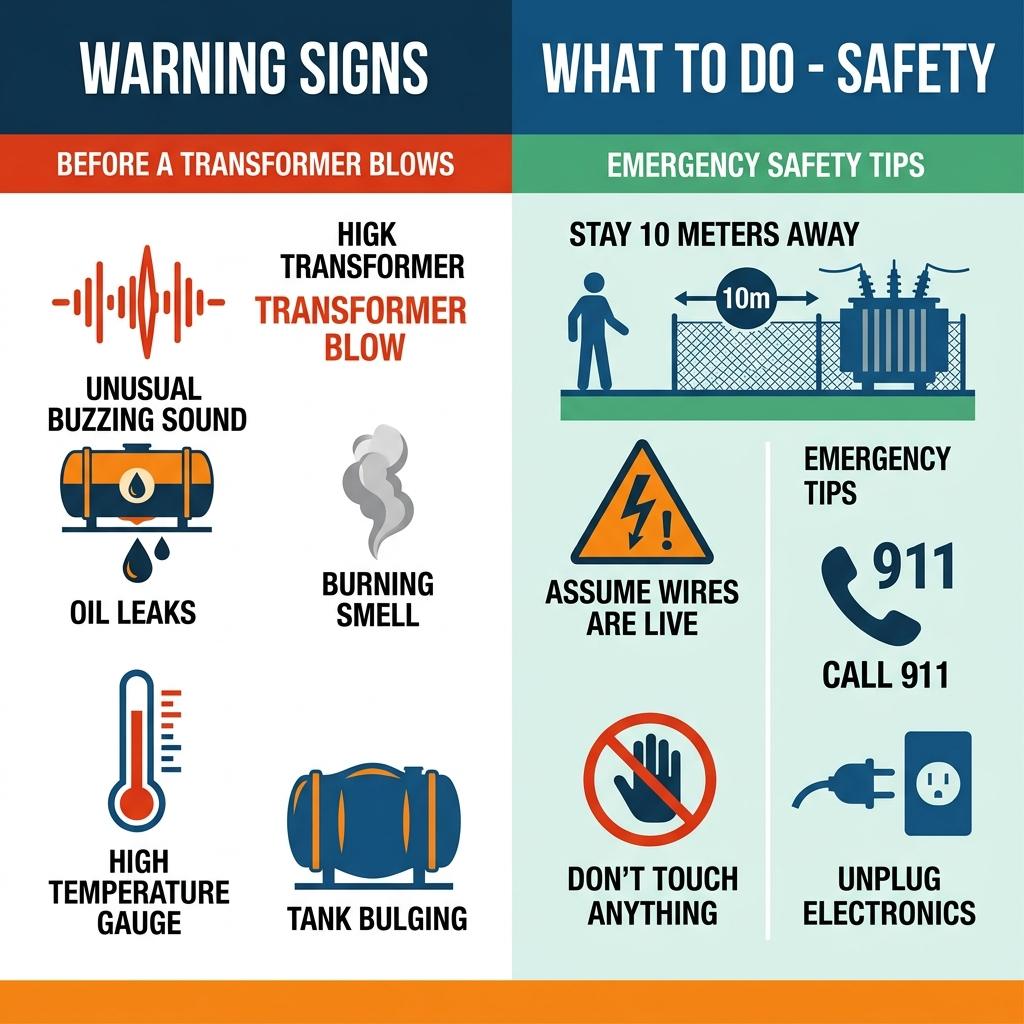
Transformers rarely fail without warning. Recognizing these signs early can prevent catastrophic failure:
| Warning Sign | What It Indicates | Urgency |
|---|---|---|
| Unusual humming or buzzing that gets louder or irregular | Loose core laminations, overloading, or mechanical vibration from a fault | ⚠️ Schedule inspection |
| Oil leaks around gaskets, valves, or bushings | Loss of cooling capacity and potential moisture ingress | ⚠️ Schedule repair |
| Burning smell near the transformer | Overheated insulation or oil decomposition | 🔴 Immediate investigation |
| Oil temperature above 90°C | Overloading or cooling system failure | 🔴 Reduce load or check cooling |
| Buchholz relay alarm | Gas accumulation from internal fault | 🔴 Take DGA sample immediately |
| Discoloration or bulging of the tank | Internal pressure buildup or severe overheating | 🔴 De-energize and inspect |
| Frequent circuit breaker trips | Recurring overcurrent or earth fault conditions | ⚠️ Investigate root cause |
| Crackling or popping sounds | Partial discharge or arcing inside the tank | 🔴 De-energize immediately |
What Happens When a Transformer Blows?
Immediate Effects
When a transformer blows, the effects are sudden and dramatic:
- Loud explosion — ranging from 140 to 160 decibels at close range, comparable to a gunshot or jet engine at takeoff. The shockwave can rattle windows and set off car alarms.
- Bright flash — the arc and igniting oil produce an intense blue-green or orange flash. The distinctive turquoise glow is caused by vaporizing copper from the windings.
- Fire — burning mineral oil can splash outward, igniting nearby vegetation, structures, or other equipment.
- Flying debris — tank fragments can be projected hundreds of feet.
- Immediate power outage — a single pole-top transformer serves 5–10 homes; a substation transformer failure can black out entire neighborhoods.
Cascading Grid Failures
In interconnected power grids, one transformer failure can overload adjacent transformers. If protective relaying is inadequate, a cascade of failures can follow — as demonstrated during the 2003 Northeast Blackout in the U.S. and Canada, and numerous ice storm events.
Environmental Impact
A major transformer failure can release hundreds or thousands of liters of mineral oil into the environment. Older transformers manufactured before the 1980s may contain PCBs (Polychlorinated Biphenyls), which are persistent environmental pollutants requiring specialized hazardous waste cleanup.
Even modern mineral oil spills require containment and remediation per environmental regulations. This is why NFPA 850 requires firewall barriers and oil containment systems around large power transformers.
Why Do Transformers Blow During Storms?
Understanding why transformers blow during storms is critical for both utility companies and the public. Storms are the number one environmental trigger for transformer failures:
- Lightning strikes deliver massive voltage surges (100 kV+) that can overwhelm surge protection
- Strong winds blow trees and branches onto power lines, creating short circuits that back-feed into transformers
- Heavy rain and flooding introduce water into transformer enclosures, causing insulation breakdown
- Power restoration surges — when power is reconnected after an outage, the inrush current spike can damage already-weakened transformers
During Hurricane Sandy (2012), over 300 transformer explosions were reported in New York City alone. The May 2022 Ontario derecho storm in Canada caused dozens of transformer explosions, with some areas losing power for over a week.
How Long Does It Take to Fix a Blown Transformer?
Repair time depends heavily on the transformer type and the severity of damage:
| Transformer Type | Typical Repair/Replacement Time | Notes |
|---|---|---|
| Pole-mounted distribution (25–167 kVA) | 4–8 hours | Utilities keep common sizes on trucks |
| Pad-mounted distribution (75–2,500 kVA) | 8–24 hours | Requires crane and site access |
| Small substation (2.5–10 MVA) | 1–5 days | May need custom replacement |
| Large power transformer (30–500 MVA) | Weeks to months | Custom-built; transportation alone takes days |
Factors Affecting Repair Time
- Severity of damage — partial failure vs. total destruction
- Spare availability — common distribution sizes are stocked; large power transformers must be ordered and may have 6–12 month lead times
- Site access — rural locations, flooded areas, or storm-damaged roads delay crew arrival
- Environmental cleanup — oil spills require containment before electrical work can begin
- Weather conditions — crews cannot safely work near energized equipment in rain or high winds
The Repair Process
- Isolate and de-energize the failed transformer and associated circuits
- Secure the area — extinguish any fire, cordon off the danger zone (minimum 10 meters / 30 feet)
- Contain oil spills and begin environmental remediation
- Remove the damaged unit — pole-mounted transformers are cut from crossarms; pad-mounted units are crane-lifted
- Install replacement — connect high-voltage and low-voltage leads, verify phasing
- Test and energize — meggering insulation resistance, verifying turns ratio, then gradually restoring power
What to Do If a Transformer Blows Near You
If you witness a transformer explosion, follow these safety steps:
- Stay away — keep at least 10 meters (30 feet) from the transformer. Electricity can still arc through the ground or metal objects nearby.
- Assume all wires are live — even if they’re on the ground and appear inactive. Keep children and pets inside.
- Call emergency services — dial 911 (US) or your local emergency number. Report the location, whether there’s fire, and if any power lines are down.
- Do not touch anything — never attempt to move wires, touch the transformer, or walk through puddles near downed lines.
- Unplug sensitive electronics — when power is restored, an inrush surge can damage computers, TVs, and other devices. Use surge protectors.
- Use flashlights, not candles — if power is out for an extended period, open flames are a fire hazard, especially near potential oil spills.
- Report electrical anomalies — after power restoration, if lights flicker, outlets spark, or appliances behave strangely, contact your utility company.
How to Prevent Transformer Explosions
Prevention is far more effective — and cheaper — than dealing with the aftermath of a blown transformer.
Regular Maintenance and Oil Testing
- Dissolved Gas Analysis (DGA) — the single most valuable diagnostic test for oil-filled transformers. By analyzing dissolved gases (H₂, CH₄, C₂H₂, C₂H₄, CO, CO₂), engineers can detect incipient faults months or years before they become catastrophic.
- Oil BDV testing — measure breakdown voltage regularly. Minimum acceptable BDV is 30 kV per ASTM D877.
- Furan analysis — monitors cellulose paper insulation degradation, providing the most sensitive indicator of remaining transformer life.
- Visual inspection — check for oil leaks, damaged bushings, corroded connections, and silica gel breather condition.
Surge Protection
- Install surge arresters (lightning arresters) on both high-voltage and low-voltage sides
- Maintain proper grounding systems per NEC Article 450
- In lightning-prone areas, consider station-class arresters with higher energy handling capacity
Load Monitoring and Management
- Monitor transformer loading using smart sensors or SCADA systems
- Follow IEEE C57.91 guidelines for acceptable overload durations
- Plan capacity upgrades before loads approach transformer ratings
Modern Protection Systems
| Protection Device | What It Detects | Response |
|---|---|---|
| Buchholz relay | Gas accumulation / oil surge | Alarm or trip |
| Pressure relief valve | Excessive internal pressure | Mechanical venting |
| Differential relay | Internal fault current imbalance | Instantaneous trip |
| Overcurrent relay | External fault / overload | Time-delayed trip |
| Temperature relay | Oil/winding overtemperature | Alarm, fan start, or trip |
| Sudden pressure relay | Rapid pressure rise | Instantaneous trip |
Smart Grid Upgrades
Modern utilities are deploying online monitoring systems that continuously track oil temperature, dissolved gas levels, partial discharge activity, and load current in real time. These systems enable condition-based maintenance — replacing the old time-based approach with data-driven decisions that catch problems early.
Real-World Transformer Explosion Statistics and Cases
- According to industry estimates, the United States experiences approximately 2,000 transformer-related failures each year, many involving fire or explosion
- Power grid failures, including transformer failures, cause over 3,000 major power outages annually in the U.S.
- The May 2022 Ontario derecho (Canada) caused dozens of transformer explosions; some communities were without power for over a week
- December 2022 British Columbia windstorm — multiple transformer failures were reported as residents observed bright flashes across affected areas
- Cold climate regions (e.g., Saskatchewan, northern U.S.) — extreme cold thickens transformer oil and makes insulation brittle, contributing to elevated winter failure rates in areas with sustained sub-zero temperatures
- Hurricane Sandy (2012) — over 300 transformer explosions reported in New York City, primarily from saltwater flooding
These events highlight that transformer failures are not rare — they are a regular part of power grid operations, and preparedness is essential.
Frequently Asked Questions
What causes a transformer to blow?
The most common causes are electrical overloading, short circuits, lightning strikes, insulation breakdown from aging, cooling system failure, tap changer malfunction, environmental factors (storms, flooding), and physical damage from animals or vehicle collisions. In oil-filled transformers, these faults trigger a chain reaction of arc formation, oil vaporization, and pressure buildup that ruptures the tank.
Why do transformers explode during storms?
Storms cause transformer explosions through lightning-induced voltage surges, trees and debris falling on power lines (creating short circuits), flooding that introduces water into the transformer, and power restoration surges when the grid is re-energized after an outage.
How long does it take to fix a blown transformer?
A pole-mounted distribution transformer can typically be replaced in 4–8 hours. Pad-mounted units take 8–24 hours. Large substation power transformers can take weeks to months due to custom manufacturing, specialized transportation, and extensive testing requirements.
Can a blown transformer cause a power surge?
Yes. When a transformer fails, it can release a sudden burst of energy into connected power lines, potentially damaging electronics. Power surges also occur during restoration — when electricity is reconnected after an outage, the inrush current can create a voltage spike.
What does it sound like when a transformer blows?
A transformer explosion can reach 140–160 decibels — comparable to a gunshot or jet engine at takeoff. Many people describe it as a loud boom or bang, often followed by a crackling or hissing sound from arcing electricity. The shockwave can rattle windows nearby.
Can a transformer blow and you still have power?
Yes. In areas served by multiple transformers, other nearby units may continue supplying power. Grid switching can also reroute electricity through alternate paths. Additionally, a partially failed transformer might still deliver some power, though at reduced or unstable voltage.
How to tell if a transformer blew?
Look for: a loud bang or explosion sound, sudden power loss or flickering lights, visible smoke or fire near a utility pole or green pad-mounted box, a burning smell, visible damage or debris around the transformer, or a blue-green flash of light.
How often do transformers explode?
The U.S. alone experiences approximately 2,000 transformer-related explosive failures each year. While the overall failure rate for individual transformers is low (less than 1% annually), the total number of transformers in service — millions across the country — means these events are a regular occurrence.
Will my appliances be damaged if a transformer blows?
Possibly. The voltage surge from a blown transformer can damage sensitive electronics like computers, TVs, and refrigerators. Using surge protectors on valuable equipment significantly reduces this risk. After power is restored following a transformer failure, plug in a simple device first to test for stable voltage before reconnecting expensive electronics.
Can a blown transformer be repaired, or must it be replaced?
It depends on the severity. Minor distribution transformer failures may be repairable — involving replacement of windings, insulation, or bushings. However, after an explosive failure, most transformers are severely damaged and must be replaced entirely. The repair process for repairable units involves initial inspection, disassembly, component replacement, reassembly, and a full suite of electrical tests before returning to service.
Conclusion
Transformer explosions are dramatic events, but they are neither random nor unpredictable. Every blown transformer tells a story of accumulated stress — whether from chronic overloading, aging insulation, deferred maintenance, environmental assault, or inadequate protection.
The key takeaways:
- Most failures are preventable with regular oil testing (DGA), load monitoring, surge protection, and timely maintenance
- Warning signs exist — unusual noises, oil leaks, high temperatures, and Buchholz relay alarms all signal trouble before catastrophic failure
- Modern protection systems like Buchholz relays, differential protection, and online monitoring can detect and isolate faults before they escalate
- Safety first — if a transformer blows near you, stay at least 10 meters away, assume all wires are live, and call emergency services immediately
Understanding what causes transformers to blow empowers engineers, utility workers, and the general public to make better decisions about maintenance, protection, and personal safety.
Related Articles
- Transformer Oil: Complete Guide to Types, Testing & Maintenance
- How to Test a Transformer: 8 Essential Tests with Step-by-Step Procedures
- Transformer Protection: Complete Guide to Protection Systems & Relays
- Transformer Overheating: Causes, Symptoms & Complete Solutions Guide
- Transformer Insulation Failure: Causes, Diagnosis & Prevention Guide
- Transformer Cooling Classes: ONAN vs ONAF Comparison Chart
- Transformer Troubleshooting: Complete Guide to Common Problems & Solutions
- Transformer Oil Leak: Causes, Detection & Complete Repair Guide
- Pole Mounted Transformer Installation: Complete Guide
- Transformer Bushing Failure: Symptoms, Causes & Complete Solutions Guide
Written by Tan @ Transformer4U — Your trusted source for transformer technical knowledge.