
Written by Tan, Electrical Engineer @ Transformer4U | Last Updated: January 2026 | Reading Time: ~12 minutes
“Is this humming sound normal, or is something wrong with my transformer?” I get this question at least once a week.
After 15 years of manufacturing and testing transformers, I can often diagnose the issue just by listening.
That steady 120Hz hum? Perfectly normal. That irregular buzzing that started last month? Let’s
investigate.
⚡ Quick Answer: Is Your Transformer Noise Normal?
✅ NORMAL: Steady, low-frequency hum at 120Hz
(60Hz systems) or 100Hz (50Hz systems) — caused by magnetostriction
⚠️ INVESTIGATE: Buzzing, rattling, or noise
that’s getting louder — check mounting, hardware, voltage
🔴 DANGER: Crackling, sizzling, or arcing sounds —
potential insulation failure, de-energize immediately
This guide explains why transformers hum, how to tell normal from abnormal sounds, NEMA ST 20 noise standards, and practical solutions to reduce unwanted noise.
For other transformer problems, visit our Complete
Troubleshooting Hub.
Table of Contents
- 1. Why Do Transformers Hum? (The Science)
- 2. Normal Hum vs. Abnormal Noise
- 3. NEMA ST 20 Sound Level Standards
- 4. Common Causes of Excessive Noise
- 5. How to Reduce Transformer Noise
- 6. Noise Troubleshooting Flowchart
- 7. FAQ
1. Why Do Transformers Hum? (The Science)
Every transformer hums. It’s not a defect—it’s physics. The phenomenon is called magnetostriction.
1.1 Magnetostriction: The Core Vibration
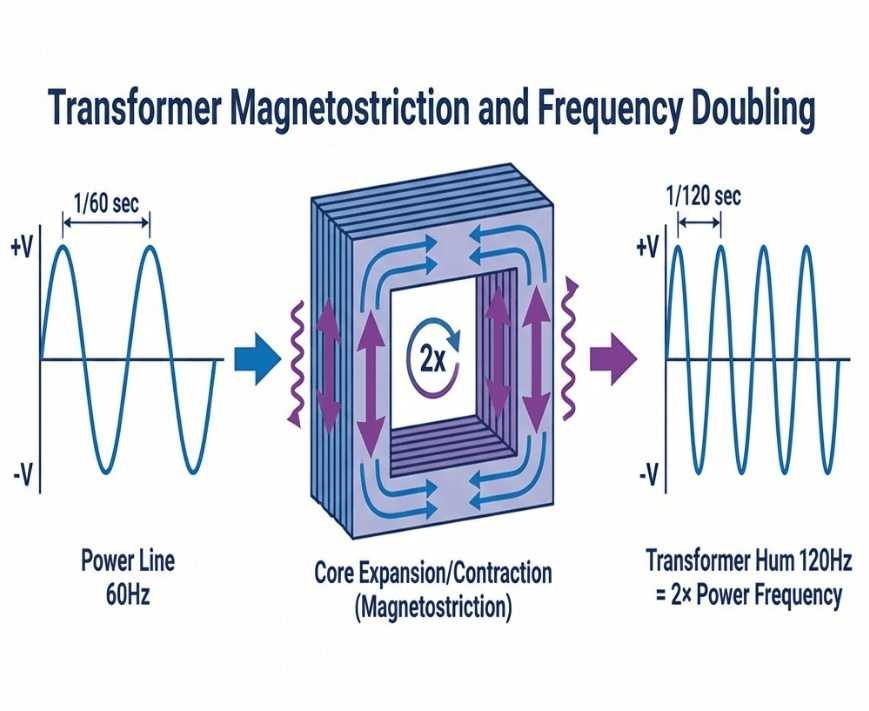
Transformer cores are made of thin steel sheets called laminations. When magnetic flux flows through
these laminations, they physically expand. When the flux reverses direction, they contract. This expansion and
contraction happens at the peaks of each AC cycle.
🔬 The Frequency Doubling Effect
Since the core expands at both the positive and negative peaks of the
AC waveform, the vibration frequency is twice the power line frequency:
| Power Line Frequency | Transformer Hum Frequency | Region |
|---|---|---|
| 60 Hz | 120 Hz | USA, Canada, Japan (parts) |
| 50 Hz | 100 Hz | Europe, UK, Australia, most of Asia |
💡 From the Field: The 120Hz hum is actually a complex sound with harmonics. When I’m testing
transformers, I can hear the difference between a healthy unit (smooth, steady hum) and one with loose
laminations (rougher, with higher-frequency overtones). After a while, your ears become a diagnostic tool.
1.2 Three Physical Mechanisms of Transformer Noise
According to transformer acoustics research, there are three distinct noise-generating mechanisms:
| Mechanism | Description | When It Dominates |
|---|---|---|
| Magnetostriction | Core laminations expand/contract with magnetic flux | Near saturation; primary cause of hum |
| MAE (Magnetoacoustic Emission) | Movement of magnetic domain walls (Bloch walls) | Steep section of hysteresis loop |
| LFAS (Lorentz Force) | Mechanical forces between laminations due to eddy currents | Depends on construction; worse in EI cores |
📊 Key Insight: Toroidal transformers are quieter than EI transformers. Why? In
toroidal cores, the continuous wound strip is held tight by winding tension, minimizing lamination movement. EI
cores have separate loose pieces that can vibrate against each other.
2. Normal Hum vs. Abnormal Noise
Knowing the difference between normal and abnormal sounds can save you from unnecessary worry—or alert you to a real
problem.
2.1 Hum vs. Buzz: Technical Distinction
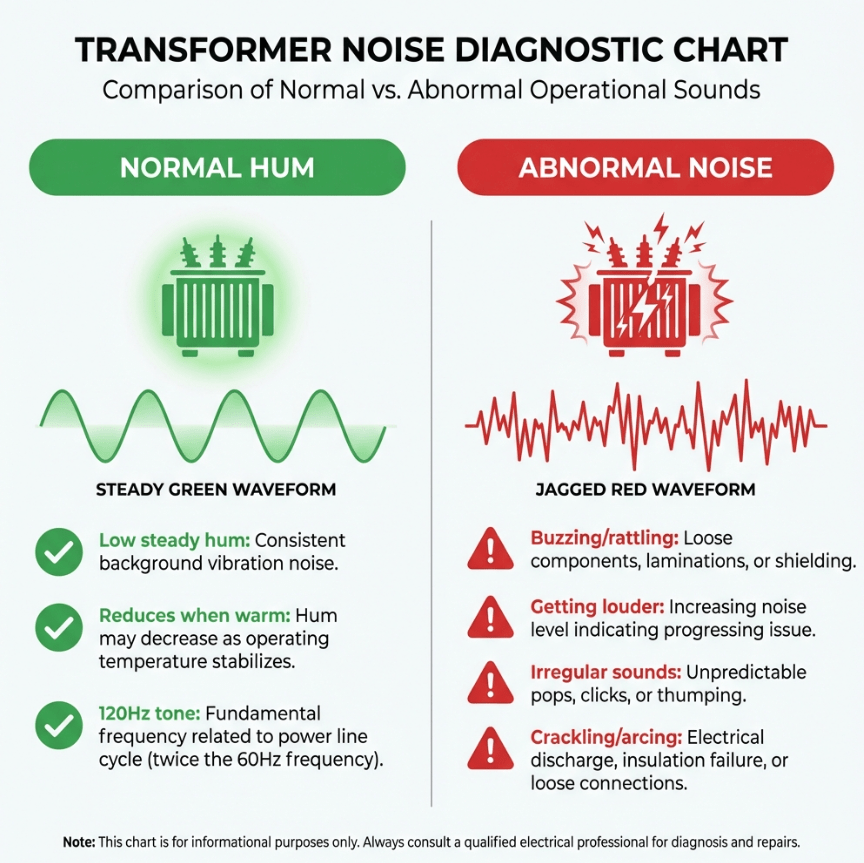
| Characteristic | Normal Hum | Abnormal Buzz |
|---|---|---|
| Source | Magnetostriction of core | Loose parts, mechanical resonance |
| Sound Character | Low, steady, continuous tone | Vibrating, murmuring, may vary |
| Frequency | Pure 120Hz (or 100Hz) + harmonics | Often has irregular components |
| Change Over Time | May decrease as transformer warms (at rated load) | Often increases over time |
| With Load | Usually stable or slight decrease | May get louder under load |
| Action Required | None (normal operation) | Investigate and address |
2.2 Warning Signs That Require Attention
| Sound Type | Possible Cause | Severity | Action |
|---|---|---|---|
| Buzzing/Rattling | Loose mounting, hardware, or laminations | 🟡 Moderate | Check all fasteners, add isolation |
| Increasing Hum | Voltage fluctuation, overload, core saturation | 🟡 Moderate | Check voltage, verify load |
| Clicking/Popping | Loose connections, failing components | 🟡 Moderate | Inspect connections |
| Crackling/Sizzling | Arcing, insulation breakdown | 🔴 CRITICAL | De-energize immediately |
| Gurgling/Bubbling | Gas generation in oil (internal fault) | 🔴 CRITICAL | De-energize, order DGA test |
🚨 Critical Safety Warning
Crackling, sizzling, or arcing sounds indicate potential insulation
failure. This is a fire and explosion hazard. Do not approach. De-energize the transformer
immediately from a safe distance and contact a qualified electrician.
💡 From the Field: I once traced a customer’s “buzzing transformer” complaint to the metal
junction box mounted on the same cabinet. The box was resonating at the transformer’s frequency. Moving it 6
inches eliminated the buzz completely. Always check what’s vibrating—it may not be the transformer itself.
3. NEMA ST 20 Sound Level Standards
The National Electrical Manufacturers Association
(NEMA) establishes acceptable sound levels for transformers through NEMA ST 20.
3.1 Maximum Sound Levels by Rating
| Transformer Rating (kVA) | NEMA Standard Sound Level (dBA) | Equivalent Loudness |
|---|---|---|
| 0 – 9 | 40 dBA | Quiet library, computer hum |
| 10 – 50 | 45 dBA | Quiet office, refrigerator |
| 51 – 150 | 50 dBA | Light traffic, moderate rainfall |
| 151 – 300 | 55 dBA | Normal conversation |
| 301 – 500 | 60 dBA | Normal conversation (close) |
| 501 – 700 | 62 dBA | Air conditioner (6m away) |
| 701 – 1000 | 64 dBA | Shower running |
3.2 Decibel Reference Chart
To put these numbers in perspective:
| dBA Level | Example Sound | Perception |
|---|---|---|
| 0-10 | Breathing, pin drop | Barely audible |
| 20-30 | Whisper, rustling leaves | Very quiet |
| 40 | Library, computer fan | NEMA standard ≤9 kVA |
| 50 | Refrigerator, light rain | NEMA standard 51-150 kVA |
| 60 | Conversation, air conditioner | Moderate |
| 70 | Vacuum cleaner, dishwasher | Can be annoying to some |
| 80+ | Alarm clock, garbage disposal | Loud, possible hearing damage with exposure |
📊 Important Note: These are A-weighted decibels (dBA), which account for how
human hearing perceives different frequencies. Low-frequency transformer hum can feel louder or more intrusive
than the dBA number suggests, especially in quiet environments.
4. Common Causes of Excessive Noise
If your transformer is louder than expected, here are the most likely culprits:
4.1 Voltage Issues
| Problem | Supply voltage above rated value |
| Why It Causes Noise | Higher voltage increases magnetic flux, pushing the core closer to saturation. This amplifies magnetostriction. |
| Example | A transformer rated for 120V receiving 127V will hum louder and produce 5-6% higher secondary voltage. |
| Solution | Verify line voltage; use a power conditioner or voltage regulator if consistently high. |
4.2 “Dirty” Power
| Problem | Harmonic distortion, DC offset on power line |
| Why It Causes Noise | Non-sinusoidal waveforms cause irregular core magnetization, producing additional vibration frequencies. |
| Common Sources | Switch-mode power supplies, VFDs, LED dimmers, computers |
| Solution | Use power conditioner or UPS; add DC-blocking capacitor for DC offset issues. |
4.3 Mounting Issues
| Problem | Direct metal-to-metal contact |
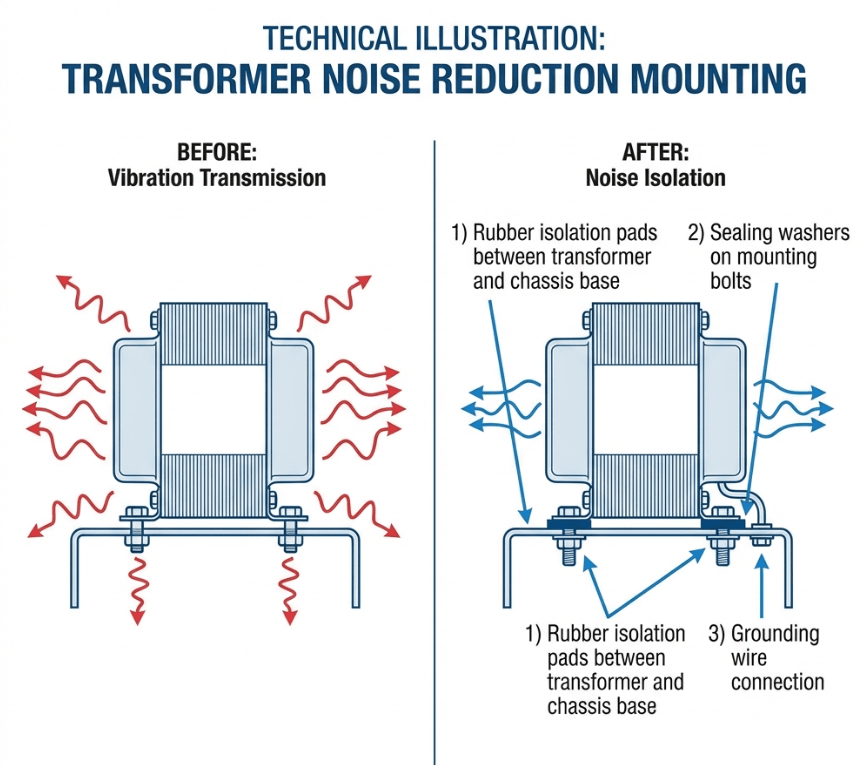
| Why It Causes Noise | The transformer’s vibration transmits directly to the chassis, which acts as a speaker to amplify the sound. |
| Tip | Older equipment with wooden chassis was often quieter than modern metal chassis! |
| Solution | Add rubber isolation pads; use sealing washers on mounting bolts. |
4.4 Load-Related Issues
| Problem | Unbalanced loads, low-quality components |
| Why It Causes Noise | Unbalanced or reactive loads can cause unusual stresses on the transformer windings. |
| Note | When operating at rated voltage and load, a transformer often hums less as it warms up. Overloading or overheating increases noise. |
| Solution | Balance phases; use quality load components with tight tolerances. |
5. How to Reduce Transformer Noise
5.1 Mounting Solutions
✅ Recommended Mounting Practices
- Rubber isolation pads: Place between transformer base and mounting surface to absorb
vibration. - Sealing washers: Use rubber-backed metal washers on mounting bolts to prevent vibration
transmission. - Ground wire: When using isolation, ensure a separate ground wire connects transformer frame
to chassis ground. - Tighten all hardware: Loose bolts amplify noise significantly.
- Clearance from walls: Keep 6+ inches from surfaces that can resonate and amplify sound.
5.2 Encapsulated vs. Varnished Transformers
| Type | Noise Level | Heat Dissipation | Cost |
|---|---|---|---|
| Standard Varnished | Moderate | Excellent | Low |
| VPI (Vacuum Pressure Impregnated) | Lower | Good | Medium |
| Encapsulated/Potted | Lowest | Limited (may overheat) | High |
⚠️ Caution: Encapsulation reduces noise but limits heat dissipation. Overly rigid potting
material can still transmit vibration. For power transformers, ensure encapsulation doesn’t cause thermal
issues. See our overheating
troubleshooting guide for temperature limits.
5.3 Power Quality Solutions
| Power Conditioner | Filters harmonics and provides clean sine wave; helps with noise from “dirty power.” |
| UPS (Uninterruptible Power Supply) | Provides stable voltage during peaks and brownouts; online UPS gives cleanest power. |
| Variable Transformer (Variac) | Useful for testing; allows gradual voltage increase while monitoring. |
6. Noise Troubleshooting Flowchart
🔍 Quick Diagnostic Checklist
Step 1: Characterize the Sound
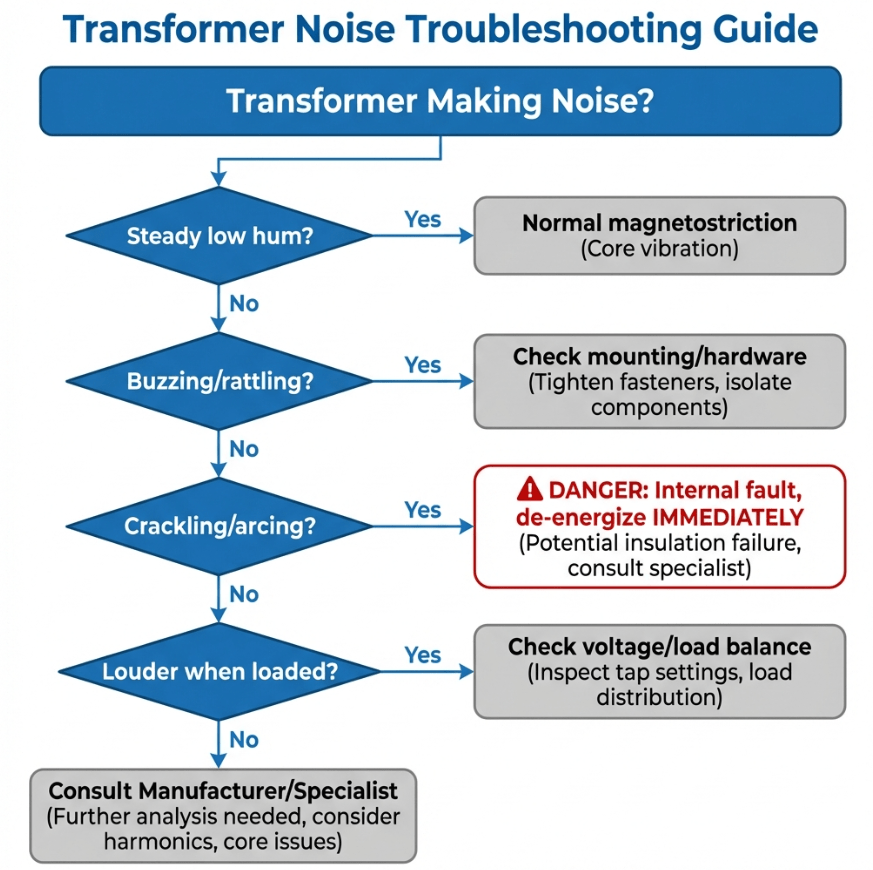
- ❓ Is it a steady, low-frequency hum? → Likely normal magnetostriction
- ❓ Is it buzzing or rattling? → Check mounting and hardware
- ❓ Is it crackling or arcing? → STOP—safety hazard, de-energize
Step 2: Check for Changes
- □ Has the noise level increased recently?
- □ Does it change with load?
- □ Does it vary with time of day? (Voltage fluctuation indicator)
Step 3: Investigate Mounting
- □ Are all mounting bolts tight?
- □ Is there metal-to-metal contact without isolation?
- □ Are nearby components resonating?
Step 4: Check Power Quality
- □ Measure line voltage (should be within ±5% of rated)
- □ Check for DC offset or waveform distortion if possible
- □ Note any new equipment that could introduce harmonics
7. Frequently Asked Questions
❓ Why does my transformer hum?
contract as magnetic flux changes. This vibration occurs at twice the power line frequency (120Hz in
60Hz systems, 100Hz in 50Hz systems). A steady, low-level hum is normal and unavoidable. However,
buzzing, rattling, or crackling sounds indicate problems requiring investigation.
❓ Is it normal for a transformer to make noise?
standards, transformers up to 9 kVA should produce no more than 40 dBA—about as loud as a quiet library.
The hum may actually decrease slightly as the transformer warms up. Abnormal sounds like buzzing,
rattling, clicking, or crackling require attention.
❓ How do I stop my transformer from humming so loud?
surface, 2) Use sealing washers on mounting bolts, 3) Ensure all hardware is tight to prevent rattling,
4) Keep adequate clearance from walls that can amplify sound, 5) Use a power conditioner if voltage
fluctuations are the cause. Note: Some humming cannot be eliminated due to the nature of
magnetostriction.
❓ What does a bad transformer sound like?
mounting, 2) Crackling or sizzling—suggests arcing or insulation breakdown (DANGER), 3) Louder hum that
increases over time—may indicate core saturation or voltage issues, 4) Gurgling or bubbling in
oil-filled units—gas generation from internal faults. Any crackling, arcing sounds, or burning smell
requires immediate de-energization.
❓ What is the acceptable noise level for transformers?
dBA, 51-150 kVA = 50 dBA, 151-300 kVA = 55 dBA, 301-500 kVA = 60 dBA. For reference, 40 dBA is similar
to a quiet library or computer hum, while 60 dBA is comparable to normal conversation.
Related Troubleshooting Guides
🔍 Complete Troubleshooting Hub
All transformer problems overview
🔥 Overheating Guide
Causes, symptoms & solutions
📝 About This Guide
This transformer noise troubleshooting guide is authored by Tan, Electrical Engineer at Transformer4U, with over 15 years of experience in transformer
manufacturing, testing, and field service.
Noise standards referenced from NEMA ST 20. Magnetostriction principles based on established electrical engineering
research. For equipment-specific ratings, always consult the manufacturer’s documentation.
Disclaimer: This guide provides general information on
transformer noise diagnostics. Sound levels may vary by transformer design and installation environment. Always
follow your organization’s safety procedures. Crackling, arcing, or burning smells indicate potentially
dangerous conditions—never approach and de-energize immediately from a safe location.
Last Updated: January 2026 | © 2026 Transformer4U. All rights reserved.