
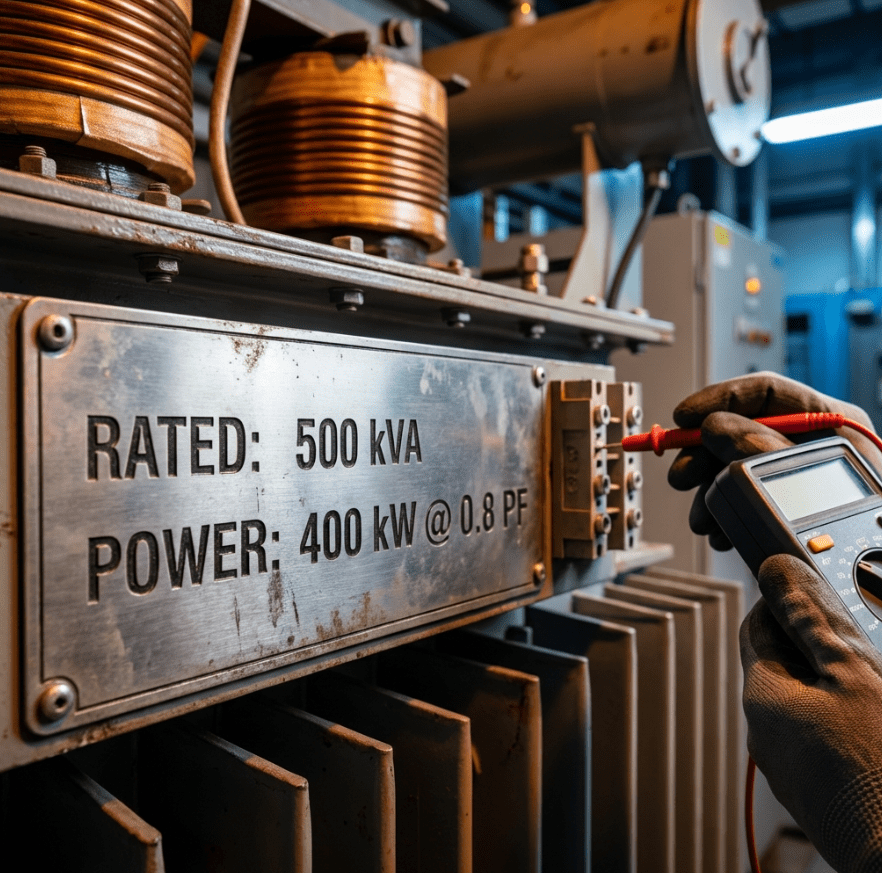
In my 15 years sizing transformers and generators at
Transformer4U, I’ve seen countless facilities make the same costly mistake: ordering equipment
based only on kW, ignoring kVA requirements.
Last week, a factory ordered a “50 kW generator” for their 45 kW load—sounds perfect, right? Wrong. With a power
factor of 0.75, they actually needed 60 kVA. The 50 kVA generator they received was overloaded
within hours. After we ran the proper kW to kVA calculation, they had to upgrade to a 75 kVA unit.
This guide provides the kW to kVA calculator and formulas you need to properly size generators,
transformers, and electrical equipment—accounting for power factor and reactive power.
⚡ Quick Answer:
kW to kVA Formula:
- kVA = kW ÷ Power Factor (PF)
Example: A 10 kW load with PF = 0.8:
- kVA = 10 ÷ 0.8 = 12.5 kVA
Why it matters: kW measures real
power (actual work). kVA measures apparent power (total capacity needed, including
reactive power). Equipment is sized by kVA, not kW.
kW to kVA Calculator (Interactive Tool)
Use our free calculator to instantly convert kilowatts to kilovolt-amps. Enter your kW and power factor.
Understanding kW vs kVA: What’s the Difference?
What is a Kilowatt (kW)?
A kilowatt (kW) measures real power—the actual amount of electrical power doing
useful work. When you run a 5 kW motor, it consumes 5 kW of real power to turn the shaft.
Real power is the energy that:
- Heats elements
- Turns motor shafts
- Powers lighting
- Runs electronics
What is a Kilovolt-Ampere (kVA)?
A kilovolt-ampere (kVA) measures apparent power—the total power that must be
supplied to the load, including both real power and reactive power.
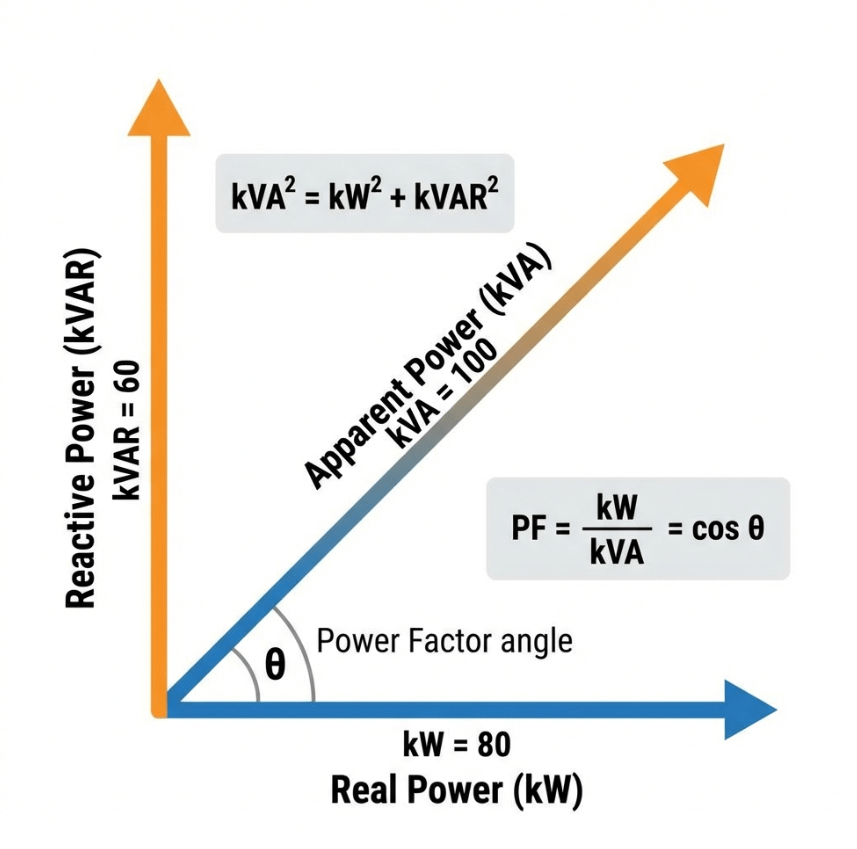
Apparent power (kVA) = Real Power (kW) + Reactive Power (kVAR)
In mathematical terms: kVA² = kW² + kVAR² (this is the power triangle).
The Role of Reactive Power (kVAR)
Reactive power (kVAR) doesn’t do real work—it builds and maintains the magnetic fields in motors,
transformers, and inductive loads. However, it still must be supplied by the electrical system, consuming capacity.
total). Their electrician sized a 75 kVA transformer, thinking it was a perfect match. But the motors had a combined
power factor of 0.72, requiring 104 kVA! The transformer was running at 138% capacity, overheating
daily. We replaced it with a 125 kVA unit and added power factor
correction capacitors, dropping apparent power to 85 kVA.
kW to kVA Formula & Calculation
Basic Formula
kVA = kW ÷ PF
Where:
- kVA = Apparent power in kilovolt-amperes
- kW = Real power in kilowatts
- PF = Power factor (ratio of real power to apparent power, 0 to 1)
Step-by-Step Example
Problem: A 20 kW three-phase motor has a nameplate power factor of 0.85. What is its kVA rating?
Solution:
kVA = 20 kW ÷ 0.85
kVA = 23.53 kVA
This means the motor requires 23.53 kVA of apparent power even though it only produces 20 kW of real work.
Why Power Factor Matters
Power factor is the ratio of real power to apparent power:
PF = kW / kVA
A low power factor means you’re paying for (and your equipment must supply) more kVA than the actual kW you’re using.
| Power Factor | kVA needed for 10 kW | Efficiency |
|---|---|---|
| 1.0 (Unity) | 10.0 kVA | Excellent |
| 0.95 | 10.5 kVA | Very Good |
| 0.90 | 11.1 kVA | Good |
| 0.85 | 11.8 kVA | Acceptable |
| 0.80 | 12.5 kVA | Fair |
| 0.75 | 13.3 kVA | Poor |
| 0.70 | 14.3 kVA | Very Poor |
kW to kVA Conversion Tables
Conversion at Different Power Factors
| kW | PF 1.0 | PF 0.95 | PF 0.9 | PF 0.85 | PF 0.8 | PF 0.75 |
|---|---|---|---|---|---|---|
| 5 | 5.0 | 5.3 | 5.6 | 5.9 | 6.3 | 6.7 |
| 10 | 10.0 | 10.5 | 11.1 | 11.8 | 12.5 | 13.3 |
| 20 | 20.0 | 21.1 | 22.2 | 23.5 | 25.0 | 26.7 |
| 50 | 50.0 | 52.6 | 55.6 | 58.8 | 62.5 | 66.7 |
| 100 | 100.0 | 105.3 | 111.1 | 117.6 | 125.0 | 133.3 |
| 200 | 200.0 | 210.5 | 222.2 | 235.3 | 250.0 | 266.7 |
| 500 | 500.0 | 526.3 | 555.6 | 588.2 | 625.0 | 666.7 |
Common Equipment Power Factors
| Equipment Type | Typical Power Factor | Notes |
|---|---|---|
| Incandescent heaters | 1.0 | Unity (resistive) |
| LED lighting | 0.95 – 0.98 | Modern drivers |
| Induction motors (100% load) | 0.85 – 0.92 | Good |
| Induction motors (50% load) | 0.73 – 0.79 | Moderate |
| Welding equipment | 0.50 – 0.70 | Poor |
| Transformers (full load) | 0.90 – 0.97 | Excellent |
| Generators | 0.80 – 0.95 | Rated at 0.8 PF |
Improving Power Factor: kVA Reduction Strategies
Why Improve Power Factor?
- Reduce equipment size: Lower kVA means smaller (cheaper) transformers and generators
- Lower energy costs: Many utilities charge penalties for PF < 0.95
- Increase capacity: Existing equipment can handle more load
- Reduce voltage drop: Less current = less I²R losses
Power Factor Correction Methods
1. Install Capacitor Banks
- Most common and cost-effective
- Capacitors supply reactive power (kVAR) locally
- Can be fixed or automatic switching
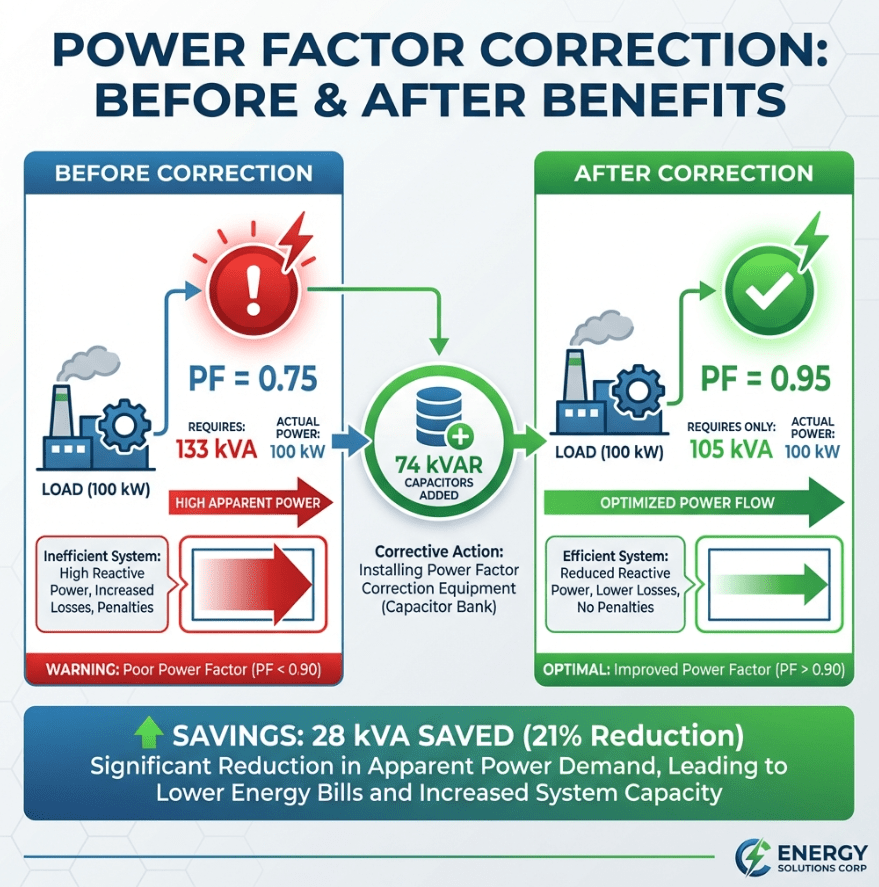
Example: 100 kW load at PF = 0.75
- Before correction: 133.3 kVA
- Install 74 kVAR capacitor bank
- New PF: 0.95
- After correction: 105.3 kVA
- Savings: 28 kVA (21% reduction!)
2. Use Synchronous Motors
- Can operate at leading PF, supplying reactive power
- More expensive but dual-purpose (work + PF correction)
3. Replace Underloaded Motors
- Motors at 40% load have terrible power factor
- Right-size motors to run at 75-100% load
For a complete guide, see Power Factor Correction: Complete
Guide.
FAQ: kW to kVA Conversion
What is the formula to convert kW to kVA?
kVA = kW ÷ Power Factor (PF)
Example: 15 kW at 0.85 PF = 15 ÷ 0.85 = 17.6 kVA
What is the difference between kW and kVA?
- kW (kilowatt) measures real power—the amount of electrical power doing actual
work - kVA (kilovolt-ampere) measures apparent power—the total power that must be
supplied, including reactive power - Relationship: kW = kVA × Power Factor
How many kW is 100 kVA?
It depends on the power factor:
- At PF 1.0: 100 kW
- At PF 0.95: 95 kW
- At PF 0.9: 90 kW
- At PF 0.85: 85 kW
- At PF 0.8: 80 kW (most common generator rating)
Why is my generator rated in kVA, not kW?
Generators must supply the total current (apparent power, kVA), not just the real power (kW). The
generator’s windings, voltage regulator, and alternator must be sized for kVA to prevent overheating, regardless of
the power factor of the load.
Most generators are rated at 0.8 power factor, meaning a “40 kW generator” is actually a 50 kVA
unit.
Can I run a 50 kW load on a 50 kVA generator?
Only if the power factor is 1.0 (resistive heating loads).
For typical loads with PF = 0.85:
- 50 kVA generator can supply: 50 × 0.85 = 42.5 kW
Running 50 kW at 0.85 PF requires: 50 ÷ 0.85 = 58.8 kVA → You’d need a 60 kVA generator.
Related Power Conversion Guides
For more electrical calculations and sizing guides:
- kVA to kW Conversion Calculator – Reverse conversion
- kW to Amps Calculator – Current calculations
- Amps to kW Calculator – Power from current
- Transformer Sizing Guide
- Generator Sizing Calculator
- Three-Phase Power Calculations
Conclusion
Converting kilowatts to kilovolt-amperes is essential for proper equipment sizing. Remember:
- kVA = kW ÷ PF (the fundamental formula)
- kW = Real Power (actual work performed)
- kVA = Apparent Power (total capacity needed)
- Never assume PF = 1.0 unless it’s a purely resistive load
- Equipment is sized by kVA, not kW
- Improving power factor reduces kVA requirements and costs
References
- Power Factor – Wikipedia
- Apparent
Power – Wikipedia - IEEE Std 141-1993 – Recommended
Practice for Electric Power Distribution - NEC Article 450 – Transformers and
Transformer Vaults
Written by Tan, Senior Transformer Technician at
Transformer4U with 15+ years of experience in industrial power systems, transformer sizing, and power factor
correction projects.