
By Tan, Senior Transformer Technician | February 5, 2026 | 7 min read
can be confusing. Both serve the same purpose—stepping down high voltage to usable levels—but they differ
significantly in installation, cost, and application.After 15 years manufacturing distribution
transformers and supporting installations across North America, Europe, and Asia, I’ve helped
hundreds of contractors and utility companies make this critical decision.
⚡ Quick Answer
Choose an electric pole transformer for rural/suburban areas with existing overhead
lines, lower upfront costs, and fewer than 15 homes. Choose a pad mounted transformer
for urban/dense developments, underground distribution, higher capacity needs (100kVA+), and where
aesthetics matter.
- Pole Transformers: $500-$20,000
- Pad Mounted: $3,000-$50,000+

What Is an Electric Pole Transformer?
An electric pole transformer (also called pole-mounted transformer or power pole
transformer) is a distribution transformer mounted on a wooden or concrete utility
pole. These cylindrical devices step down high voltage electricity from
distribution lines (typically 7,200-14,400V) to usable levels (120/240V) for homes and businesses.
Key Characteristics
| Feature | Specification |
|---|---|
| Mounting | Utility pole (wood or concrete) |
| Typical Capacity | 10-167 kVA (single-phase) |
| Weight Limit | Usually under 1,000 kg |
| Cooling | ONAN (Oil Natural Air Natural) |
| Primary Voltage | 2.4kV to 35kV |
| Secondary Voltage | 120/240V or 480V |
Pole mount transformers are the most common type in rural and suburban North America.
You’ve probably seen them—those gray cylinders sitting atop every third or fourth power
pole in your neighborhood.
What Is a Pad Mounted Transformer?
A pad mounted transformer is a ground-level distribution transformer installed on a
concrete pad. These are enclosed in a locked, weatherproof steel cabinet and connect to underground
distribution lines.
Key Characteristics
| Feature | Specification |
|---|---|
| Mounting | Concrete pad at ground level |
| Typical Capacity | 75-2,500 kVA |
| Enclosure | Locked steel cabinet |
| Cooling | ONAN or ONAF |
| Primary Voltage | 4.16kV to 34.5kV |
| Secondary Voltage | 120/240V, 208Y/120V, or 480V |
Pad mounted transformers are increasingly common in modern developments where underground
power distribution is preferred for aesthetics and reliability.
Learn more about our pad mounted transformer
solutions.
7 Key Differences: Pole vs Pad Mounted Transformer
Here’s the comprehensive comparison that every contractor and utility planner needs:
Master Comparison Table
| Factor | Electric Pole Transformer | Pad Mounted Transformer |
|---|---|---|
| 1. Mounting Location | Elevated on utility pole | Ground level on concrete pad |
| 2. Capacity Range | 10-333 kVA (typical 25-100kVA) | 75-2,500 kVA |
| 3. Cost (Unit Only) | $500-$20,000 | $3,000-$50,000+ |
| 4. Space Required | Vertical (pole footprint only) | 6×6 ft to 12×12 ft pad |
| 5. Safety Access | Requires bucket truck/climbing | Ground-level access |
| 6. Maintenance | More difficult (height) | Easier (ground-level) |
| 7. Installation Time | 2-4 hours | 4-8 hours (+2 days for pad) |
1. Mounting Location
Pole Transformer:
- Mounted 18-25 feet above ground
- Uses existing pole infrastructure
- Visible on the skyline
- Clearance requirements per NEC Article 450
Pad Mounted:
- Installed at ground level
- Requires dedicated concrete pad
- Connects to underground cables
- Often located in utility easements
Real-World Insight: In my experience, pole transformers work best when you already have
overhead distribution lines. Retrofitting underground for pad mounted units can cost $50-150 per linear
foot—that adds up quickly.
2. Capacity Range
| Capacity | Pole Transformer | Pad Mounted |
|---|---|---|
| 10-50 kVA | ✅ Common | ❌ Too small |
| 75-100 kVA | ✅ Available | ✅ Entry-level |
| 150-333 kVA | ⚠️ Requires platform | ✅ Common |
| 500+ kVA | ❌ Not practical | ✅ Standard |
| 1,000+ kVA | ❌ Not available | ✅ Available |
From Our Factory: Pole transformers exceeding 100 kVA often require a support bracket or
platform due to weight limitations (typically 1,000 kg max for direct pole mounting). At that point, the
cost advantage diminishes, and pad mounted becomes competitive.
3. Cost Comparison
Unit Cost Only
| Capacity | Pole Transformer | Pad Mounted | Difference |
|---|---|---|---|
| 25 kVA | $1,200-$2,500 | $3,500-$5,000 | Pole 50% cheaper |
| 50 kVA | $2,500-$4,000 | $5,000-$8,000 | Pole 45% cheaper |
| 100 kVA | $4,500-$7,000 | $8,000-$15,000 | Pole 50% cheaper |
| 167 kVA | $7,000-$12,000 | $12,000-$20,000 | Similar |
| 333 kVA | $14,000-$22,000 | $20,000-$35,000 | Mixed |
Total Installed Cost (Including Infrastructure)
| Cost Factor | Pole | Pad |
|---|---|---|
| Transformer unit | $3,000 (50kVA) | $6,000 (50kVA) |
| Pole (if new) | $2,000-$5,000 | N/A |
| Concrete pad | N/A | $1,500-$3,000 |
| Underground cable | N/A | $50-150/ft |
| Installation labor | $1,500-$3,000 | $2,500-$5,000 |
| TOTAL (existing overhead) | $4,500-$6,000 | $12,000-$20,000 |
| TOTAL (new infrastructure) | $8,000-$12,000 | $15,000-$30,000 |
Bottom Line: Pole transformers are 40-60% cheaper when overhead infrastructure exists. But
for new developments with underground utilities, the gap narrows significantly.
4. Space Requirements
Pole Transformer:
- Uses only vertical space
- Pole footprint: ~2 ft × 2 ft
- No ground-level real estate needed
- ✅ Ideal for right-of-way constraints
Pad Mounted:
- Requires dedicated ground space
- Typical pad: 6 ft × 6 ft (small) to 12 ft × 12 ft (large)
- Plus clearance zone: 3 ft front, 3 ft sides
- ⚠️ Can conflict with landscaping/parking plans
Case Study: A commercial developer I worked with saved $15,000 by choosing pole transformers
over pad mounted—the pad would have required sacrificing 2 parking spots ($8,000/year revenue loss each).
5. Safety & Accessibility
| Safety Factor | Pole | Pad |
|---|---|---|
| Public access risk | Low (elevated) | Medium (ground level) |
| Tampering protection | Height = natural barrier | Locked cabinet required |
| Flood risk | None | High in flood zones |
| Vehicle collision risk | None | Bollards recommended |
| Wildlife interference | Squirrels, birds | Less common |
From the Field: We’ve seen pad mounted transformers submerged during flooding events. Modern
units per IEEE C57.12.28 can handle temporary submersion, but oil-immersed transformers in flood-prone
areas often require elevated pads or special enclosures.
6. Maintenance Accessibility
Pole Transformer:
- Requires bucket truck ($150-300/hour rental)
- Must de-energize and isolate
- Weather-dependent scheduling
- ⚠️ More downtime per maintenance event
Pad Mounted:
- Ground-level access
- Can perform visual inspections without equipment
- Load-break switches allow hot switching
- ✅ Faster routine maintenance
Experience Insight: For utilities managing 1,000+ transformers, pad mounted units reduce
average maintenance time by 40%. But for single installations, the bucket truck cost is still cheaper than
the pad mounted premium.
7. Installation Time
| Installation Phase | Pole | Pad |
|---|---|---|
| Site prep | 0.5-1 hr (if pole exists) | 1-2 days (pad curing) |
| Transformer mounting | 1-2 hours | 2-3 hours |
| Connections | 1-2 hours | 2-3 hours |
| Testing & energization | 0.5-1 hour | 0.5-1 hour |
| TOTAL | 2-4 hours | 4-8 hours (+2 days) |
When to Choose: Decision Guide
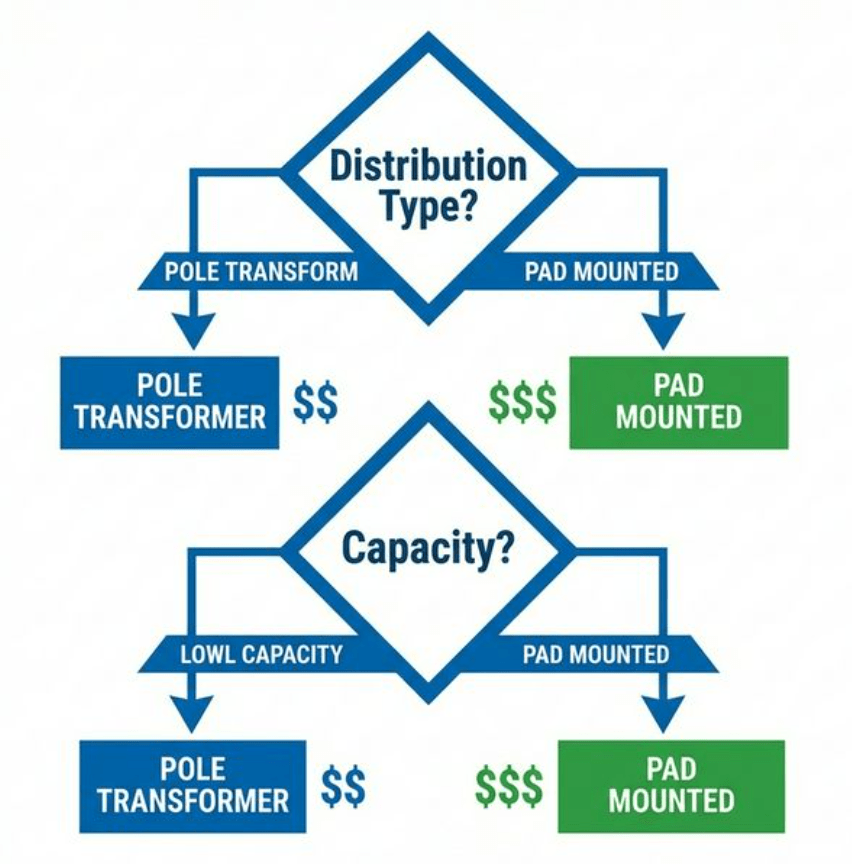
Choose Electric Pole Transformer When:
- ✅ Existing overhead distribution lines
- ✅ Rural or suburban location
- ✅ Capacity need < 100 kVA
- ✅ Budget-constrained project
- ✅ Limited ground space
- ✅ Single or few customers served
Choose Pad Mounted Transformer When:
- ✅ Underground distribution required
- ✅ Urban or dense development
- ✅ Capacity need > 100 kVA
- ✅ Aesthetics are important
- ✅ Frequent maintenance expected
- ✅ Flood-prone area (with proper design)
- ✅ Commercial/industrial application
Frequently Asked Questions
What is the lifespan of pole vs pad mounted transformers?
Both types last 25-40 years with proper maintenance. Pad mounted may have slightly longer
service life due to better protection from environmental elements. However, pole transformers are easier to
replace quickly when failures occur.
Are pad mounted transformers safer than pole transformers?
Not necessarily. While pad mounted units bring high voltage to ground level, they have locked enclosures
meeting UL/IEEE tamper-resistance standards. Pole transformers rely on height for safety. Both are
equally safe when properly installed per NEC codes.
Can a pole transformer be converted to pad mounted?
Yes, but it requires:
- Installing underground conduit ($50-150/ft)
- Pouring a concrete pad ($1,500-$3,000)
- Purchasing a pad mounted unit
- Utility coordination for cutover
The total conversion typically costs $15,000-$50,000 depending on distance, capacity, and
local labor rates.
Which is better for solar/EV charging installations?
For most residential solar and EV charging (<15 kVA additional load), existing pole transformers are
adequate. For commercial EV charging stations (50+ kW per charger), pad mounted three-phase transformers
often provide better capacity and power quality.
Summary: Key Takeaways
| Factor | Winner |
|---|---|
| Lower cost | 🏆 Pole Transformer |
| Higher capacity | 🏆 Pad Mounted |
| Easier maintenance | 🏆 Pad Mounted |
| Less ground space | 🏆 Pole Transformer |
| Aesthetics | 🏆 Pad Mounted |
| Faster installation | 🏆 Pole Transformer |
| Underground distribution | 🏆 Pad Mounted |
Final Recommendation: Start with the distribution infrastructure—if you have overhead lines,
pole transformers make sense. If you’re building new with underground utilities, go pad mounted. Capacity
above 100 kVA? Pad mounted becomes increasingly practical.
Need Help Choosing?
At Transformer4U, we manufacture both pole-mounted transformers and pad-mounted transformers for utilities and
contractors worldwide:
- ✅ Pole Mounted: 10kVA to 333kVA, single or three-phase
- ✅ Pad Mounted: 75kVA to 2,500kVA
- ✅ Standards: IEEE, CSA, IEC, DOE compliant
- ✅ Custom configurations available
Related Articles
- Power Pole Transformer: Complete Guide
- Pad Mounted Transformer Sizing
Guide - Oil-Immersed Transformer: Types &
Applications
References:
- IEEE C57.12.00:
General Requirements for Distribution Transformers - IEEE C57.12.28:
Pad-Mounted Equipment Standards - NEC Article 450: Transformers and Transformer Vaults
- Wikipedia: Distribution Transformer
Article by Tan, Senior Transformer Technician at Transformer4U. With over 15 years of experience in
transformer manufacturing and installations worldwide.