
Comprehensive guide to isolation transformers for electrical safety and sensitive electronics protection
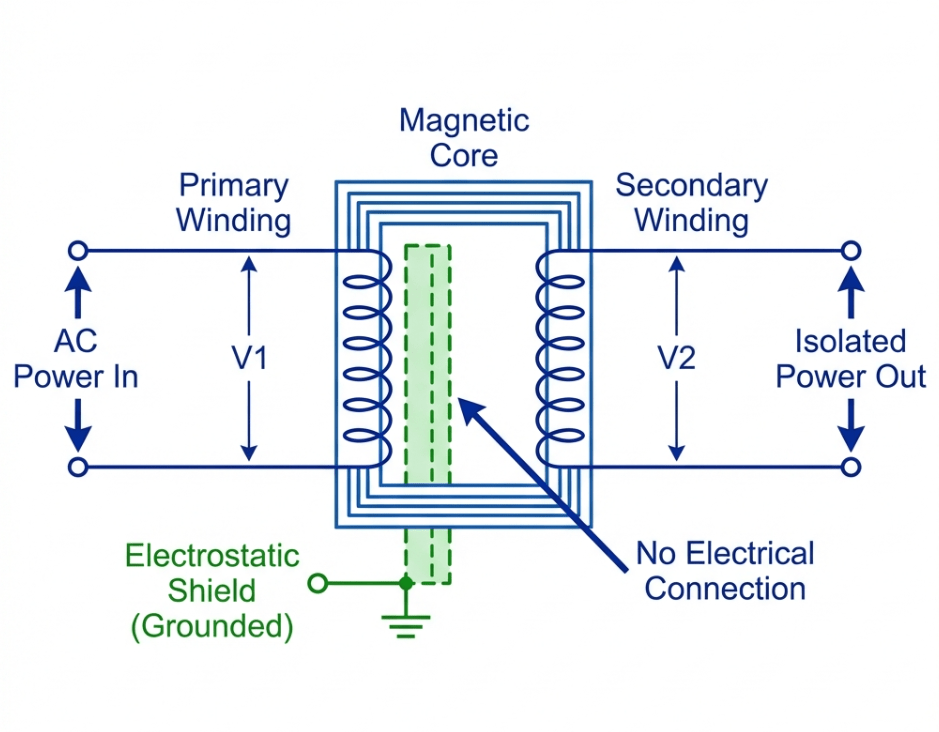
An isolation transformer is a transformer designed to transfer electrical power from an AC power
source to equipment while providing complete electrical isolation between the primary and secondary circuits. Unlike
auto transformers, isolation transformers have separate windings with no electrical connection, providing galvanic
isolation for safety and noise reduction.
This complete guide covers isolation transformer working principles, types, applications in medical
equipment and sensitive electronics, and maintenance requirements.
between the power source and load. This protects against electric shock, suppresses electrical noise in sensitive
devices, and blocks DC components between circuits.
What is an Isolation Transformer?
An isolation transformer has physically and electrically separate primary and secondary windings.
The primary purpose is not voltage transformation (often 1:1 ratio) but complete electrical isolation between
circuits.
Key Features of Isolation Transformers
| Feature | Description |
|---|---|
| Galvanic Isolation | No direct electrical path between input and output |
| Electrostatic Shield | Faraday shield between windings reduces capacitive coupling |
| High Dielectric Strength | Enhanced insulation between primary and secondary (1000-4000V) |
| Noise Attenuation | Blocks common-mode and transverse-mode noise |
| DC Blocking | Prevents DC component transfer between circuits |
Isolation Transformer vs Auto Transformer
| Feature | Isolation Transformer | Auto Transformer |
|---|---|---|
| Windings | Separate primary and secondary | Single shared winding |
| Electrical Isolation | Complete isolation | No isolation |
| Safety | High – protects from shock | Lower – no shock protection |
| Noise Reduction | Excellent | Minimal |
| Size/Cost | Larger and more expensive | Smaller and cheaper |
| Efficiency | Lower (more losses) | Higher (less losses) |
For detailed information on auto transformers, see our Auto Transformer Complete
Guide.
How Isolation Transformers Work
Galvanic Isolation Principle
Isolation transformers transfer power through magnetic induction only – there is no electrical connection between
primary and secondary windings:
- AC power is applied to the primary winding
- Alternating current creates a changing magnetic field in the core
- The magnetic field induces voltage in the secondary winding
- Power transfers magnetically without any electrical path
Electrostatic Shield
High-quality isolation transformers include a Faraday shield (grounded metal layer) between windings:
- Blocks capacitive coupling between primary and secondary
- Prevents common-mode noise from transferring
- Provides additional protection for sensitive electronics
capacitive coupling can still occur around the shield.
Types of Isolation Transformers
1. Standard Isolation Transformer
| Feature | Description |
|---|---|
| Ratio | 1:1 (same input and output voltage) |
| Purpose | Basic electrical isolation |
| Application | General equipment protection |
2. Ultra Isolation Transformer
| Feature | Description |
|---|---|
| Shielding | Multiple electrostatic shields |
| Noise Attenuation | Superior common-mode and transverse-mode rejection |
| Dielectric Strength | 1000V to 4000V between windings |
| Application | Medical devices, laboratory instruments, data centers |
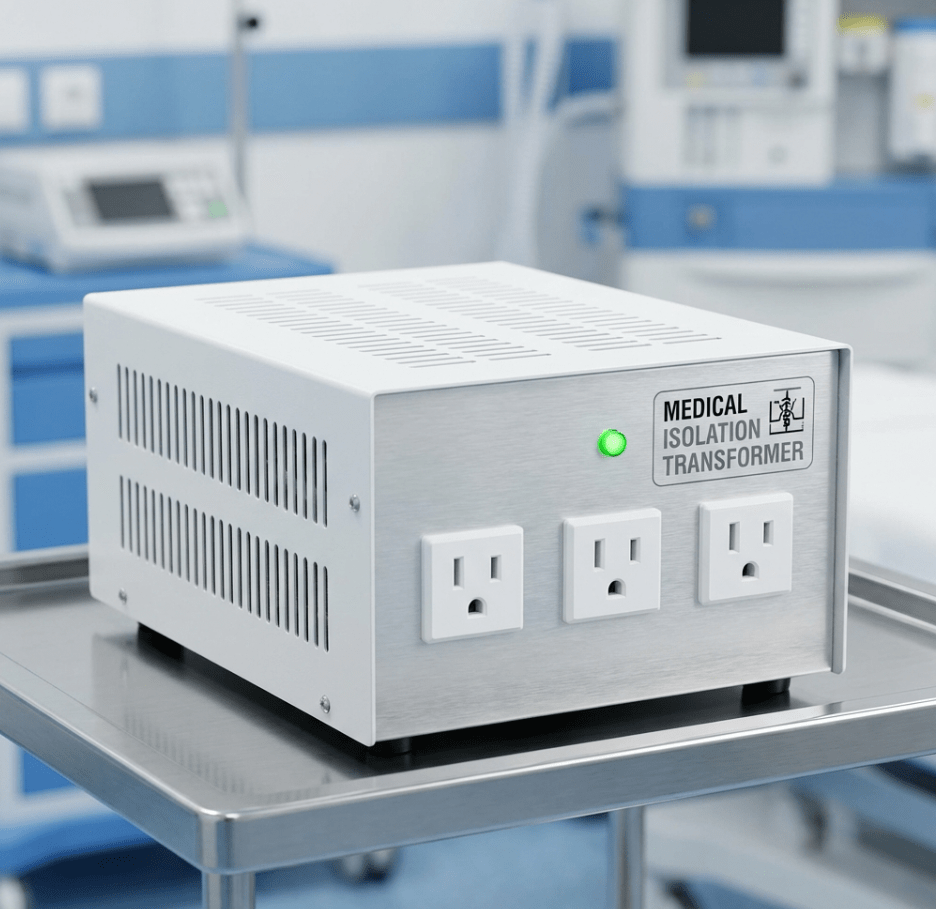
3. Medical Grade Isolation Transformer
| Feature | Description |
|---|---|
| Standards | IEC 60601, UL 60601 |
| Leakage Current | Ultra-low (< 100µA) |
| Ground Fault | Line isolation monitor (LIM) compatible |
| Application | Operating rooms, ICU, patient care areas |
4. Drive Isolation Transformer
Designed for variable frequency drives (VFDs) with:
- High harmonic tolerance
- Thermal protection
- Delta-wye configuration
Applications of Isolation Transformers
1. Medical Equipment
Medical devices require isolation transformers for patient safety:
- Operating room equipment
- MRI and CT scanners
- Patient monitoring systems
- Life support equipment
2. Sensitive Electronics
- Laboratory instruments
- Oscilloscopes and test equipment
- Computer systems and servers
- Audio/video production equipment
3. Industrial Applications
- CNC machines
- PLC and automation systems
- Telecommunications equipment
- Data centers
4. Electronics Testing and Repair
Technicians use isolation transformers to safely work on equipment with live chassis, preventing electric shock when
probing circuits.
Advantages of Isolation Transformers
| Advantage | Benefit |
|---|---|
| Electric Shock Protection | Isolates load from power source for safety |
| Noise Reduction | Blocks common-mode and transverse-mode noise |
| Surge Protection | Attenuates voltage spikes and transients |
| Ground Loop Elimination | Prevents ground loop interference |
| DC Component Blocking | Blocks DC component between circuits |
| Harmonic Isolation | Prevents harmonic distortion transfer |
Disadvantages of Isolation Transformers
| Disadvantage | Consideration |
|---|---|
| Higher Cost | More expensive than auto transformers |
| Larger Size | Requires more copper and core material |
| Lower Efficiency | More losses than auto transformers |
| Weight | Heavier due to separate windings |
🏭 Factory Experience:
- Grounding the Shield: Always ground the electrostatic shield. An ungrounded shield provides
no noise protection and may actually increase capacitive coupling. - Medical Applications: Medical isolation transformers must meet IEC 60601 standards. Regular
testing of leakage current is required – exceeding limits can endanger patients. - Load Considerations: Size isolation transformers for actual load plus 25% margin.
Overloading reduces isolation effectiveness and increases leakage current. - Installation Location: Install isolation transformers as close to sensitive equipment as
possible to minimize noise pickup in secondary wiring.
Frequently Asked Questions
What is an isolation transformer used for?
An isolation transformer is used to provide complete electrical isolation between a power source and
connected equipment. Key uses include protecting sensitive electronics from electrical noise, preventing electric
shock hazards, and meeting safety requirements for medical equipment.
Does an isolation transformer reduce voltage?
Most isolation transformers have a 1:1 ratio, meaning input and output voltages are the same. However, isolation
transformers can also step up or step down voltage if designed with different turns ratios while still providing
electrical isolation.
What is the difference between an isolation transformer and a regular transformer?
All standard two-winding transformers provide some isolation. An isolation transformer is specifically designed and
built with enhanced insulation, electrostatic shielding, and higher dielectric strength specifically for safety and
noise reduction applications.
Can an isolation transformer protect against lightning?
Isolation transformers can attenuate surge energy and are sometimes specified as part of lightning protection
systems. However, they should not be relied upon as the sole protection – dedicated surge protection devices (SPDs)
are also needed.
Why are isolation transformers used in hospitals?
Hospitals use isolation transformers to protect patients from electric shock. Medical isolation transformers have
extremely low leakage current (<100µA) and are used with line isolation monitors to detect ground faults before they
become dangerous.
Related Articles
- Auto
Transformer: Complete Guide - What is a Transformer?
Complete Guide - Types of
Transformer: Complete Classification Guide - Voltage
Transformer (VT): Complete Guide - Step
Down Transformer Explained
References
- Wikipedia –
Isolation Transformer - IEC 60601 – Medical Electrical Equipment
Safety Standards - Eaton Tripp Lite – Isolation
Transformers
Disclaimer: This information is provided for educational purposes. Always follow applicable standards and
manufacturer guidelines when specifying or installing isolation transformers, especially for medical
applications.