
By Tan, Electrical Engineer @Transformer4U | Updated: January 22, 2026
⚡ Quick Answer
Bushings are the Achilles’ heel of power transformers. While they seem like simple
insulators, CIGRE surveys show they cause 10-25% of all transformer failures—and when
they fail, they
often fail catastrophically with explosions.
Key diagnostic warning signs:
- Tan Delta > 2× nameplate value: Insulation deterioration (investigate immediately)
- Capacitance change > 5%: Short-circuited layers or physical damage
- Oil level drop: Seal failure and moisture ingress (most common cause)
- Visible oil stains or cracks: Impending failure—do not energize
transformer had exploded at 3 AM. When I arrived at the site, the devastation was shocking. Twisted
metal, shattered porcelain everywhere, and a crater where the bushing used to be. The fire marshal
estimated the oil fire burned for over an hour.The cause? A high-voltage bushing that had been showing elevated Tan Delta readings for two
years. The maintenance team knew about it but kept postponing the replacement because “it was
still within acceptable limits.” That decision cost them $2 million in equipment damage and six months
of lost production.
This guide will teach you how to recognize bushing problems before they become disasters.
What is a Transformer Bushing and Why Does It Fail?
A transformer bushing is an insulating
device that allows a high-voltage conductor to pass safely through the grounded transformer tank. It
must simultaneously:
- Insulate the conductor from the tank (thousands of volts)
- Carry full load current without overheating
- Withstand lightning impulses and switching surges
- Survive mechanical stresses (wind, seismic, short-circuit forces)
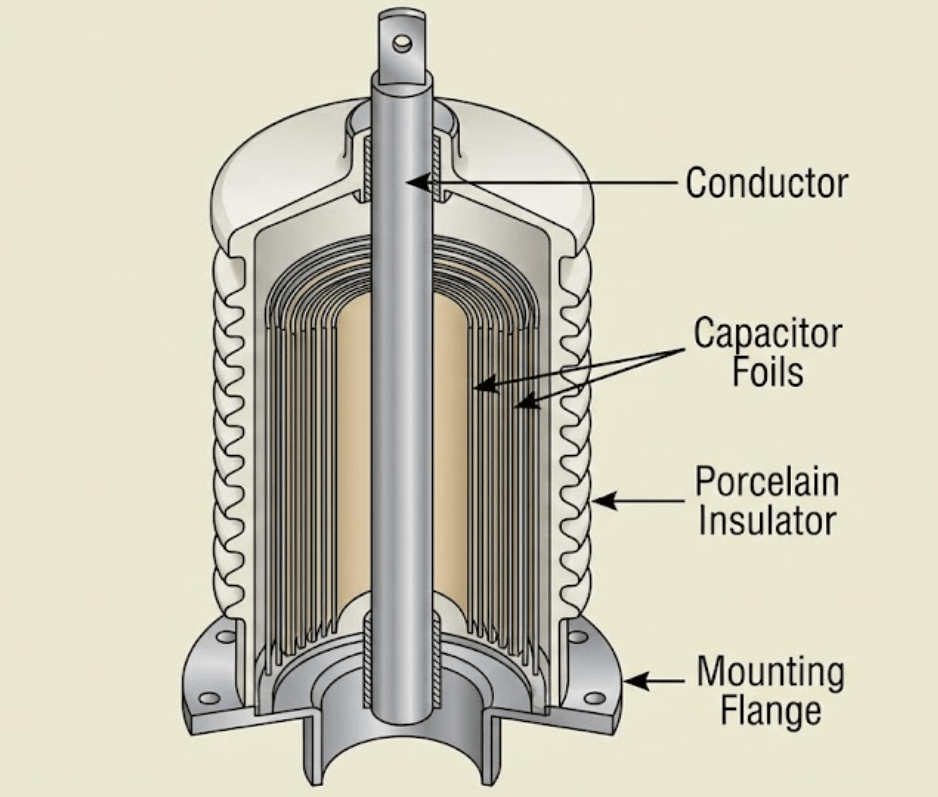
Cross-section of a capacitance-graded bushing showing conductor, capacitor foils, and porcelain
insulator
Why Bushings Are Vulnerable
Unlike windings buried safely inside the tank, bushings are exposed to the environment.
They project through the tank wall, creating a weak point where:
- Rain, humidity, and pollution attack the external porcelain
- Thermal cycling stresses the seals between dissimilar materials
- UV radiation degrades polymer components
- Direct lightning strikes impact the top terminal
939), bushing failures account for
10-25% of all transformer failures, with an average of approximately one-quarter.
Bushings are consistently ranked among the top three failure locations
alongside windings (35-40%) and tap changers (27-40%). Critically, bushing failures frequently result in
catastrophic consequences including fires and explosions.
Bushing Types: OIP vs RIP
Understanding the construction is essential because different bushing types fail in different ways.
| Feature | OIP (Oil-Impregnated Paper) | RIP (Resin-Impregnated Paper) |
|---|---|---|
| Insulation Medium | Liquid mineral oil | Solid epoxy resin |
| Thermal Class (IEC 60137) | Class A (105°C) | Class E (120°C) |
| Tan Delta (New) | ≤ 0.45% | ≤ 0.35% |
| Partial Discharge | < 5 pC | < 2 pC |
| Moisture Susceptibility | High (seals can leak) | Low (solid insulation) |
| Explosion Risk | High (oil + arcing = fire) | None (no liquid oil) |
| Weight | 100% | ~50% lighter |
| Mounting Angle | Vertical only (±30°) | Any angle |
| Seismic Performance | Low (IEEE 693) | High (IEEE 693) |
their superior safety profile and lower maintenance requirements. However, a vast installed base of OIP
bushings remains in service, making proper monitoring essential.
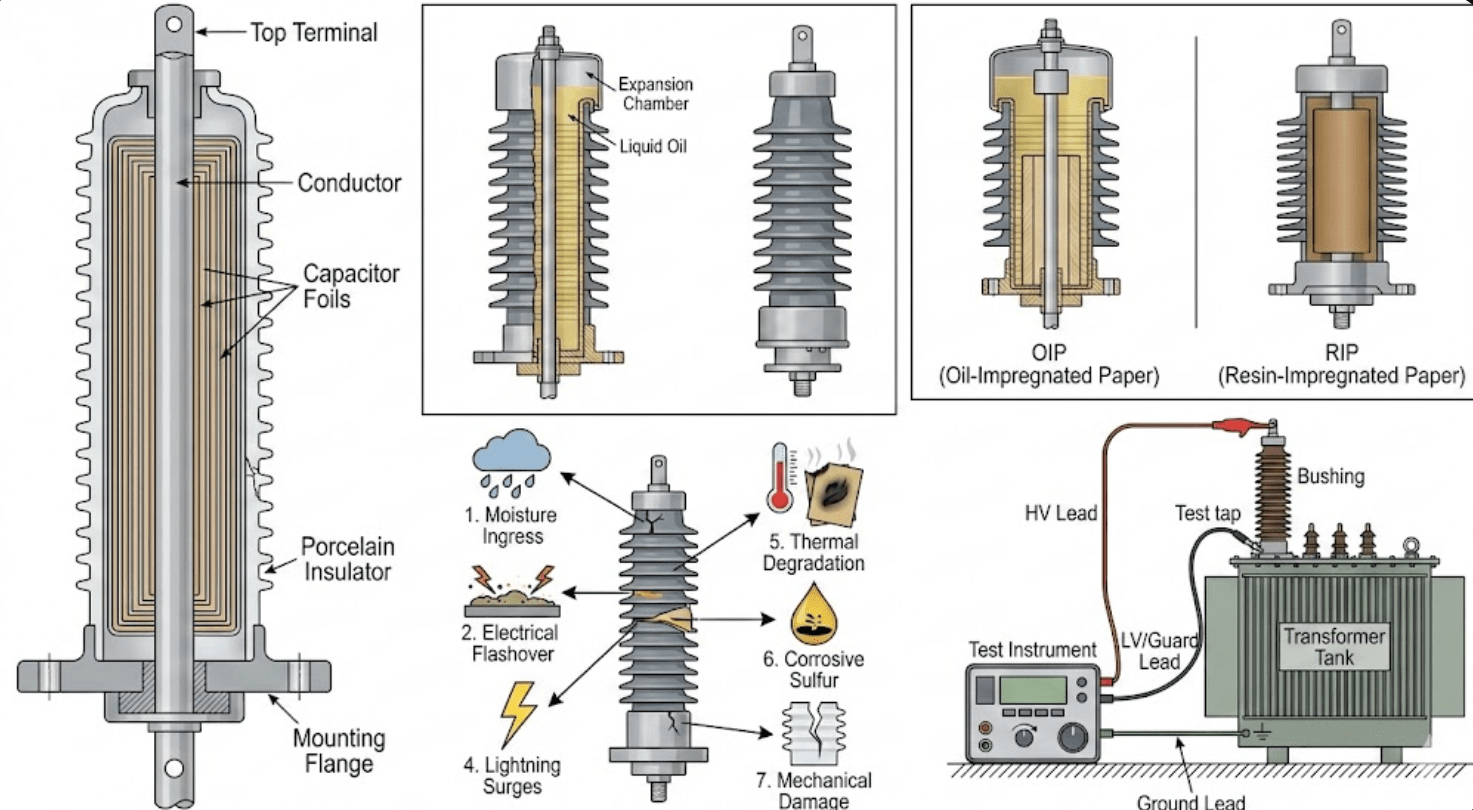
Side-by-side comparison of OIP (left) and RIP (right) bushing construction
7 Common Causes of Bushing Failure
1. Moisture Ingress (Most Common)
Water is the primary enemy of bushing insulation. It enters through:
- Worn or cracked gaskets at the flange
- Failed O-rings on oil gauge fittings
- Thermal breathing (condensation during cooling cycles)
- Manufacturing defects leaving wet-paper pockets
Effect: Water reduces dielectric strength and accelerates paper degradation. Even 0.5%
moisture content can halve insulation life.
2. Electrical Flashover
Contamination on the porcelain surface (salt, industrial pollution, bird droppings) creates a conductive
path that can lead to external flashover during wet conditions.
3. Capacitor Layer Breakdown
In capacitance-graded bushings, internal foil layers control the electric field. If a layer
short-circuits due to localized overheating or manufacturing defects, the remaining layers become
overstressed, leading to cascading failure.
4. Lightning Surges
Direct or nearby lightning strikes can exceed the bushing’s BIL (Basic Impulse Level), causing internal
breakdown.
5. Thermal Degradation
Overloading causes excessive heating. If the conductor temperature exceeds the insulation class limit,
the paper chars and carbonizes, creating conductive paths.
6. Corrosive Sulfur
Certain transformer oils contain corrosive sulfur compounds (dibenzyl disulfide) that attack copper and
paper insulation. This equally affects bushings sharing the same oil.
7. Mechanical Damage
Impact during shipping, seismic events, or short-circuit forces can crack porcelain or shift internal
components.
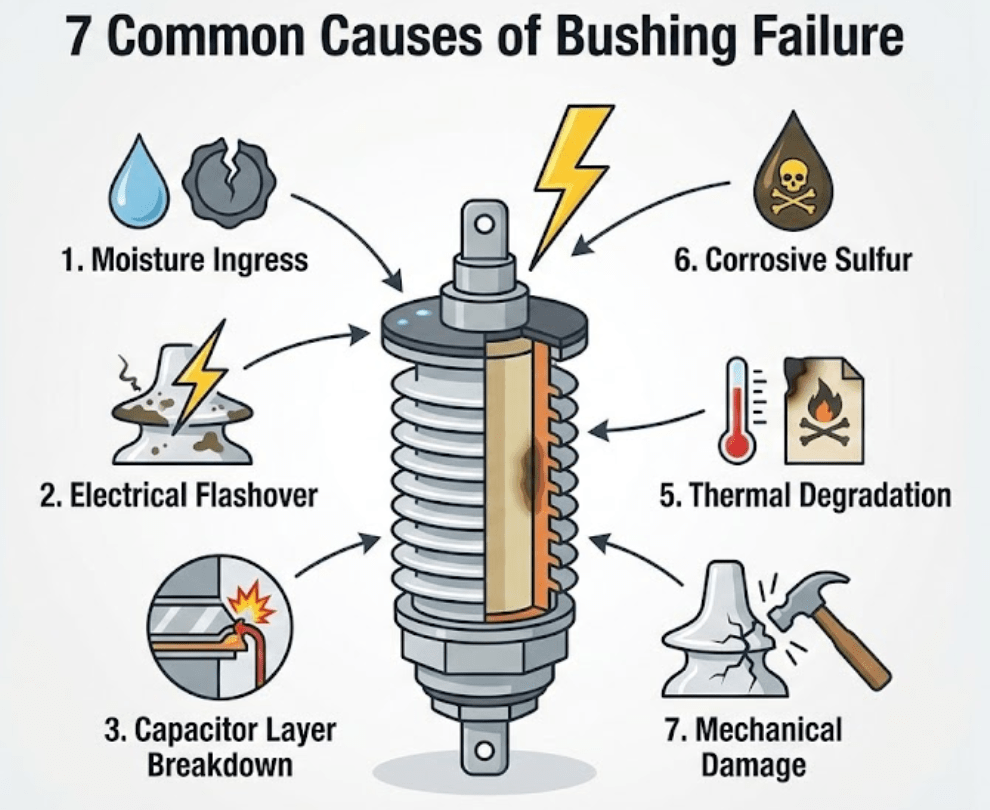
Diagram showing the 7 primary failure mechanisms in transformer bushings
Diagnostic Testing: Detecting Problems Before Failure
Bushing failure doesn’t happen overnight—except when it does. These tests help catch problems early.
1. Power Factor / Tan Delta Test (Most Important)
This is your primary screening tool. It measures the dielectric losses in the insulation.
| Tan Delta Value @ 20°C | Condition Assessment | Recommended Action |
|---|---|---|
| < 0.5% (nameplate) | Good (New condition) | Continue routine monitoring |
| 0.5% – 1.0% | Acceptable (Aging) | Increase test frequency |
| 1.0% – 1.5% (or 2× nameplate) | Marginal (Investigate) | Schedule DFR test, check oil/moisture |
| > 1.5% (or 3× nameplate) | Critical | Plan replacement immediately |
nameplate value. If it does, schedule additional testing. If it exceeds three times
the nameplate value, the bushing is likely compromised and should be replaced.
2. Capacitance Measurement
Each bushing has a design capacitance (C1) between the conductor and tap, and (C2) between the tap and
flange. Changes indicate physical problems.
- Increase > 5%: Short-circuited condenser layers (dangerous)
- Decrease > 3%: Loss of oil, open layers, or physical damage
3. Dielectric Frequency Response (DFR)
This advanced test sweeps through multiple frequencies to build a “moisture fingerprint” of the
insulation. It can detect moisture problems that Tan Delta alone might miss.
4. Hot Collar Test
A specialized test for OIP bushings that detects:
- Low oil or compound levels
- Voids in the paper insulation
- Contamination or deterioration in a specific zone
5. Infrared Thermography (Online)
A non-contact method to detect hot terminals, loose connections, and blocked oil circulation. Can be
performed while the transformer is energized.
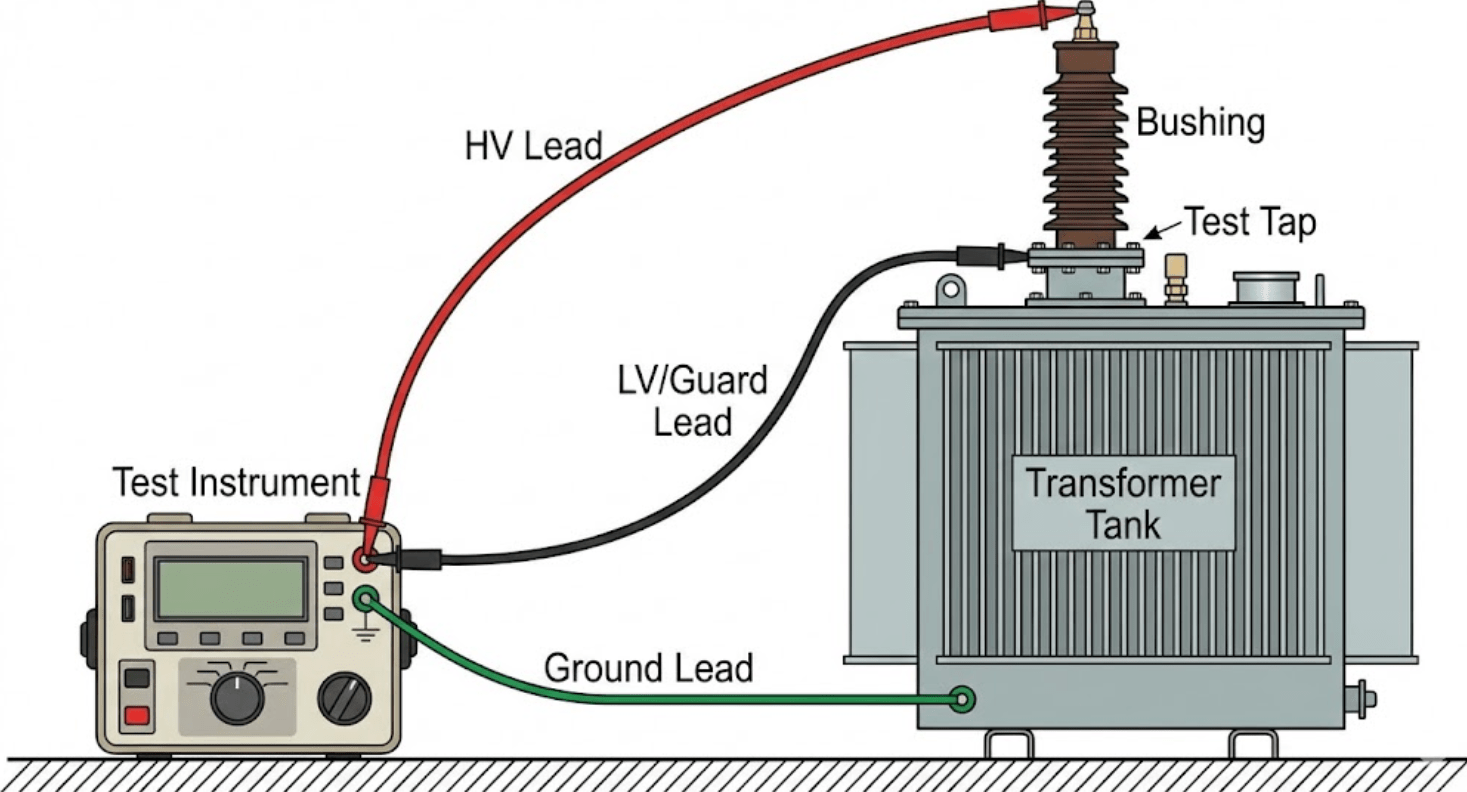
Typical test setup for bushing power factor / Tan Delta measurement
Visual Warning Signs: What to Look For
In addition to electrical tests, regular visual inspections can catch problems early.
| Observation | Possible Cause | Urgency |
|---|---|---|
| Oil stains on porcelain or flange | Seal leak → moisture ingress | 🟡 Medium |
| Low oil level in sight glass | Seal leak or thermal contraction | 🟡 Medium |
| Cracked or chipped porcelain | Mechanical damage → flashover risk | 🔴 High |
| Brown/black discoloration on porcelain | Tracking, pollution flashover | 🔴 High |
| Corona rings missing or damaged | Corona discharge → gradual erosion | 🟡 Medium |
| Visible arc marks on terminal | Previous flashover event | 🔴 Critical – Do not energize |
are invisible from ground level—hairline cracks, minor oil weeping, damaged arcing horn gaps—become
obvious at 10× magnification.
When to Replace: Decision Framework
Bushing replacement is expensive and requires a transformer outage. Use this framework to make the
call:
| Indicator | Action |
|---|---|
| Tan Delta > 3× nameplate OR Capacitance change > 5% | ⚠️ Replace immediately—failure is imminent |
| Tan Delta 2-3× nameplate with rising trend | Schedule replacement within next outage |
| Visible cracks, arc marks, or major oil loss | ⚠️ Do not energize—replace before service |
| OIP bushing > 30 years old with marginal readings | Consider proactive RIP upgrade |
| Multiple minor issues compounding | Cost-benefit analysis vs. replacement |
RIP Upgrade Considerations
When replacing OIP bushings, strongly consider upgrading to RIP technology:
- Safety: Eliminates explosion risk entirely
- Reduced Maintenance: No oil monitoring, no seal replacement
- Mounting Flexibility: RIP can be installed at any angle
- No Oil Lowering: RIP replacement doesn’t require draining transformer oil
Frequently Asked Questions
Can a bushing be repaired instead of replaced?
Generally, no. Bushings are designed as sealed, non-repairable units. Once internal degradation
occurs (moisture in paper, carbonized insulation, shorted layers), there is no practical way to
restore the insulation without complete factory rebuild—which often costs more than a new unit.
Minor external repairs (replacing seals, repainting porcelain) are possible.
How often should bushing Tan Delta be tested?
We recommend: 1) Factory acceptance test (baseline), 2) Commissioning test (verify shipping damage),
3) Every 3-5 years for units under 15 years old, 4) Annually for units over 25 years old or with
known issues. Critical transformers feeding hospitals, data centers, etc. may warrant more frequent
testing.
What temperature correction factor should be used for Tan Delta?
Both IEEE C57.19.01 and IEC 60137 require correction to 20°C. The correction factor depends on
bushing type. For OIP bushings, Tan Delta approximately doubles for every 20°C increase. Many modern
test sets apply this automatically—consult your instrument manual.
Can faulty bushings cause DGA gas generation?
Yes. Internal arcing or overheating in bushings connected to the main tank can generate combustible
gases that appear in main tank DGA. High Hydrogen (H₂) or Acetylene (C₂H₂) with no obvious winding
problem may indicate bushing issues. Some utilities perform separate DGA on bushing oil samples.
Are silicone composite bushings better than porcelain?
Silicone composite shells (used with RIP cores) offer better pollution resistance, lighter weight,
and explosive fragmentation safety. They are increasingly preferred for EHV applications and
contaminated environments. However, long-term aging behavior (>40 years) is less documented than
porcelain.
Conclusion
Transformer bushings are deceptively simple components with catastrophic failure potential. The
difference between a routine replacement and an explosive failure often comes down to a few percentage
points on a Tan Delta test report.
Key takeaways:
- ✅ Establish baselines—know your nameplate values
- ✅ Trend is everything—a rising Tan Delta is more concerning than a stable one
- ✅ Don’t ignore visual signs—oil stains and cracks are warnings
- ✅ Consider RIP upgrades—safety improvements are worth the cost
Our engineering team specializes in transformer diagnostics. Send us your test data for a second
opinion.Contact Us for Analysis