
Ever wondered what those cylindrical devices are sitting on top of utility poles throughout your
neighborhood? Those are power pole transformers, and they’re the unsung heroes that make
electricity usable in your home.
After 15 years manufacturing distribution transformers at Transformer4U and supporting over 10,000 utility installations
worldwide, I’ve seen firsthand how critical these devices are—and how often they’re misunderstood.
⚡ Quick Answer: What Is a Power Pole Transformer?
A power pole transformer (also called pole-mounted transformer) is an oil-filled
electrical device mounted on utility poles that steps down high voltage electricity (typically
7,200-14,400V) to usable levels (120/240V) for homes and small businesses.
- Price Range: $500 to $20,000+ depending on capacity
- Capacity Range: 10kVA to 333kVA
- Service Capacity: One transformer typically serves 5-15 homes
- Lifespan: 25-40 years with proper maintenance
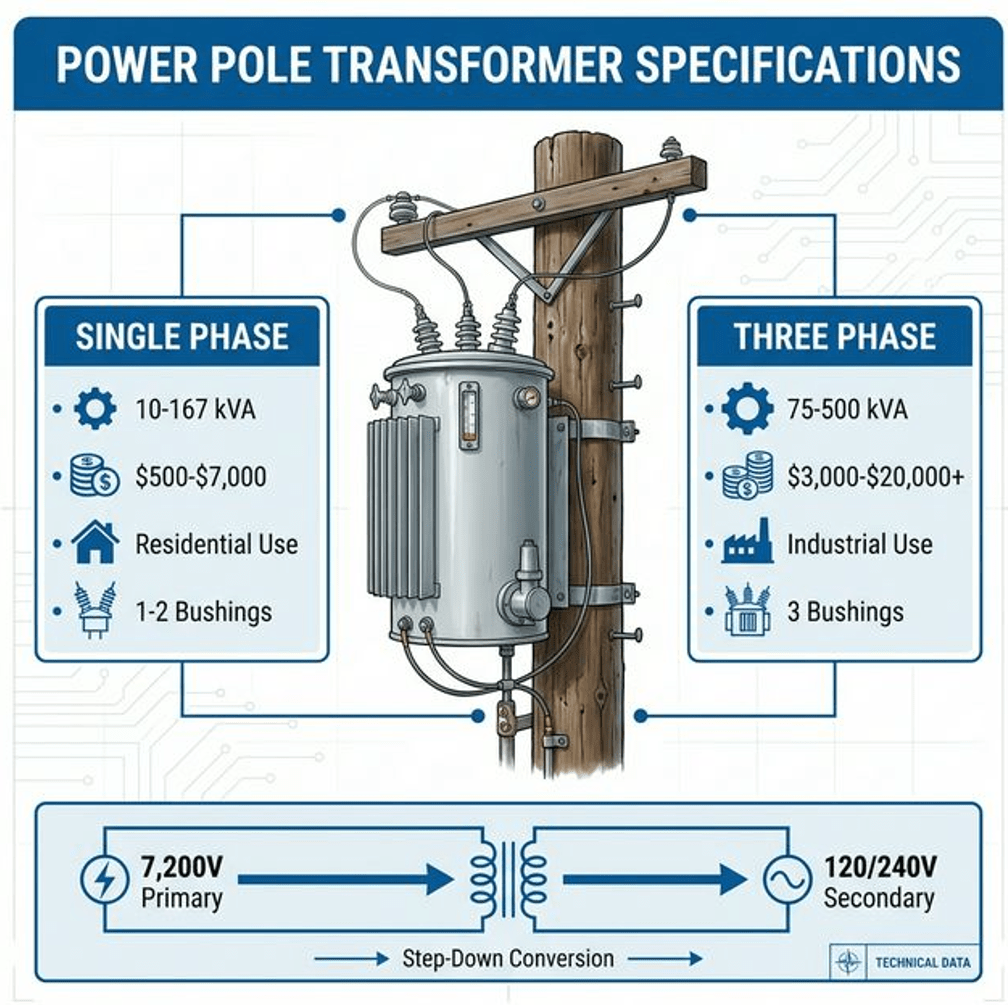
What Is a Power Pole Transformer?
A power pole transformer is a type of distribution transformer specifically designed for mounting on wooden or
concrete utility poles. Its primary function is stepping down the voltage from distribution
levels (2.4kV to 35kV) to consumption levels (120/240V in North America, 230/400V in Europe).
Key Characteristics
| Feature | Specification |
|---|---|
| Mounting | Utility pole (wood or concrete) |
| Insulation | Oil-immersed (mineral oil or FR3) |
| Capacity Range | 10kVA to 333kVA |
| Primary Voltage | 2,400V to 34,500V |
| Secondary Voltage | 120/240V (split-phase) or 480V |
| Phases | Single-phase or three-phase |
| Cooling | ONAN (Oil Natural Air Natural) |
| Weight Limit | Usually under 1,000 kg for pole mount |
Pro Tip: If the transformer exceeds 1,000 kg (roughly 100kVA+), a support bracket must be
installed or consider pad-mounted installation instead.
How Does a Power Pole Transformer Work?
Power pole transformers operate on the principle of electromagnetic induction. Inside every
transformer, you’ll find two sets of windings wrapped around a magnetic core:
The Transformation Process
- Primary Winding receives high-voltage electricity from distribution lines (e.g.,
7,200V) - Magnetic core transfers energy between primary and secondary windings
- Secondary Winding outputs lower voltage electricity (e.g., 240V) to service drops
The voltage ratio follows this formula:
Where V = Voltage, N = Number of turns
Real Example: A 7,200V primary with 30:1 turns ratio produces 240V secondary (7,200 ÷ 30 =
240V).
Why Oil-Immersed?
Power pole transformers are filled with transformer oil for two critical reasons:
- Cooling: Oil circulates naturally, dissipating heat from the windings
- Insulation: Oil provides superior electrical insulation, preventing arcing
From Our Factory: We’ve tested transformers running at 100% load continuously. A
well-designed oil-immersed unit maintains
core temperature under 65°C even at 40°C ambient—that’s why oil-filled units dominate outdoor applications.
Types of Power Pole Transformers
Single-Phase vs. Three-Phase

| Feature | Single-Phase | Three-Phase |
|---|---|---|
| Bushings | 1-2 HV bushings | 3 HV bushings |
| Application | Residential, small commercial | Industrial, large commercial |
| Capacity | 10-167 kVA typical | 75-500 kVA typical |
| Cost | $500-$7,000 | $3,000-$20,000+ |
| Efficiency | 97-98.5% | 98-99% |
| Complexity | Simple | More complex |
| Common Voltage | 7,200V → 120/240V | 12,470V → 480/277V |
| Weight | 100-600 lbs | 500-2,000 lbs |
When to Use Each:
- Single-phase: Residential neighborhoods, rural areas, small businesses
- Three-phase: Industrial parks, manufacturing facilities, large commercial buildings
Learn more about single phase transformers
and three phase transformers.
Conventional vs. CSP (Completely Self-Protected)
| Feature | Conventional | CSP |
|---|---|---|
| Protection | External fuses + arresters | Built-in breaker + fuses + arrester |
| Cost | Lower initial cost | 15-25% higher |
| Maintenance | Separate components to check | All-in-one protection |
| Visual Indication | Limited | Fault indicator built-in |
| Recommended For | Urban areas with frequent maintenance | Remote/rural installations |
How Much Does a Power Pole Transformer Cost?
Based on current 2026 market pricing, here’s what you can expect to pay:
Price by Capacity (kVA Rating)
| Capacity | Price Range (USD) | Typical Application | Weight |
|---|---|---|---|
| 10 kVA | $500 – $1,200 | Single home, irrigation pump | 100-150 lbs |
| 25 kVA | $1,200 – $2,500 | 2-5 homes, small farm | 150-250 lbs |
| 50 kVA | $2,500 – $4,000 | 8-15 homes, small business | 300-450 lbs |
| 75 kVA | $3,500 – $5,500 | 15-25 homes, commercial | 450-600 lbs |
| 100 kVA | $4,500 – $7,000 | 25-40 homes, light industrial | 600-800 lbs |
| 167 kVA | $7,000 – $12,000 | Large subdivision, school | 800-1,100 lbs |
| 250 kVA | $10,000 – $16,000 | Industrial facility | 1,000-1,400 lbs |
| 333 kVA | $14,000 – $22,000 | Manufacturing plant | 1,200-1,800 lbs |
Note: Prices include standard oil-filled transformer with basic accessories. Add 10-20% for
CSP type, 15-30% for copper windings (vs. aluminum).
Factors Affecting Price
- Winding Material: Copper costs 20-40% more than aluminum but offers better conductivity
- Voltage Class: Higher primary voltage = more insulation = higher cost
- Energy Efficiency: DOE 2016 compliant units cost 5-15% more but save on losses
- Custom Features: Tap changers, special bushings, or enhanced surge protection
How Many Houses Can One Transformer Serve?
This is one of the most common questions we receive. The answer depends on several factors:
Calculation Method
Step 1: Determine average home demand
- US Average: 15-20 kVA peak demand per home
- With diversity factor (0.5-0.6): Effective demand = 8-12 kVA per home
Step 2: Apply to transformer capacity
- 50 kVA transformer: 50 ÷ 10 kVA = ~5-8 homes
- 100 kVA transformer: 100 ÷ 10 kVA = ~10-15 homes
Service Capacity Table
| Transformer Size | Homes Served | Best For |
|---|---|---|
| 25 kVA | 2-4 homes | Rural, low-density |
| 50 kVA | 5-10 homes | Suburban residential |
| 75 kVA | 10-15 homes | Dense suburban |
| 100 kVA | 15-25 homes | Urban residential |
| 167 kVA | 25-40 homes | Subdivision |
Real-World Insight: In my experience, utilities typically plan for 50-60% loading to allow
for peak demand and future load growth. A 50 kVA transformer usually serves about 8-10 homes in typical
suburban America.
Installation Requirements & Safety
Mounting Height Standards
According to NEC Article 450 and utility guidelines:
| Clearance Type | Minimum Distance |
|---|---|
| Ground to transformer bottom | 18-25 feet |
| Road crossing | 18.5+ feet |
| Pedestrian areas | 12+ feet |
| Building proximity | 3+ feet horizontal |
| Other utility lines | 4+ feet |
Surge Protection
Every power pole transformer should have surge arresters installed per IEEE C62.23. Lightning
strikes are the #1 cause of transformer failure in exposed installations.
From the Field: We’ve seen utilities reduce transformer failure rates by 40% simply by
upgrading to metal-oxide varistor (MOV) arresters instead of older silicon carbide types.
Common Problems and Troubleshooting

Top 5 Failure Causes
| Cause | Percentage | Symptoms | Prevention |
|---|---|---|---|
| Lightning/Surge | 30% | Sudden failure, burnt smell | Install MOV arresters |
| Overloading | 25% | Excessive heat, humming | Proper sizing, load monitoring |
| Animal Contact | 20% | Tripped fuses, scorch marks | Animal guards, fencing |
| Age/Insulation | 15% | Oil leaks, declining performance | Regular oil testing |
| Manufacturing Defect | 10% | Early failure (1-3 years) | Buy from UL-listed manufacturer |
The Buzzing Sound Explained
That humming or buzzing from a power pole transformer is caused by magnetostriction—the
magnetic core physically vibrates at 60 Hz (or 50 Hz in other regions).
When to Worry:
- Normal: Low, steady hum (60 Hz)
- Warning: Louder than usual, intermittent → Check for loose laminations
- Danger: Crackling or popping → Internal arcing, contact utility immediately
Frequently Asked Questions
What is the difference between a pole transformer and a distribution transformer?
A pole transformer IS a type of distribution transformer. The term “pole transformer” specifically refers to
the mounting method (on a utility pole), while “distribution transformer” is the broader category that also
includes pad-mounted and underground units. All pole transformers are distribution transformers, but not all
distribution transformers are pole-mounted.
How long does a power pole transformer last?
A well-maintained oil-immersed transformer
typically lasts 25-40 years. However, factors like overloading, lightning exposure, and
environmental conditions can significantly reduce lifespan. Utilities typically plan for 30-year service
life when budgeting replacements.
Can a power pole transformer explode?
Yes, but it’s rare. Transformer failures can cause fires or explosions if internal arcing
ignites the oil. Modern transformers include pressure relief devices and fusing to minimize this risk. This
is why transformers mounted near buildings require special considerations per NEC codes.
Who is responsible for a transformer on my property?
In most cases, the utility company owns and maintains the transformer, even if it’s on
private property. They have an easement for maintenance access. However, some commercial or industrial
customers own their transformers (customer-owned equipment) and are responsible for maintenance.
What size transformer do I need for my home?
Most single-family homes require only 5-15 kVA of the transformer’s capacity. However,
transformers serve multiple homes, so utilities typically install 25-50 kVA units for small
groups of residences. For a single isolated home, a 15-25 kVA transformer is usually
sufficient.
Summary: Key Takeaways
- ✅ Definition: Power pole transformers step down high voltage (7,200V+) to usable
levels (120/240V) - ✅ Price Range: $500 (10kVA) to $22,000+ (333kVA)
- ✅ Service Capacity: One 50kVA transformer typically serves 5-10 suburban homes
- ✅ Lifespan: 25-40 years with proper maintenance
- ✅ Top Failure Cause: Lightning/surge (30%) — install proper arresters
- ✅ Types: Single-phase (residential) vs. Three-phase (industrial)
Need a Custom Pole Transformer Solution?
At Transformer4U, we manufacture high-quality pole-mounted transformers for utilities and
contractors worldwide:
- ✅ Capacity Range: 10kVA to 333kVA
- ✅ Standards Compliant: IEEE, CSA, IEC, DOE
- ✅ Options: Conventional or CSP, copper or aluminum windings
- ✅ Certifications: UL listed, CSA certified
- ✅ Support: Engineering assistance for sizing and specifications
Related Articles
References:
- IEEE C57.12.20:Standard for Overhead-Type Distribution Transformers
- NEC Article 450: Transformers and Transformer Vaults
- IEEE C62.23: Guide for Application of Surge Protection
- Wikipedia: Distribution Transformer
Article by Tan, Senior Transformer Technician at Transformer4U. With over 15 years of experience in
transformer manufacturing and 10,000+ installations supported worldwide.