
Everything you need to know about single phase distribution transformers including specifications, types,
applications, and selection guidelines

A single phase distribution transformer is an essential component in electrical power distribution
systems, primarily used to step down primary voltage from distribution lines (2.4kV to 34.5kV) to
utilization voltage (120/240V) for residential and light commercial loads. Unlike three-phase transformers,
single phase distribution transformers are specifically designed for applications where
single-phase power is sufficient and economical.
transformers in North American residential areas, with ratings typically ranging from 5 kVA to 167 kVA.
What is a Single Phase Distribution Transformer?
A phase distribution transformer is a static electrical device that transfers electrical energy
between circuits through electromagnetic induction. It consists of:
- Magnetic Core: Made from grain-oriented silicon steel laminations
- Primary Winding: Connected to the high-voltage distribution line
- Secondary Winding: Delivers stepped-down voltage to customers
- Insulating Medium: Typically mineral oils or natural ester fluids
- Tank and Bushings: Including high voltage bushing and low voltage terminals
Working Principle
- AC voltage applied to the primary winding creates an alternating magnetic field
- The magnetic flux travels through the laminated iron core
- This changing flux induces voltage in the secondary winding
- The voltage ratio equals the turns ratio between windings
Types of Single Phase Distribution Transformers
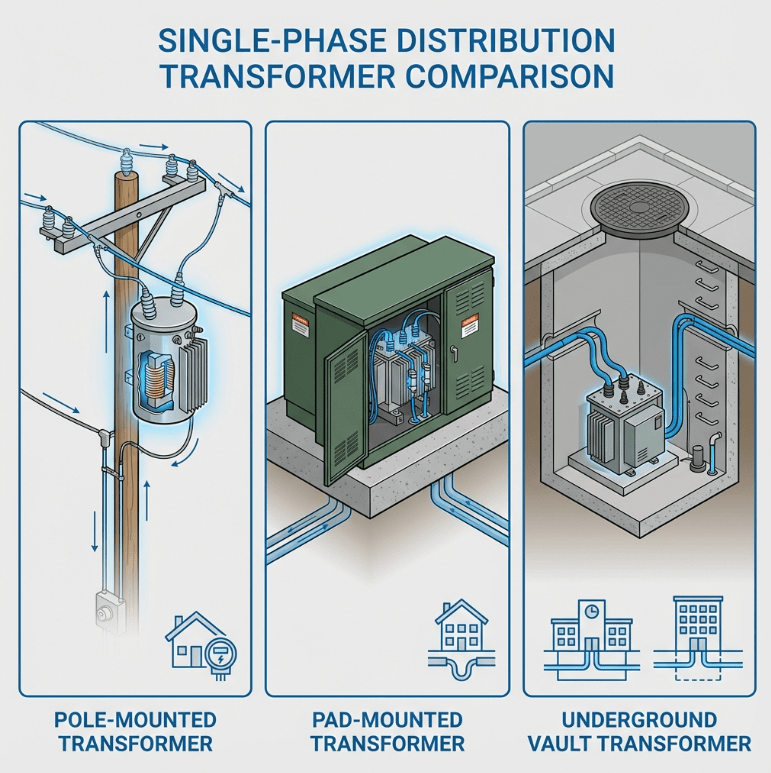
1. Pole-Mounted Transformers
Mounted on utility poles for overhead distribution systems.
| Feature | Specification |
|---|---|
| Typical Ratings | 5, 10, 15, 25, 37.5, 50, 75, 100, 167 kVA |
| Primary Voltage | 2,400V to 34,500V |
| Secondary Voltage | 120/240V (split-phase) |
| Installation | Single pole or platform |
| Cooling | ONAN (Oil Natural Air Natural) |
2. Pad-Mounted Transformers
Ground-level installation for underground distribution systems.
| Feature | Specification |
|---|---|
| Typical Ratings | 25 to 500 kVA |
| Enclosure | Lockable steel cabinet |
| Installation | Concrete pad |
| Applications | Residential subdivisions, commercial |
3. Conventional vs. CSP Type
| Type | Features | Best For |
|---|---|---|
| Conventional | Basic protection, lower cost | Standard installations |
| CSP (Completely Self-Protected) | Built-in arresters, fuses, breaker | High-reliability needs |
Single Phase Distribution Transformer Specifications
Standard Ratings (ANSI/IEEE)
| kVA | Primary Voltage | Secondary Voltage | No-Load Loss (W) | Load Loss (W) |
|---|---|---|---|---|
| 10 | 7200/12470Y | 120/240 | 35-45 | 100-130 |
| 15 | 7200/12470Y | 120/240 | 50-65 | 140-180 |
| 25 | 7200/12470Y | 120/240 | 70-90 | 210-270 |
| 37.5 | 7200/12470Y | 120/240 | 95-120 | 290-370 |
| 50 | 7200/12470Y | 120/240 | 115-145 | 370-470 |
| 75 | 7200/12470Y | 120/240 | 155-195 | 510-650 |
| 100 | 7200/12470Y | 120/240 | 195-245 | 650-830 |
| 167 | 7200/12470Y | 120/240 | 290-365 | 1000-1280 |
Key Standards
All quality single phase distribution transformers should be manufactured meeting or exceeding the
following standards:
- ANSI C57.12.00 – General Requirements
- IEEE C57.12.20 – Overhead-Type Distribution Transformers
- IEEE C57.12.28 – Pad-Mounted Equipment
- DOE 2024 – Energy Efficiency Standards
- CSA C2.1/C2.2 – Canadian Standards
Insulating Fluids
Single phase distribution transformers use various insulating fluids:
| Fluid Type | Properties | Applications |
|---|---|---|
| Mineral Oils | Traditional, economical, proven performance | Standard installations |
| FR3 (Natural Ester) | Biodegradable, high fire point (360°C) | Environmentally sensitive areas |
| Silicone Fluid | Non-toxic, fire resistant | Indoor, high-fire-risk areas |
reliability and lower cost. For installations near waterways or in fire-sensitive areas, FR3 natural ester
provides excellent protection with biodegradability.
Applications
Residential
- Single-family homes (10-25 kVA typical)
- Multi-family dwellings
- Rural overhead distribution
Commercial
- Small retail stores
- Office buildings
- Light industrial loads
Utility
- Distribution network step-down
- Street lighting circuits
- Railroad signal power
Special Applications
- Renewable energy connections
- Temporary construction power
- Agricultural irrigation systems
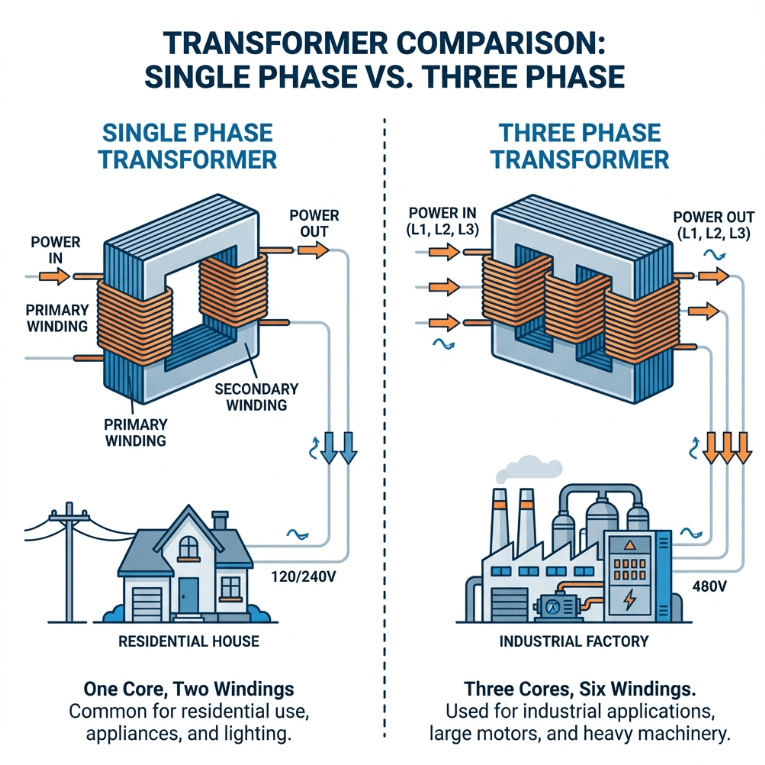
Single Phase vs. Three Phase Distribution Transformers
| Factor | Single Phase | Three Phase |
|---|---|---|
| Power Delivery | Lower capacity | Higher capacity |
| Cost | Lower initial cost | Higher initial cost |
| Efficiency | Slightly lower | Higher for large loads |
| Size/Weight | Lighter, smaller | Heavier, larger |
| Best For | Residential, light commercial | Industrial, commercial |
| Typical Ratings | 5-167 kVA | 75-2500+ kVA |
| Connections | 120/240V split-phase | 208Y/120V, 480Y/277V |
Selection Guide
Step 1: Determine Load Requirements
Calculate total connected load in kVA:
Single phase kVA = (Volts × Amps) / 1000
Step 2: Apply Demand Factor
Typical demand factors:
- Residential: 40-60%
- Commercial: 60-80%
- Industrial: 70-90%
Step 3: Add Growth Margin
Add 20-25% for future load growth.
Step 4: Select Standard Size
Choose next higher standard kVA rating:
5, 10, 15, 25, 37.5, 50, 75, 100, 167 kVA
Transformer Sizing Calculator for quick and accurate results.
Installation Considerations
Pole-Mounted Installation
- Mounting Height: Minimum 18 feet (5.5m) for public areas
- Clearances: Per NEC Article 450 and utility requirements
- Grounding: Proper system and equipment grounding required
- Fusing: Fused cutout on primary side
Pad-Mounted Installation
- Pad Size: Minimum 4′ × 4′ concrete pad
- Clearances: 10′ front, 3′ sides minimum (check local codes)
- Drainage: Proper grading away from unit
- Access: Lockable enclosure per IEEE C57.12.28
Frequently Asked Questions
What size single phase transformer do I need for a house?
Most single-family homes require 15-25 kVA transformers. Calculate your expected peak demand and add 25% for future
growth. Consult your local utility for specific requirements.
What is the difference between a single phase and three phase transformer?
A single phase transformer operates on one phase of AC power and typically serves residential loads. Three phase
transformers operate on three phases and are used for larger commercial and industrial loads requiring higher power
capacity.
Can a single phase transformer be used for three phase power?
No, a single phase transformer cannot convert single phase to three phase power. However, three single phase
transformers can be connected (delta or wye) to create a three-phase transformer bank.
What is a CSP transformer?
A CSP (Completely Self-Protected) transformer includes built-in surge arresters, primary fuses, and secondary circuit
breaker. It provides comprehensive protection without requiring external protective devices.
How long does a distribution transformer last?
Quality single phase distribution transformers typically last 25-40 years under normal operating conditions. Factors
affecting lifespan include loading, ambient temperature, and maintenance.
Related Articles
- Distribution
Transformer Sizing Calculator - Distribution
Transformer Losses Calculation - Pad
Mounted Transformer: Complete Guide - Distribution
Transformer: Complete Guide
References
- IEEE C57.12.00 – General Requirements for
Distribution Transformers - DOE Appliance and Equipment Standards Program
- NFPA 70 – National Electrical Code
Disclaimer: This information is provided for educational purposes. Always consult with your local utility and a qualified electrical engineer for specific transformer applications and installations.