
From the massive substation on your street corner to the small charger in your pocket, step down
transformers are the unsung heroes of electrical safety. They take lethal high voltage and
“step it down” to safer, usable levels for your home and devices.
⚡ Quick Answer
A step down transformer is an electrical device that reduces voltage from the
primary winding (input) to the secondary winding (output). It has
more turns on the primary coil than the secondary.
Vs = (Ns / Np) × Vp
Since Ns < Np (fewer secondary turns), the output voltage (Vs) is
always lower than the primary voltage (Vp).
In this guide, I’ll explain how they work, compare them to step-up units, and show you how to size one
correctly—avoiding the common mistake of blowing up your expensive heavy-duty appliances.
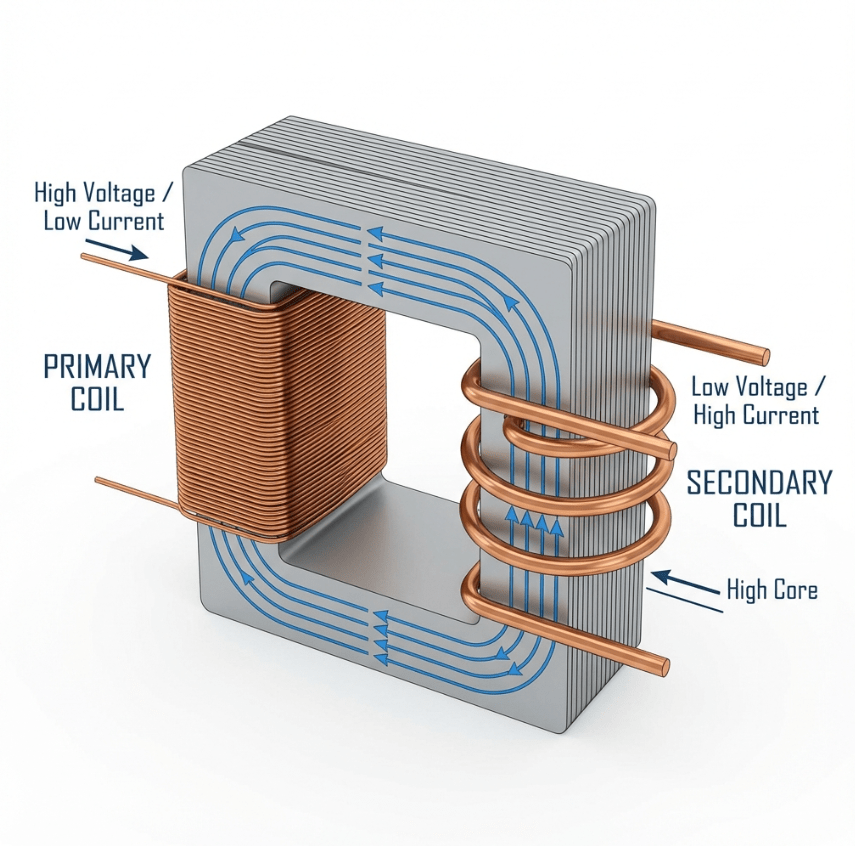
What Is a Step Down Transformer?
A step down transformer is designed to decrease an AC supply voltage. This voltage reduction
creates a higher current capability at the output, following the law of conservation of energy (Power In ≈
Power Out).
If you look inside a transformer, you can often tell if it’s step-down:
- Primary Coil (Input): Thinner wire, many turns (Handles High Voltage, Low Current)
- Secondary Coil (Output): Thicker wire, fewer turns (Handles Low Voltage,
High Current)
This conversion is vital because power is transmitted efficiently at high voltage
(minimizing line losses) but must be consumed at low voltage for safety.
How Does It Work? The “Lever” Analogy
Think of electricity like water in a pipe, or a mechanical lever. A step-down transformer acts like a lever
that trades “distance” (Voltage) for “force” (Current).
The Working Principle
It operates on Faraday’s Law of Electromagnetic Induction:
- AC current enters the primary winding.
- It creates a fluctuating magnetic field in the iron core.
- This flux cuts across the secondary winding.
- Because the secondary has fewer turns, a lower voltage is induced.
Expert Warning: High Current Risk
Low voltage doesn’t mean low risk. In a step-down transformer, current increases. A 10A input
becomes 100A output! If the secondary wires aren’t thick enough, they can melt and cause a fire. Always
verify your wire gauge.
Key Applications: Industrial vs. Consumer
Step down transformers serve two very different worlds: the utility grid and your home electronics.

🏭 Industrial & Grid Applications
1. Power Distribution Grids
This is the most critical application. Electricity leaves the power plant at ultra-high voltages (e.g.,
400kV) and gets stepped down in stages:
- Substation: 400kV → 33kV or 11kV
- Distribution (Pole/Pad): 11kV → 415V/240V (Standard residential
voltage)
Expert Note: “In residential projects, we install 315 kVA oil-cooled units. These
run 24/7 and use ONAN cooling to dissipate the heat generated by core losses.”
2. Data Centers & Factories
- Data Centers: 13.8kV → 415V to power server racks reliably.
- Motor Control: 480V → 120V for control circuits, isolating operators from high power.
Need to drop 240V to 208V for a motor? You don’t always need a full isolation transformer. A
Buck-Boost Transformer is smaller and cheaper for these slight voltage adjustments (usually
<20%).
🏠 Consumer & Home Applications
1. Travel Converters (Voltage Converters)
These allow you to use 110V US appliances in 220V countries (Europe/Asia). Warning: Many cheap
converters are Autotransformers (see Safety section below).
2. “Wall Warts” & LED Drivers
The block on your laptop charger? It’s a tiny step-down transformer (often switching type) taking 120V/240V
down to 19V or 5V DC. Similarly, LED Drivers are specialized transformers that step
down voltage and convert AC to DC for LED strips.
Safety Critical: Isolation vs. Autotransformer
Not all step-down transformers are created equal, especially when it comes to safety.
| Feature | Isolation Transformer | Autotransformer |
|---|---|---|
| Coils | Two separate coils | One shared coil |
| Safety | High (Input/Output electrically separated) | Low (Direct electrical path) |
| Size/Cost | Larger, more expensive | Smaller, cheaper |
| Typical Use | Medical, Bathroom, Safety | Cheap Travel Converters |
⚠️ The “Shock” Risk
If you use a cheap Autotransformer travel converter, your device is technically still connected
to the
220V mains. If the neutral/live wires are reversed (common in old buildings), the chassis of
your device
could become live! For medical devices or use in bathrooms, ALWAYS use an Isolation
Transformer.
Step Down vs. Step Up: Comparison
How does it differ from its counterpart, the Step Up
Transformer?
| Feature | Step Down Transformer | Step Up Transformer |
|---|---|---|
| Function | Reduces Voltage | Increases Voltage |
| Turns Ratio (Ns/Np) | Less than 1 (Ns < Np) | Greater than 1 (Ns > Np) |
| Current | Increases | Decreases |
| Primary Wire | Thinner (High V) | Thicker (High I) |
| Typical Use | Distribution, Home, Safety | Power Generation, Transmission |
Sizing Guide: Don’t Blow Up Your Dryer
Choosing the wrong transformer is the #1 cause of equipment failure. Follow these steps:
Step 1: Divide Appliances by Type
- Resistive Loads (Simple): Light bulbs, simple heaters.
Margin required:
+25% - Inductive/Motor Loads (Complex): Hair dryers, fridges, power
tools,
laser printers.
Margin required: 300% (3x Rating)
⚠️ The Hair Dryer Warning
Do NOT use a standard 2000W converter for a 1600W hair dryer.
Hair dryers have massive motor startup surges. A standard converter will likely melt or trip. You need a
heavy-duty transformer rated for at least 5000 Watts to safely run a 1600W dryer.
Ignoring this is the #1 cause of failure.
Step 2: Check Plug & Voltage
Ensure the Input plug matches the wall and the Output socket matches your device:
- Type A/B (US): Flat parallel pins (110-120V).
- Type C/F (EU): Round pins (220-240V).
- Type G (UK): Rectangular pins (230V).
Step 3: Frequency (50Hz vs 60Hz)
Using a 60Hz US device on a 50Hz EU grid can cause overheating if the transformer isn’t rated for it.
Ensure
your transformer says “50/60Hz” on the label.
Need a Custom Industrial Step-Down Transformer?
From 315 kVA pole-mounted units to specialized data center transformers, we build reliable,
high-efficiency solutions.
Troubleshooting Common Issues
- Why is it humming vs. whining?
- Hum (Low Pitch): Magnetostriction (core vibration). Tighten screws.
- Whine (High Pitch): Coil whine in switching supplies. Hard to fix; usually
requires replacement.
- Why is it hot? Small linear adapters are only ~70% efficient and feel warm
naturally.
If it’s too hot to touch (>60°C), it’s likely overloaded (see Step 1). - No Output? (Fuse Check) Check the fuse.Rule of Thumb: Fuse Rating (Amps) ≈ Watts / Input Volts × 1.25.
Frequently Asked Questions
Can a step down transformer increase voltage?
No. By definition, a step-down transformer reduces voltage. To increase voltage, you need a step up transformer.
Can I use a 60Hz transformer on 50Hz?
Using a 60Hz-only transformer on 50Hz can cause core saturation and overheating. However, a
transformer rated
for 50Hz works safely on 60Hz. Ideally, look for “50/60Hz” on the label.
Do step down transformers waste power?
Yes. While large units are >98% efficient, small “wall warts” can waste 20-30% as heat. Unplug travel
converters when not in use to save energy.
References