Comprehensive guide to transformer cooling methods for optimal heat dissipation and performance
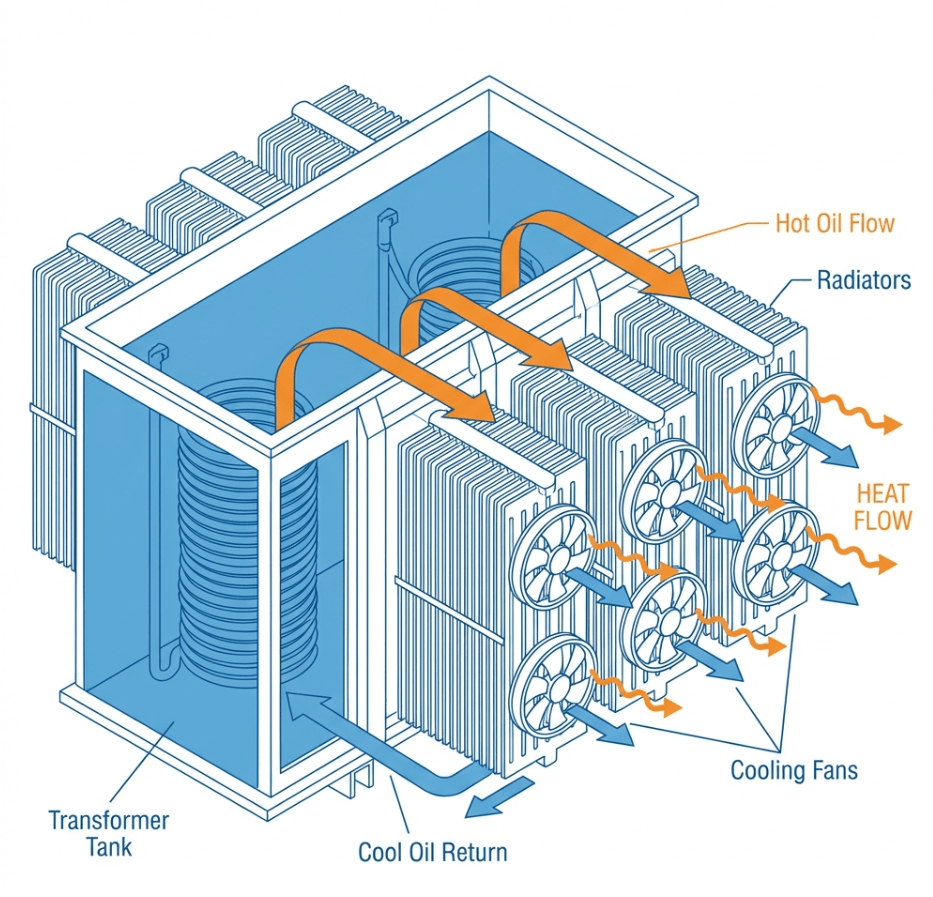
A transformer cooling system is essential for managing heat generated during transformer operation.
Heat is produced in the transformer core and windings due to electrical losses (copper and iron losses). Without
effective cooling, excessive temperature rise degrades insulation, reduces efficiency, and can lead to transformer
failure.
This complete guide covers transformer cooling methods, cooling class designations (ONAN, ONAF, OFAF, OFWF), and how
to select the appropriate cooling system for your application.
internal cooling media (oil or air) and external cooling methods (natural convection or forced air/water
circulation). The cooling class indicates how heat is transferred away from the transformer.
Why Transformer Cooling is Critical
Transformers generate heat from two main sources:
| Heat Source | Description |
|---|---|
| Copper Losses (I²R) | Heat generated in windings due to current flow through resistance |
| Iron/Core Losses | Heat from hysteresis and eddy currents in the magnetic core |
Without adequate heat dissipation:
- Insulation degrades (paper, oil) reducing transformer life
- Hot spots develop, potentially causing failure
- Efficiency decreases as losses increase with temperature
- Overload capacity is limited
Transformer Cooling Class Naming System
The transformer cooling system is identified by a four-letter code on the nameplate. Each letter has a specific
meaning:

| Position | Meaning | Options |
|---|---|---|
| 1st Letter | Internal Cooling Medium | O = Mineral oil (<300°C flash) K = Less flammable fluid (>300°C flash) L = Non-flammable fluid |
| 2nd Letter | Internal Circulation | N = Natural convection F = Forced (non-directed) D = Directed flow |
| 3rd Letter | External Cooling Medium | A = Air W = Water |
| 4th Letter | External Circulation | N = Natural convection F = Forced circulation |
(F)
Oil-Filled Transformer Cooling Classes
1. ONAN – Oil Natural Air Natural
The simplest and most common transformer cooling system using natural convection only:
| Feature | Description |
|---|---|
| Oil Circulation | Natural – hot oil rises, cool oil sinks |
| External Cooling | Natural air convection over radiators |
| Equipment | No pumps, no fans – passive system |
| Capacity | Up to ~25-30 MVA |
| Advantages | Silent, maintenance-free, reliable |
| Limitations | Limited heat dissipation capacity |
2. ONAF – Oil Natural Air Forced
Enhanced cooling with fans for forced air circulation:
| Feature | Description |
|---|---|
| Oil Circulation | Natural convection |
| External Cooling | Fans blow air across radiators |
| Equipment | Radiator fans (typically thermostat controlled) |
| Capacity Increase | 25-33% higher rating than ONAN |
| Advantages | Higher capacity, fans activate only when needed |
| Limitations | Requires fan maintenance, some noise |
3. OFAF – Oil Forced Air Forced
High-capacity cooling with pumped oil and forced air:
| Feature | Description |
|---|---|
| Oil Circulation | Pumps force oil through radiators |
| External Cooling | Forced air across heat exchanges |
| Equipment | Oil pumps + radiator fans |
| Capacity | 60+ MVA, up to 500+ MVA |
| Advantages | Maximum heat dissipation, handles high loads |
| Limitations | Higher complexity, requires auxiliary power |
4. OFWF – Oil Forced Water Forced
Water-cooled system for special applications:
| Feature | Description |
|---|---|
| Oil Circulation | Pumps force oil flows through heat exchangers |
| External Cooling | Water circulation through oil-water heat exchanges |
| Equipment | Oil pumps + water pumps + heat exchangers |
| Applications | Power plants, underground substations, ships |
| Advantages | Compact, excellent cooling in enclosed spaces |
| Limitations | Requires water supply, complex maintenance |
Cooling Class Comparison
| Cooling Class | Oil Flow | External | Capacity (MVA) | Equipment |
|---|---|---|---|---|
| ONAN | Natural | Air Natural | Up to 30 | None |
| ONAF | Natural | Air Forced | Up to 60 | Fans |
| OFAF | Forced | Air Forced | 60-500+ | Pumps + Fans |
| OFWF | Forced | Water Forced | 100-1000+ | Pumps + Heat Exchangers |
| ODAF | Directed | Air Forced | 100+ | Pumps + Fans + Baffles |
Dry Type Transformer Cooling
Dry type transformers use air for both internal and external cooling:
| Class | Description | Application |
|---|---|---|
| AN (AA) | Air Natural – natural convection cooling | Indoor, low-medium capacity |
| AF (FA) | Air Forced – forced air cooling with fans | Higher capacity, variable load |
| ANV | Air Natural, Non-Ventilated – sealed enclosure | Hazardous environments |
| GA | Gas (sealed) Air cooled – hermetic | Special applications |
Heat Transfer Process in Transformers
Understanding the heat transfer mechanisms helps explain why different cooling systems are needed:
Internal Heat Transfer
Heat moves from the transformer core and windings to the cooling medium through:
- Conduction: Heat flows from winding conductors through insulation to the oil
- Convection: Hot oil rises (lower density) and cool oil sinks (higher density), creating natural
circulation - Radiation: Heat radiates from hot surfaces to cooler areas (minor contribution)
External Heat Transfer
Heat is removed from the transformer to the environment by:
- Radiators: Increase surface area for heat exchange with ambient air
- Fans: Force air across radiator surfaces for enhanced heat transfer
- Heat Exchangers: Oil-to-water or oil-to-air heat exchanges for maximum cooling
Temperature Monitoring
Modern transformer cooling systems use automatic temperature monitoring and control:
| Measurement | Typical Setpoints | Action |
|---|---|---|
| Top Oil Temperature | 55-60°C | Start first fan stage |
| Top Oil Temperature | 65-70°C | Start second fan stage / pumps |
| Winding Hot Spot | 80-90°C | High temperature alarm |
| Winding Hot Spot | 100-110°C | Trip / load reduction |
Temperature indicators and relays protect transformers from thermal damage and optimize cooling equipment operation.
Extended Cooling Ratings
Many transformers have dual or triple cooling ratings (e.g., ONAN/ONAF/OFAF):
Example: A transformer rated 20/25/33 MVA – ONAN/ONAF/OFAF
• 20 MVA with natural cooling (ONAN) – no fans, no pumps
• 25 MVA with fans running (ONAF) – 25% increase
• 33 MVA with pumps and fans (OFAF) – 65% increase
Fans and pumps are controlled by temperature sensors and activate automatically when load or ambient temperatures
increase.
Selecting the Right Cooling System
| Factor | Consideration |
|---|---|
| Power Rating | Higher MVA requires more active cooling |
| Load Profile | Variable loads benefit from staged cooling (ONAN/ONAF) |
| Ambient Temperature | Hot environments need higher cooling capacity |
| Installation Location | Indoor/enclosed spaces may require OFWF |
| Noise Sensitivity | Residential areas prefer ONAN (silent) |
| Reliability | Passive systems (ONAN) have fewer failure points |
| Future Expansion | Dual ratings allow capacity headroom |
🏭 Factory Experience:
- Fan Staging: On ONAN/ONAF transformers, fans typically activate in stages. First stage at
60°C top oil, second stage at 70°C. This extends fan life significantly. - Oil Flow Direction: In OFAF systems, verify oil flow direction after pump replacement.
Reversed flow causes overheating of core and coils despite appearing to operate normally. - Radiator Maintenance: Dirty or blocked radiators drastically reduce cooling efficiency.
Schedule annual cleaning, especially in dusty environments. - Ambient Temperature Derating: Transformer ratings assume 40°C max ambient. For every 1°C
above 40°C, derate capacity by approximately 1%.
Frequently Asked Questions
What is a transformer cooling system?
A transformer cooling system removes heat generated in the core and windings during operation. It
uses cooling media (oil or air) and circulation methods (natural convection or forced) to transfer heat from
internal components to the surrounding environment, maintaining safe operating temperatures.
What does ONAN mean on a transformer?
ONAN stands for Oil Natural Air Natural. It indicates the transformer uses mineral oils with natural convection (no
pumps) for internal cooling, and natural air convection (no fans) for external cooling. This is the simplest, most
reliable transformer cooling method.
What is the difference between ONAN and ONAF?
In ONAN, both oil circulation and air cooling use natural convection. In ONAF (Oil Natural Air Forced), fans provide
forced air circulation across the radiators, improving heat dissipation and allowing approximately 25-33% higher
capacity.
Which cooling method is best for indoor transformers?
Dry type transformers with AN (Air Natural) or AF (Air Forced) cooling are preferred for indoor installations. For
high-capacity indoor requirements, KNAN or KNAF (less flammable fluid) or OFWF (water cooled) may be used.
How do I know what cooling class my transformer has?
Check the transformer nameplate. The cooling class is indicated by a four-letter code (e.g., ONAN, ONAF, OFAF). Older
transformers (pre-2000) may use two or three-letter designations like OA, FA, or FOA.
Related Articles
- Transformer Oil:
Complete Guide - What is a Transformer? Complete
Guide - Three
Phase Transformer: Complete Guide - Isolation Transformer:
Complete Guide
References
- Maddox Transformer – Transformer Cooling Classes
- Bowers Electricals – Transformer Cooling Methods
- Taishan Transformer – Power Transformer Cooling Methods
Disclaimer: This information is provided for educational purposes. Always follow applicable standards (IEEE C57,
IEC 60076) and manufacturer guidelines when specifying transformer cooling systems.