
When a customer calls complaining that their new transformer is “too loud,” my first question is always the same: what is the kVA rating? Before you can judge whether a transformer is running abnormally loud, you need to know what the standard says it should measure at that capacity. I have seen plenty of engineers assume there is a fault when the unit is actually operating perfectly within specification — just at the high end of the allowed range for its size.
This guide gives you the complete transformer noise level chart by kVA, explains why transformer sound increases with capacity, and covers practical steps to reduce hum when the noise is genuinely problematic. Everything here is based on NEMA ST-20, IEEE C57.12.01, and fifteen years of building and testing transformers at our factory.
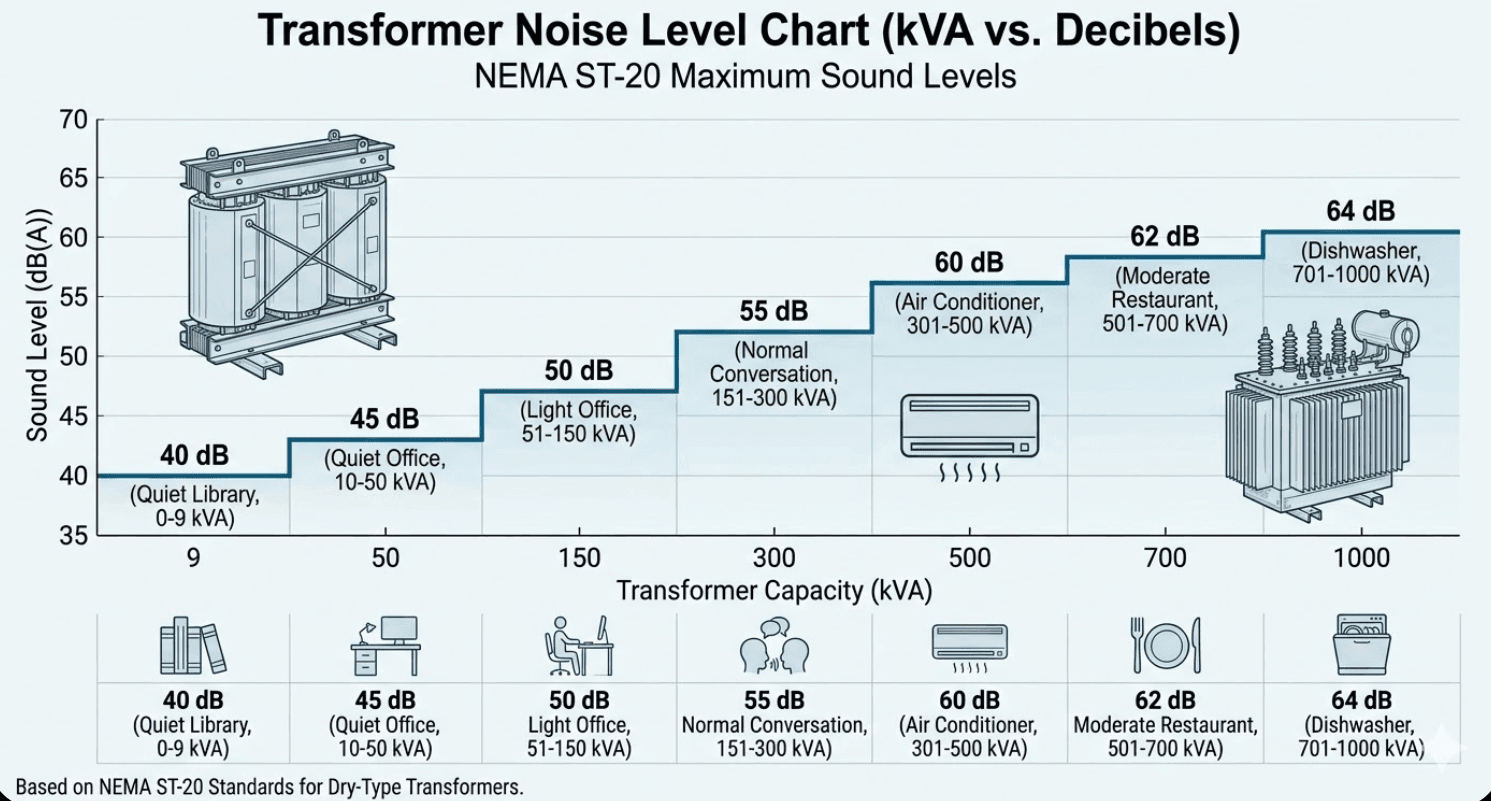
NEMA ST-20 Transformer Noise Level Chart by kVA
The National Electrical Manufacturers Association (NEMA) publishes Standard ST-20, which sets the maximum allowable sound levels for distribution transformers based on rated kVA. This is the primary reference used in North America for dry-type transformer noise specifications.
| Rated kVA | NEMA ST-20 Max Sound Level | Real-World Comparison |
|---|---|---|
| 0 – 9 kVA | 40 dB | Quiet library, soft background music |
| 10 – 50 kVA | 45 dB | Quiet office, refrigerator hum |
| 51 – 150 kVA | 50 dB | Light office activity, moderate rain |
| 151 – 300 kVA | 55 dB | Normal conversation at 1 m distance |
| 301 – 500 kVA | 60 dB | Air conditioner unit, busy office |
| 501 – 700 kVA | 62 dB | Moderate restaurant background noise |
| 701 – 1000 kVA | 64 dB | Shower, dishwasher running |
For large power transformers above 1000 kVA, refer to IEEE C57.12.01, which extends the noise limit tables to 10,000 kVA and higher. The European standard IEC 60076-10 uses equivalent methodology but measures sound power level (Lw) rather than sound pressure level (Lp).
What Causes Transformer Noise?
All transformers make noise. Understanding the mechanism tells you whether the sound you are hearing is normal or a warning sign.
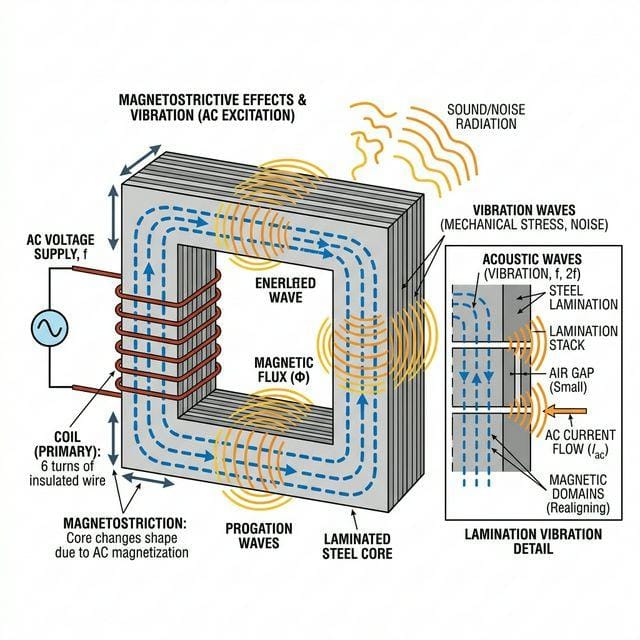
Magnetostriction: The Primary Source
Magnetostriction accounts for 80–90% of audible transformer noise under normal operating conditions. When alternating current flows through the windings, the magnetic field causes the steel core (silicon steel laminations) to physically expand and contract in sync with the changing field. The dimensional change happens twice per electrical cycle:
- 60 Hz supply (North America): core vibrates at 120 Hz — the fundamental frequency of transformer hum
- 50 Hz supply (Europe, Asia): core vibrates at 100 Hz
These are pure tones, which human ears find particularly intrusive compared to broadband noise of the same energy. The sound also contains harmonics at 240 Hz, 360 Hz, and above — which is why transformer hum has that characteristic layered quality rather than a simple single note. For the underlying physics, the Wikipedia article on magnetostriction provides a solid technical reference.
Two Additional Noise Sources
Beyond magnetostriction, two other physical mechanisms contribute to core transformer sound:
- Lorentz Force Acoustic Signal (LFAS): Eddy currents within adjacent lamination layers create magnetic forces between the sheets, causing them to vibrate against each other. This is especially pronounced in EI-type cores, where lamination pieces are only clamped at the corners and can move independently.
- Winding vibration: Load current flowing through the conductors generates Lorentz forces that cause the winding to vibrate at twice the supply frequency. This typically contributes 10–20% of total noise and becomes more noticeable at loads above 70% of rated capacity.
Hum vs. Buzz — They Have Different Causes
A hum is a smooth, continuous low-frequency sound originating in the steel core via magnetostriction. A buzz is a more mechanical, rattling sound caused by the core vibrating against the chassis, mounting hardware, or enclosure panels. Buzzing is usually an installation or mounting problem, not a transformer defect — and it is much easier to fix.
How Transformer Type Affects Sound Levels
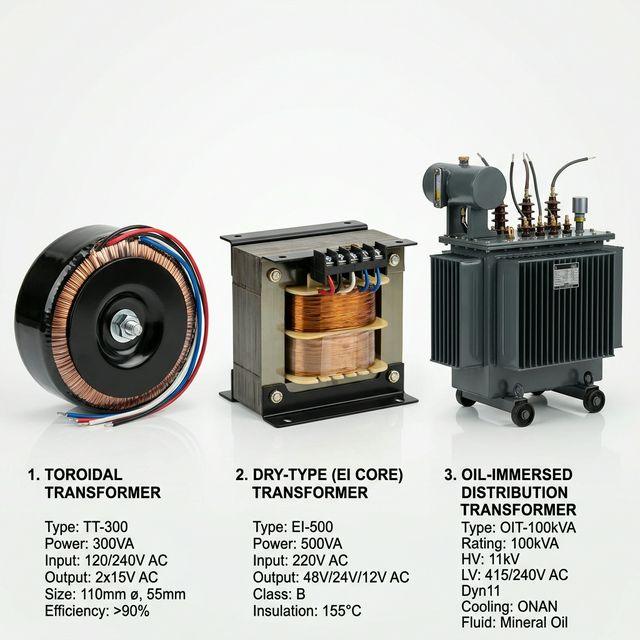
The NEMA chart above applies primarily to dry type transformers. Different construction types produce meaningfully different acoustic profiles at the same kVA rating.
| Transformer Type | Relative Noise Level | Why | Best For |
|---|---|---|---|
| Toroidal | Lowest (3–10 dB quieter than EI) | Continuous ring core — no 90° joints, no corner gaps. Winding tension clamps the core uniformly everywhere, suppressing LFAS vibration. | Audio equipment, medical devices, any noise-sensitive application |
| Oil-immersed | Moderate (3–5 dB quieter than dry type at same kVA) | Insulating oil surrounds and damps core/winding vibrations before they radiate as sound. | Outdoor substations, large industrial loads, situations where noise is less critical |
| Dry type (EI core) | Highest of the three | No oil damping; EI lamination pieces clamped only at corners allow more movement. Air cooling provides no acoustic isolation. | Indoor buildings, data centers, fire-sensitive areas — where safety outweighs acoustic requirements |
What Makes a Transformer Louder Than Normal?
If a transformer is running noticeably louder than when it was first installed, or louder than the NEMA limit for its kVA class, one of these causes is usually responsible:
- Core saturation from overvoltage or overload: Magnetostriction increases dramatically as the steel core approaches saturation. Even a 5–10% overvoltage can push the core into the nonlinear region and significantly increase noise. This is the most common cause of a transformer that was once quiet suddenly getting louder.
- Loose laminations: Continuous vibration and thermal cycling cause the clamping bolts to loosen over time. Individual lamination sheets then rattle against each other (LFAS), producing a sharp buzzing or rattling noise on top of the normal hum.
- Harmonic-rich loads: Variable frequency drives, rectifiers, and switch-mode power supplies inject harmonic currents back into the supply. Total harmonic distortion (THD) exceeding 5% can increase transformer noise by 5–10 dB above the rating measured under clean sinusoidal conditions.
- Resonant mounting: If the transformer is bolted directly to a steel frame, cabinet, or building floor without vibration isolation, the structure acts as a sounding board and amplifies the core vibration into a much louder audible buzz.
How to Reduce Transformer Noise
Since magnetostriction cannot be eliminated — it is a fundamental property of ferromagnetic steel cores — noise reduction focuses on managing how that vibration is transmitted and amplified. Here are the methods we use, from simplest to most involved:
1. Rubber Isolation Mounts
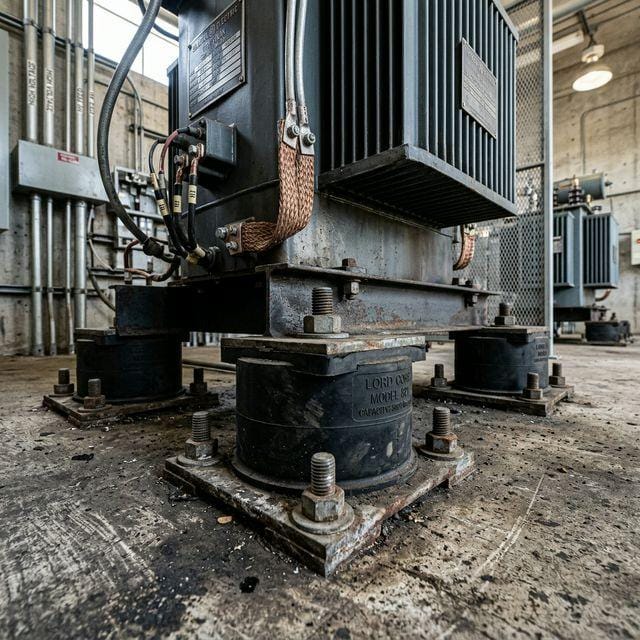
The single most cost-effective fix for buzzing from a rigidly mounted transformer. Install rubber anti-vibration pads between the transformer base and the mounting surface. For threaded fasteners, use sealing washers (metal washer with rubber backing) to prevent vibration transmission through the bolts. Always maintain a ground connection via a separate grounding wire when using rubber isolation mounts.
2. Vacuum Pressure Impregnation (VPI)
In VPI processing, the wound transformer is placed in a vacuum chamber and impregnated with varnish under vacuum and pressure. The varnish fills any air gaps between winding turns, bonding the conductors into a rigid unit. This significantly reduces winding vibration and the buzz it causes when the transformer is loaded. VPI is standard on our commercial-grade dry-type units.
3. Step-Lap Core Construction
Conventional EI core joints concentrate the magnetic flux transition at a single gap plane, creating a localized vibration hot spot. Step-lap construction staggers the joints across multiple lamination layers, distributing the flux transition and reducing localized vibration. Field measurements show step-lap cores achieve 3–6 dB lower noise versus conventional mitered joints at the same flux density.
4. Reduce Operating Flux Density
Specifying a transformer with a larger core cross-section allows the same kVA to be handled at lower flux density. Reducing flux density from 1.7 T to 1.5 T can decrease core noise by 4–6 dB. The trade-off is increased core material cost and physical size — typically 8–15% more. For noise-critical installations, this is often worth it.
5. Correct Sizing and Loading
Transformers run noisiest when significantly underloaded. A 500 kVA unit supplying only 50 kVA of load is operating at very low flux density, which seems counterintuitive — but at very low flux, the core operates in a regime where magnetostriction is less predictable. Match transformer capacity to actual load. As the unit heats up to normal operating temperature under its designed load, the hum typically settles and decreases slightly from the cold-start level.
Frequently Asked Questions
What is a normal transformer noise level?
A normal transformer noise level falls at or below the NEMA ST-20 limit for that kVA rating — 40 dB for units under 9 kVA, up to 64 dB for 701–1000 kVA units. A steady, consistent hum within these limits is completely normal and does not indicate a fault. Well-designed units typically run 2–5 dB below the NEMA ceiling.
Why does my transformer hum louder at night?
At night, total electrical load across the grid drops, which often causes supply voltage to rise slightly above nominal. Higher voltage increases the magnetic flux density in the steel core, which amplifies magnetostriction and raises the audible hum level. Simultaneously, ambient background noise is lower at night, so the same transformer sound appears louder by comparison. If the increase is moderate and consistent, it is usually not a cause for concern — but if it is dramatic, check the incoming voltage.
Is a dry type transformer louder than an oil-filled transformer?
Yes. Dry type transformers are generally 3–5 dB louder than oil-filled units of the same kVA rating. The insulating oil in oil-filled units acts as a vibration damper, absorbing core and winding vibrations before they radiate as audible sound. Dry type units have no such damping medium, so vibrations transmit more directly to the tank surface and surrounding air.
What dB level is too loud for a transformer?
Any level consistently above the NEMA ST-20 limit for that kVA class warrants investigation. A sudden increase of 5 dB or more above the unit’s established baseline also signals a developing problem — typically loose laminations, core saturation, or winding deterioration. For noise-sensitive environments (hospitals, recording studios, residential buildings), even NEMA-compliant levels may require additional isolation. Residential outdoor regulations typically cap transformer noise at 45–55 dB at the property boundary.
How do I measure transformer noise?
Use a calibrated sound level meter set to A-weighting (dB(A)). Per IEC 60076-10, the formal method takes measurements at 0.3 m from the transformer surface at multiple points around the perimeter, then averages them. For a practical field check, measure at 1 m from the surface — this gives a useful approximation and is easier to compare across installations. Always record the load level at the time of measurement, as winding noise increases with load.
Need a low-noise transformer for a sensitive installation?
At Transformer4U, we manufacture toroidal, dry-type, and oil-immersed transformers with full factory noise test documentation. Tell us your kVA requirement, installation environment, and noise target — we will specify the right unit and confirm it meets spec before shipment. Request a quote →
Key Takeaways
Use the NEMA chart to establish your baseline, verify that your transformer type and installation match the noise target, and apply the right mitigation if the numbers are out of range.
- NEMA ST-20 defines maximum transformer sound levels by kVA: 40 dB (≤9 kVA) to 64 dB (701–1000 kVA).
- The primary cause of transformer noise is magnetostriction in the silicon steel core, producing vibration at 120 Hz (60 Hz systems) or 100 Hz (50 Hz systems).
- Dry type transformers are noisier than oil-filled units; toroidal transformers are the quietest option.
- Noise above normal levels usually indicates overvoltage, core saturation, loose laminations, harmonic loads, or resonant mounting.
- Rubber isolation mounts, VPI processing, step-lap core construction, and reduced flux density all reduce operational noise.
- Always verify transformer noise at operating load and temperature — not just at no-load.
Related articles:
- Dry-Type Transformer: Complete Selection Guide
- Toroidal Transformer: Why It’s Quieter Than EI Core
- Oil-Immersed Transformer: Construction and Applications
- Transformer Efficiency: How to Calculate Core and Copper Losses
- Transformer Sizing Guide: How to Choose the Right kVA Rating
About the author: Tan is a transformer engineer at Transformer4U, a manufacturer of toroidal, EI, dry-type, and oil-immersed transformers. He has spent over a decade on the production floor testing and troubleshooting transformer designs for industrial and commercial applications worldwide.