
🔍 Quick Answer
Breakdown Voltage (BDV) measures transformer oil’s ability to withstand electrical
stress. Low BDV indicates contamination and increases failure risk.
- Good BDV (D1816, 2mm gap): >40 kV — oil in healthy condition
- Investigate: 30-40 kV — check for moisture/contamination
- Take Action:
<30 kV — treatment required immediately
Primary Cause: Moisture. Even 20-30 ppm water can reduce BDV by >20%; 50+ ppm can halve
dielectric strength.
Solution: Vacuum dehydration + degassing can restore BDV from <10 kV to>50 kV.
What is Transformer Oil BDV?
Breakdown Voltage (BDV), also called dielectric strength, is the voltage at which
transformer oil fails electrically—where a spark bridges between two electrodes through the oil. It’s a
critical indicator of the oil’s insulating capability.
Why BDV Matters
- Prevents Internal Flashover: High BDV ensures oil can insulate windings, bushings,
and tap changers under normal and transient voltage stress - Early Warning: Declining BDV often indicates moisture ingress, contamination, or
oil degradation before failure occurs - Asset Life: Maintaining adequate BDV protects insulation and extends transformer
lifespan
reduce BDV by >20%, and at 50+ ppm, dielectric strength can drop to less than half its initial
value—invisible to the naked eye but measurable through proper testing.
BDV Testing Standards: ASTM D877 vs D1816
Two primary ASTM standards govern BDV testing, with important differences:
| Feature | ASTM D877 | ASTM D1816 |
|---|---|---|
| Electrode Type | Flat disc electrodes | Spherical (VDE/mushroom) electrodes |
| Electrode Gap | 2.54 mm (0.1 inch) | 1 mm or 2 mm (most common: 2 mm) |
| Electric Field | Non-uniform | More uniform |
| Sensitivity | Good for fibrous particles | Better for moisture & dissolved contaminants |
| Recommended Use | New oil acceptance | In-service oil evaluation (per IEEE C57.106) |
| Voltage Rise Rate | 3 kV/s | 0.5 kV/s (500 V/s) |
its lower sensitivity to moisture—the primary contaminant in operating transformers. Use D1816 for
routine condition assessment.

Comparison of D877 flat disc electrodes vs D1816 spherical electrodes
BDV Acceptance Limits by Application
For New Oil (ASTM D1816, 2mm gap)
| Application | Minimum BDV (kV) |
|---|---|
| Oil as received from supplier | ≥35 kV |
| Oil in new equipment ≤69 kV (before energizing) | ≥45 kV |
| Oil in new equipment >69 kV to <230 kV | ≥52 kV |
| Oil processed for equipment ≥230 kV to <345 kV | ≥55 kV |
| Oil processed for equipment ≥345 kV | ≥60 kV |
For In-Service Oil (ASTM D1816, 2mm gap)
maintain in-service BDV >45-50 kV to provide adequate safety margin. The limits above are general
guidelines—always consult manufacturer specifications and utility standards.
5 Causes of Low Transformer Oil BDV
1. Moisture Contamination (Most Critical)
Water is the single most impactful factor on BDV. Sources include:
- Breather malfunction or saturation
- Gasket/seal degradation
- Improper oil handling during maintenance
- Cellulose insulation releasing moisture under load cycling
- Condensation in conservator tank
Impact: At 10-50 ppm moisture, BDV can decrease by 40%; above 50 ppm, dielectric
strength may fall to less than half of original value.
2. Solid Particle Contamination
Particles create conductive paths and concentrate electric field stress:
- Carbon from arcing or partial discharge
- Cellulose fibers from paper degradation
- Sludge from oil oxidation
- Metal particles from wear or corrosion
- Dust ingress during maintenance
3. Dissolved Gases
Air (especially oxygen) and fault gases reduce dielectric strength:
- Air entrainment during filling or maintenance
- Breathing action in non-sealed transformers
- Fault gases from internal defects
4. Oil Oxidation & Aging
Over time, oil degrades forming acidic compounds and sludge:
- High operating temperature accelerates oxidation
- Copper and iron act as catalysts
- Acids attack cellulose insulation and reduce oil resistivity
5. Conducting Impurities
Polar compounds and ionic contaminants reduce insulation resistance:
- Dissolved metals from corrosion
- Soap-like compounds from oil-gasket interaction
- Cross-contamination from other oil types
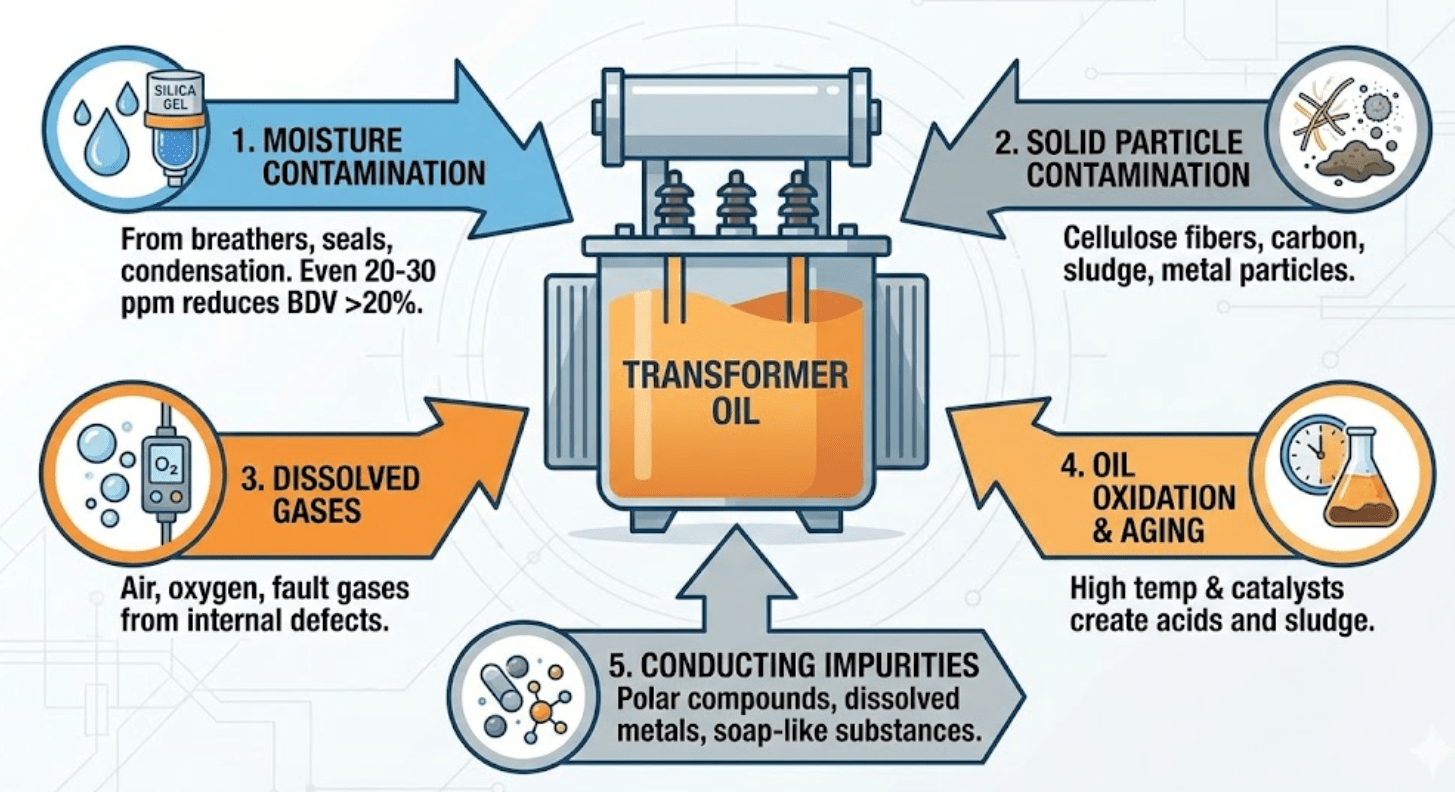
Diagram showing the 5 main causes of low transformer oil BDV
BDV Testing Procedure
Standard Test Sequence (per ASTM)
- Sample Collection: Use clean, dry glass or stainless steel containers. Avoid
plastic. Fill completely to minimize air contact. - Equipment Setup: Clean electrodes thoroughly; verify gap setting (2.54mm for D877,
1mm or 2mm for D1816). - Test Execution: Apply voltage at specified rate (2-3 kV/s) until breakdown occurs.
Record breakdown voltage. - Repeat: Allow 1-minute settling, stir gently, repeat. Perform 5-6 breakdowns.
- Calculate Average: Discard first breakdown, average remaining values.
📋 Sampling Best Practices
- Sample from bottom drain valve after flushing 1-2 liters
- Avoid sampling immediately after oil treatment—wait for settling
- Record oil and ambient temperature at sampling
- Transport samples upright, protected from light and temperature extremes
- Test within 24-48 hours of sampling for best accuracy
the test sequence and calculate averages. Regular calibration against laboratory standards is essential.
Treatment Methods to Restore BDV
1. Vacuum Dehydration
The most effective method for moisture removal. Oil is heated (60-70°C) and exposed to vacuum (< 1 mbar)
to evaporate water.
| Parameter | Typical Specification |
|---|---|
| Operating Temperature | 60-70°C |
| Vacuum Level | < 1 mbar (0.75 mmHg) |
| BDV Improvement | From <10 kV to>50 kV in single cycle |
| Moisture Reduction | Can achieve < 5 ppm |
2. Degassing
Removes dissolved gases including air, which can contain up to 12% dissolved in saturated oil.
- Vacuum degassers use thin-film spreading over Raschig rings or spray nozzles
- Can reduce dissolved air from 12% to <0.25% in single pass
- Removes oxygen to slow oxidation rate
3. Filtration
Removes solid particles through multi-stage filter systems:
- Coarse filters: 25-50 micron — removes large debris
- Fine filters: 1-5 micron — removes small particles
- Edge/depth filters: Sub-micron filtration
4. Centrifugal Separation
Uses centrifugal force to separate water and particles by density difference. Effective for free
water and larger particles; often combined with vacuum treatment for dissolved moisture.
5. Fuller’s Earth Reclamation (for severely degraded oil)
When oil has high acidity or oxidation products, fuller’s earth (activated clay) absorbs polar
contaminants. This process:
- Removes acids and sludge precursors
- Restores interfacial tension (IFT)
- Reduces tan delta (dissipation factor)
oil replacement and can be performed with the transformer in service or de-energized.
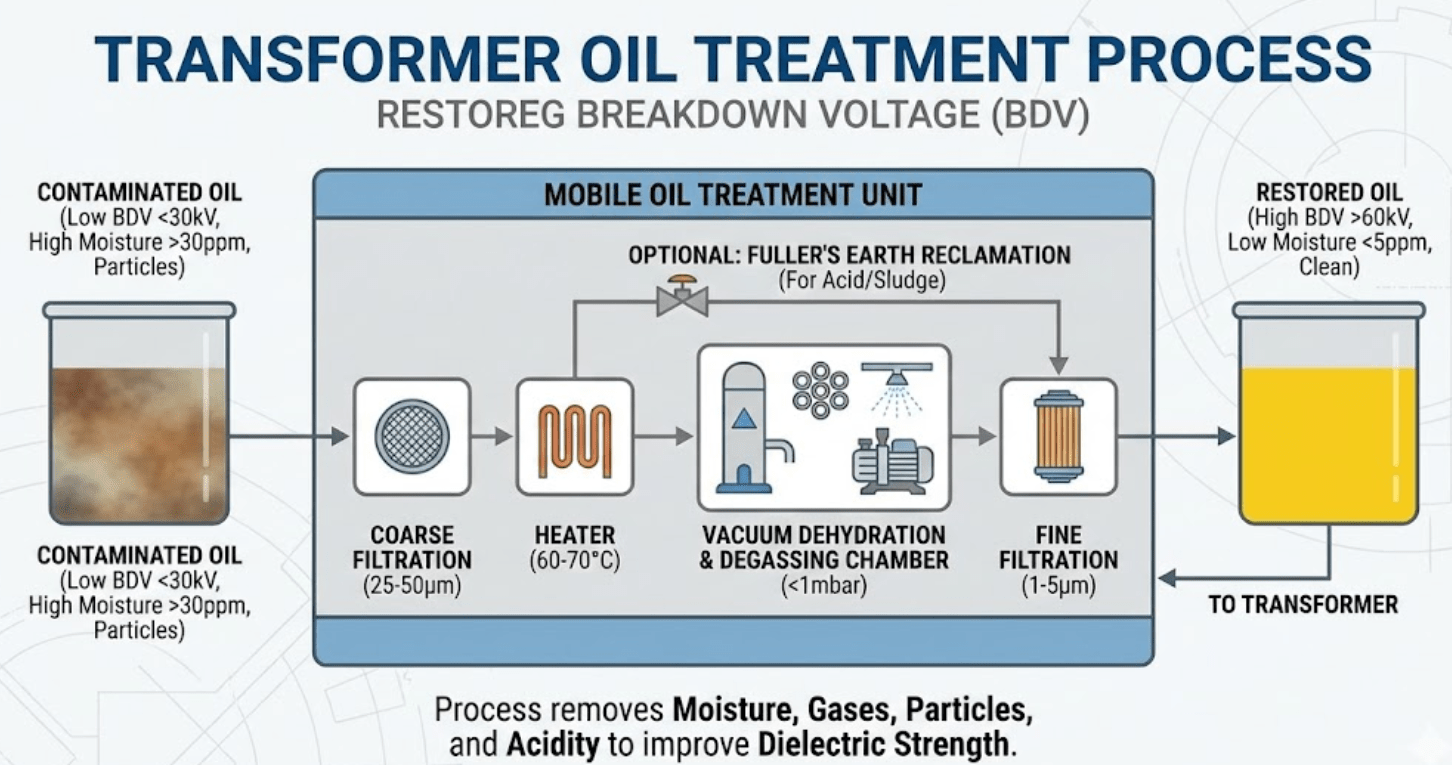
Flowchart showing oil treatment process from contaminated to restored condition
Prevention Strategies
- Breather Maintenance: Use silica gel breathers; replace or regenerate when
saturated (color change from blue to pink) - Gasket Integrity: Inspect seals during maintenance; replace aged or damaged gaskets
with compatible materials (NBR recommended for mineral oil) - Oil Level: Maintain proper oil level to minimize headspace air exposure
- Conservator Design: Consider rubber bladder/diaphragm conservators to isolate oil
from atmosphere - Handling Procedures: Use clean, dry equipment for oil sampling and handling; flush
lines before transfer - Regular Testing: Establish BDV testing schedule based on transformer criticality
| Transformer Category | Recommended BDV Test Frequency |
|---|---|
| Critical (>100 MVA or >138 kV) | Annually or semi-annually |
| Important (25-100 MVA) | Annually |
| Standard Distribution | Every 1-3 years |
| After oil work or suspected contamination | Immediately after event |
Frequently Asked Questions
Can BDV test alone determine oil condition?
No. BDV is one indicator—primarily sensitive to moisture and particles. A comprehensive assessment
requires additional tests: Dissolved Gas Analysis (DGA) for internal faults, acidity (neutralization
number) for oxidation, interfacial tension (IFT) for polar contamination, and moisture content
measurement (ppm). Use BDV as a screening test, not the sole criterion.
Why is my BDV good but DGA shows problems?
BDV and DGA measure different aspects of oil/transformer condition. Good BDV means the oil can still
insulate, but DGA gases (like acetylene, ethylene, hydrogen) indicate internal electrical or thermal
faults. The fault might be generating gases but hasn’t yet contaminated the oil enough to lower BDV.
Both tests are essential for complete assessment.
How long does oil treatment take?
Treatment time depends on oil volume and contamination level. A 50,000-liter transformer might
require 8-24 hours of vacuum dehydration for moisture removal. Higher contamination levels or larger
volumes require longer treatment. Some mobile treatment units can process 2,000-5,000 liters per
hour.
Is it better to treat or replace degraded oil?
Generally, treatment is more cost-effective if the oil is not severely oxidized (acidity <0.3 mg KOH/g, IFT>20 mN/m). Treatment costs are typically 20-30% of replacement. However, if the oil is
heavily oxidized with high acidity and low IFT, or contaminated with PCBs, replacement is
recommended. Fuller’s earth reclamation can restore moderately oxidized oil.
Can BDV be tested in-service?
Yes, sampling can be done on energized transformers via the bottom drain valve or sampling port.
However, treatment typically requires de-energization for hot oil circulation, or is done on-line
using bypass filtration equipment. Online treatment takes longer but avoids outage costs.
Conclusion
Transformer oil BDV is a critical indicator of insulating capability. Low BDV, primarily caused by
moisture contamination, significantly increases the risk of internal flashover and transformer failure.
Key takeaways:
- Use ASTM D1816 for in-service oil evaluation—more sensitive to moisture than D877
- Maintain BDV >40 kV (2mm gap) for reliable operation; investigate <30 kV
immediately - Vacuum dehydration is the most effective treatment—can restore BDV from <10 kV to>
50 kV - Combine BDV with DGA and other tests for comprehensive oil condition assessment
Our team provides on-site BDV testing, oil sampling, and mobile treatment services.Request Oil Testing Service
References