
Comprehensive guide to transformer protection methods for preventing failures and equipment damage

Transformer protection refers to systems and devices designed to detect internal faults and abnormal
operating conditions in transformers. Since transformers are among the most expensive and critical components in
power systems, proper protection is essential to prevent costly damage and ensure reliable operation.
This complete guide covers transformer protection types, protective relays, fault detection methods, and selection
criteria for protection schemes.
circuit, internal faults) and initiate protective actions (alarm, trip) to minimize damage to the transformer and
connected equipment.
Why Transformer Protection is Important
Transformer failure can have severe consequences:
| Impact | Consequence |
|---|---|
| Financial Loss | High repair/replacement costs (power transformers cost millions) |
| Extended Downtime | Lead time for replacement can be 6-18 months |
| Safety Hazards | Potential for fire, explosion, oil spills |
| Collateral Damage | Failure can damage nearby equipment and infrastructure |
| System Instability | Loss of critical transformer affects entire network |
Common Causes of Transformer Failure
Internal Faults
| Fault Type | Cause | Frequency |
|---|---|---|
| Winding Faults | Insulation breakdown, turn-to-turn short circuit | ~51% |
| Tap Changer Failure | Mechanical wear, contact degradation | ~19% |
| Bushing Failure | Contamination, aging, moisture ingress | ~9% |
| Transformer Core Faults | Shorted laminations, core insulation failure | ~2% |
| Miscellaneous | CT problems, oil leakage, contamination | ~13% |
External Faults
- Overloads: Excessive current beyond rated capacity
- External Short Circuits: Faults on connected lines or equipment
- Overvoltage: Switching surges, lightning strikes
- Over-fluxing: Excessive magnetic flux density in core
Types of Transformer Protection
Transformer protection schemes include both electrical and mechanical protection devices:
1. Overcurrent Protection
Protects against overloads and external short circuit faults:
| Device | Function |
|---|---|
| Fuses | Simple overcurrent protection for distribution transformers |
| Circuit Breakers | Interrupts fault current when tripped by protective relay |
| Overcurrent Relay (50/51) | IDMT or definite time relay, trips breaker on overcurrent |
| Setting | Typically 150-300% of rated current |
2. Differential Protection (87)
The most sensitive protection for internal transformer faults:
- Compares current entering and leaving transformer
- If difference exceeds threshold, internal fault is indicated
- Uses biased differential relay to account for tap changer operation
- High sensitivity for winding faults
- Fast operation (1-2 cycles)
and accuracy must be carefully selected.
3. Buchholz Relay (Gas Detection)
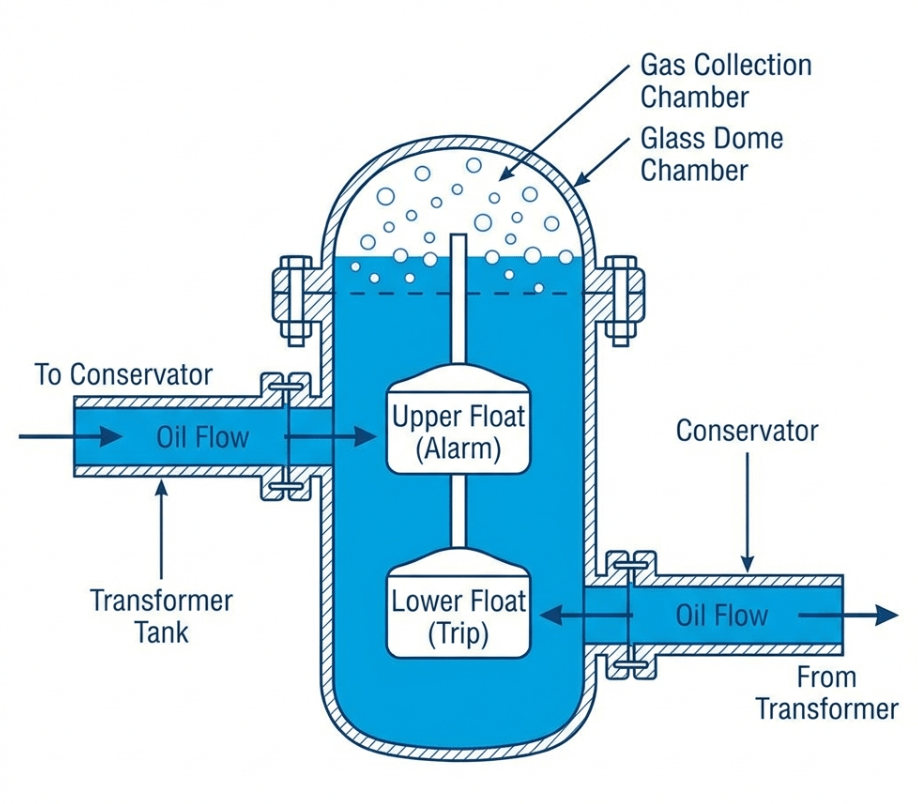
A Buchholz relay is a gas-actuated relay installed between the transformer tank and conservator. It
provides excellent protection for internal faults:
| Element | Function | Action |
|---|---|---|
| Upper Float (1st Stage) | Collects gas from minor faults | Alarm when 300-500ml gas accumulated |
| Lower Float (2nd Stage) | Detects rapid oil flow from severe fault | Trip at oil velocity >100cm/s |
How Buchholz relay works:
- Internal fault generates heat, decomposing oil into gases
- Gas bubbles rise and collect in the Buchholz relay chamber
- Accumulated gas displaces oil, causing upper float to drop (alarm)
- Severe fault causes rapid oil surge, tilting lower float (trip)
4. Overheating Protection
Thermal protection prevents insulation damage from excessive temperature:
| Measurement | Typical Setting | Action |
|---|---|---|
| Top Oil Temperature | 85-95°C | Alarm |
| Top Oil Temperature | 105°C | Trip |
| Winding Hot Spot | 120-140°C | Alarm/Trip |
Fiber-optic sensors can directly measure temperature in the transformer core and windings for critical applications.
5. Over-Fluxing Protection (24)
Protects against excessive magnetic flux density in the transformer core:
- Monitors V/Hz (volts per hertz) ratio
- Trips when flux exceeds safe limits
- Critical during generator startup/shutdown
- Over-fluxing causes core saturation and overheating
6. Pressure Relief Protection
Prevents transformer tank rupture during severe internal faults:
- Pressure Relief Device (PRD): Spring-loaded valve vents oil at excessive pressure
- Sudden Pressure Relay: Detects rapid pressure rise (0.5-0.6 kg/cm²/s), faster than Buchholz
7. Restricted Earth Fault Protection (REF/64)
Provides sensitive earth fault protection within transformer zone:
- Detects ground faults in winding with low fault current
- Complements differential protection for single phase-to-ground faults
- Typical setting: 5-10% of rated current
Complete Transformer Protection Scheme
| ANSI Code | Protection | Type | Application |
|---|---|---|---|
| 87 | Differential | Electrical | Internal winding faults |
| 50/51 | Overcurrent | Electrical | External faults, backup |
| 51N/67N | Earth Fault | Electrical | Ground faults |
| 64REF | Restricted Earth Fault | Electrical | Sensitive ground fault |
| 24 | Over-Fluxing (V/Hz) | Electrical | Core overexcitation |
| 49 | Thermal Overload | Electrical | Overheating |
| 63 | Buchholz/Gas Pressure | Mechanical | Internal faults, gas |
| 26 | Winding Temperature | Mechanical | Overheating |
| 71 | Oil Level | Mechanical | Oil loss |
Protection Selection Guidelines
| Transformer Rating | Minimum Protection | Full Protection |
|---|---|---|
| <500 kVA | Fuses, thermal relay | + Overcurrent relay |
| 500 kVA – 5 MVA | Overcurrent, Buchholz (oil type) | + Differential |
| >5 MVA | Differential, Buchholz, overcurrent | + REF, V/Hz, temperature |
| Critical/Generator | Full protection suite | + Redundant relays |
Lightning and Surge Protection
External overvoltages from lightning strikes and switching operations can damage transformer insulation:
| Protection Device | Function | Application |
|---|---|---|
| Surge Arresters | Clamp overvoltage to safe levels | All outdoor transformers |
| Lightning Arresters | Divert lightning current to ground | Exposed installations |
| Spark Gaps | Basic voltage limiting (older systems) | Backup protection |
| Rod Gaps | Arcing gaps on bushings | Extreme overvoltage |
Fire Protection
Oil-filled transformers contain large quantities of flammable insulating oil. Fire protection measures include:
- Fire Walls: Physical barriers between transformers
- Containment Basins: Oil spill containment, sized for full tank volume
- Deluge Systems: Water spray to cool transformer if fire detected
- Nitrogen Injection: Inert gas injection to suppress fire in enclosed spaces
- Safe Spacing: Minimum distance from buildings and other transformers
For indoor installations, less-flammable fluids (natural ester FR3, silicone) are often required to reduce fire risk.
Additional Protective Accessories
Silica Gel Breather
Silica gel breathers protect transformer oil from moisture contamination:
- Absorbs moisture from air entering conservator during breathing
- Blue silica gel turns pink when saturated – indicates replacement needed
- Oil cup traps dust particles before air enters transformer tank
- Critical for maintaining oil dielectric strength
Oil Level Gauge
Monitors oil level in transformer tank to detect leaks:
- Magnetic level indicator on tank side
- Low oil alarm and trip contacts
- Temperature compensated for accurate readings
Winding Temperature Indicator
Calculates winding hot spot temperature from:
- Top oil temperature measurement
- Current-dependent thermal model
- Operating time at various loads
This indicator triggers cooling fan stages and overload alarms to prevent transformer failure from overheating.
- Buchholz Gas Analysis: When Buchholz relay alarms, collect the gas for analysis.
Combustible gas indicates internal fault; air indicates external leak. This determines whether to continue
operation or trip immediately. - Differential CT Matching: Mismatched CT ratios cause nuisance tripping. Use interposing CTs
or relay tap settings to balance currents. Test thoroughly during commissioning. - Inrush Current Blocking: Differential relays must have harmonic restraint (2nd harmonic
blocking) to prevent false trips during transformer energization. Inrush current can reach 8-12x rated. - Coordination: Ensure backup overcurrent protection coordinates with downstream devices but
trips before transformer damage occurs. Use time-current curves for verification.
Frequently Asked Questions
What is transformer protection?
Transformer protection refers to systems and devices that detect abnormal conditions in transformers
(such as internal faults, overheating, or short circuit) and take protective action (alarm or trip) to prevent
damage to the transformer and connected equipment.
What is a Buchholz relay and how does it work?
A Buchholz relay is a gas-actuated protective device installed between the transformer tank and
conservator. It detects gases produced by internal faults. Gas accumulation triggers an alarm; rapid oil surge from
severe faults triggers a trip. It is used on oil-filled transformers above 500 kVA.
What is differential protection in transformers?
Differential protection compares current entering and leaving the transformer. Under normal conditions, these
currents balance. If the difference exceeds a threshold, it indicates an internal fault, and the relay trips the
circuit breaker. It is the most sensitive protection for internal winding faults.
Why is overcurrent protection needed for transformers?
Overcurrent protection defends against overloads and external short circuit faults. When fault current exceeds the
relay setting, the protection trips the circuit breaker to prevent overheating and insulation damage. It also serves
as backup protection for downstream faults.
How do you select transformer protection?
Protection selection depends on transformer rating, criticality, and application. Small distribution transformers may
only need fuses. Large power transformers require comprehensive protection including differential, Buchholz,
overcurrent, earth fault, and temperature monitoring.
Related Articles
- Transformer
Cooling System: Complete Guide - Transformer Oil:
Complete Guide - What is a Transformer? Complete
Guide - Three
Phase Transformer: Complete Guide
References
- AX Control – 7 Common Types of Transformer Protection Systems
- Wikipedia – Transformer
- SlideShare – Power Transformer Protection
Disclaimer: This information is provided for educational purposes. Always follow applicable standards (IEEE, IEC)
and manufacturer guidelines when designing transformer protection systems.