
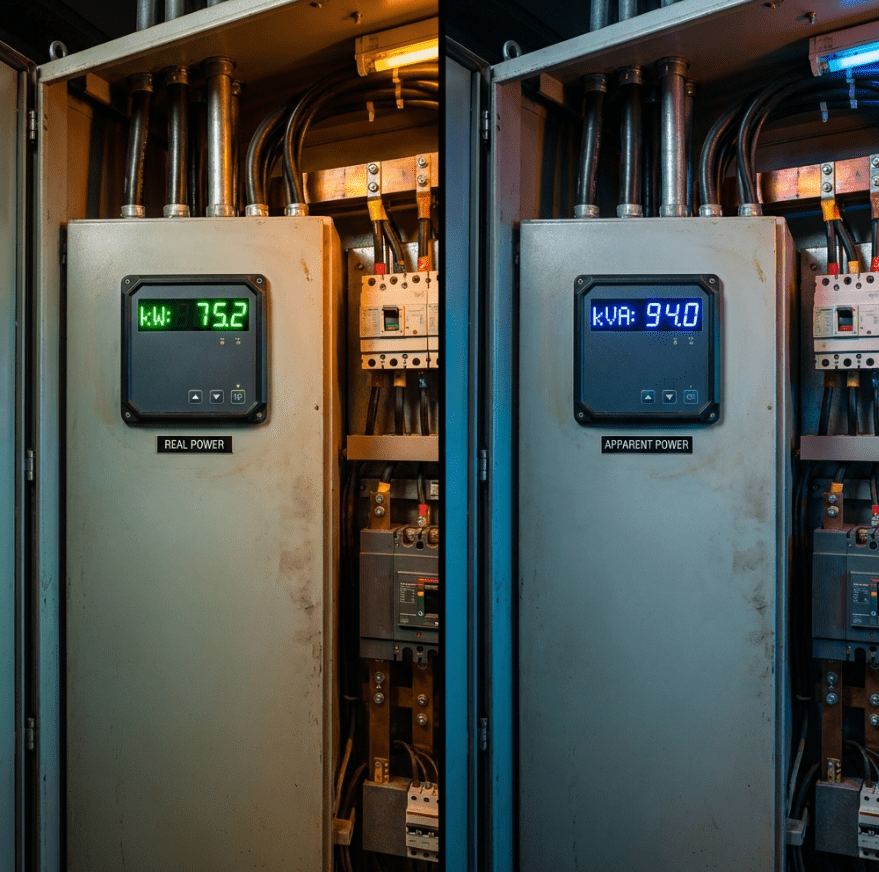
In my 15 years installing generators and transformers at Transformer4U,
I’ve seen this confusion cost facilities tens of thousands of dollars:
Last month, a warehouse ordered a “100 kW generator” for their 95 kW load. Sounds perfect with 5% overhead, right?
Wrong. Their equipment had a power factor of 0.78, requiring 122 kVA. The 100 kVA
generator (80 kW at 0.8 PF) they received couldn’t even handle 82% of their load. They had to rent a second
generator while waiting for a 150 kVA replacement.
The confusion? They thought kW and kVA were the same thing.
⚡ Quick Answer:
- kW (Kilowatt) = Real Power = Power doing actual work (running motors,
heating, lighting) - kVA (Kilovolt-Ampere) = Apparent Power = Total power supplied (includes
wasted reactive power) - Relationship: kW = kVA × Power Factor
Why it matters: Equipment is sized by
kVA, not kW. A “50 kW generator” is actually a 62.5 kVA generator (at 0.8 PF).
The Core Difference: Real Power vs Apparent Power
What is kW (Kilowatt)?
kW measures real power—the portion of electrical power that performs actual work.
Real power (kW) is what:
- Turns motor shafts
- Heats elements
- Lights up bulbs
- Runs computers
- Pumps water
Think of kW as the useful energy that you pay for on your electricity bill.
What is kVA (Kilovolt-Ampere)?
kVA measures apparent power—the total power that must be supplied to the electrical
system, including both useful power and wasted reactive power.
Apparent power (kVA) is:
- The capacity your generator or transformer must provide
- Always equal to or greater than kW
- What electrical supply equipment is rated for
- The combination of real power (kW) + reactive power (kVAR)
The Beer Analogy (Made Famous in the UK)
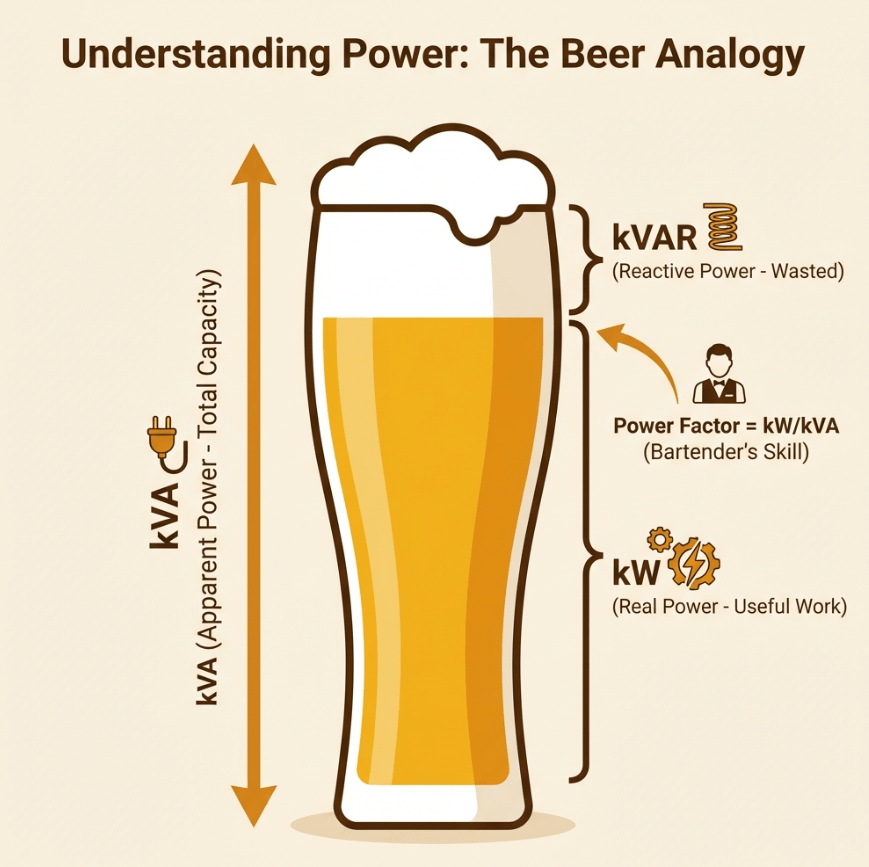
Here’s the classic explanation that’s helped thousands understand this concept:
Imagine a pint of beer:
- The entire pint glass (liquid + foam) = kVA (apparent power)
- Just the liquid beer = kW (real power doing useful work)
- The foam on top = kVAR (reactive power—wasteful but necessary)
- The bartender’s skill = Power Factor (efficiency)
A better bartender (higher power factor) gives you more beer (kW) and less foam (kVAR) in the same sized glass (kVA).
based on kW alone. Their 200 kW of servers had modern power supplies (PF 0.95), requiring 211 kVA—they were fine.
But when they added legacy equipment (PF 0.75), their actual need jumped to 267 kVA, overloading their 250 kVA UPS
by 17%. The UPS shut down during a power outage, costing them $180,000 in lost uptime.
kW vs kVA: Side-by-Side Comparison
| Feature | kW (Kilowatt) | kVA (Kilovolt-Ampere) |
|---|---|---|
| Measures | Real Power (actual work) | Apparent Power (total supply) |
| Also Called | Active Power, Working Power | Apparent Power, Total Power |
| Used For | Calculating energy costs, actual load | Sizing generators, transformers, cables |
| On Utility Bill | ✅ Yes (kWh = kilowatt-hours) | ❌ No (but may affect demand charges) |
| Equipment Rating | Motors, heaters, appliances | Generators, transformers, UPS |
| In DC Circuits | kW = kVA (100% efficient) | kVA = kW (no reactive power) |
| In AC Circuits | kW < kVA (due to PF < 1) | kVA > kW (includes kVAR) |
| Value | Always ≤ kVA | Always ≥ kW |
The Power Factor: The Missing Link
The power factor (PF) is the bridge between kW and kVA:
Power Factor = kW / kVA
Power factor is expressed as a decimal between 0 and 1 (or 0% to 100%):
- PF = 1.0 (100%) = Perfect efficiency (all kVA becomes kW)
- PF = 0.8 (80%) = Common for generators and motors
- PF = 0.5 (50%) = Very poor efficiency (half the power is wasted)
The Power Triangle
The relationship between kW, kVA, and kVAR (reactive power) forms a right triangle:
kVA² = kW² + kVAR²
Where:
- kVA = Hypotenuse (apparent power)
- kW = Adjacent side (real power)
- kVAR = Opposite side (reactive power)
- Power Factor = cos(θ) = kW / kVA
Conversion Formulas
kW to kVA (When You Know Power Factor)
kVA = kW ÷ Power Factor
Example: A 50 kW motor with PF = 0.85
kVA = 50 ÷ 0.85 = 58.8 kVA
kVA to kW (When You Know Power Factor)
kW = kVA × Power Factor
Example: A 100 kVA generator at 0.8 PF
kW = 100 × 0.8 = 80 kW
For detailed conversion tools, see our kW to kVA Calculator and
kVA to kW Calculator.
Practical Application: Sizing a Generator

Step-by-Step Generator Sizing Example
Step 1: List All Connected Loads (kW)
| Equipment | kW | Power Factor | kVA Needed |
|---|---|---|---|
| Induction motors | 40 | 0.82 | 48.8 |
| Welding equipment | 15 | 0.65 | 23.1 |
| LED lighting | 8 | 0.95 | 8.4 |
| Office loads | 12 | 0.90 | 13.3 |
| TOTAL | 75 kW | — | 93.6 kVA |
Step 2: Add Safety Margin (25%)
93.6 kVA × 1.25 = 117 kVA
Step 3: Select Generator
Choose next standard size: 125 kVA generator
At 0.8 PF: 125 kVA × 0.8 = 100 kW (more than the 75 kW load ✓)
Common Error
❌ Wrong: Order a 75 kW generator (thinking it matches 75 kW load)
- Reality: “75 kW generator” at 0.8 PF = 93.75 kVA
- Actual need: 117 kVA (with margin)
- Result: 25% undersized, generator overloads
✅ Correct: Order a 125 kVA (100 kW at 0.8 PF) generator
For more generator sizing guidance, see our Generator Sizing
Calculator.
Common Mistakes & How to Avoid Them
| Mistake | Problem | Solution | Cost Impact |
|---|---|---|---|
| Sizing generator by kW only | Generator overloads under actual load | Always calculate kVA = kW ÷ PF | 30-50% undersizing |
| Assuming PF = 1.0 | Underestimates required capacity | Use actual nameplate PF or measure | 10-40% undersize |
| Confusing kW with kVA | Order wrong equipment | Understand which rating applies | Complete re-order |
| Ignoring starting current | Breakers trip on motor start | Add 25-30% margin for inrush | Nuisance tripping |
| Using average PF for mixed loads | Overload during peak | Calculate per-load kVA, then sum | 15-25% overload |
FAQ: kW vs kVA
Which is bigger, kW or kVA?
kVA is always equal to or greater than kW in AC circuits.
The only time kW = kVA is in:
- DC circuits (no reactive power)
- AC circuits with purely resistive loads (PF = 1.0, like electric heaters)
For all inductive loads (motors, transformers), kVA
> kW.
Can kW be greater than kVA?
No, never.
In AC circuits: kW = kVA × Power Factor
Since power factor is always ≤ 1.0, kW cannot exceed kVA.
Think of it this way: You can’t get more useful beer (kW) than the total capacity of your glass (kVA).
How do I convert kW to kVA without power factor?
You cannot accurately convert without knowing the power factor.
If you must estimate, use conservative defaults:
- Industrial loads: PF = 0.80 → kVA = kW ÷ 0.80
- Commercial loads: PF = 0.85 → kVA = kW ÷ 0.85
- Residential loads: PF = 0.90 → kVA = kW ÷ 0.90
Better approach: Check equipment nameplates or measure with a power meter.
Why do generators use kVA instead of kW?
Generators produce electrical power, not mechanical work. The generator’s alternator must supply the
total current to the load, which depends on kVA.
The generator’s windings heat up based on current flow (determined by kVA), not on how much useful
work the load is doing (kW).
What’s the difference between kW and kWh?
Different concepts entirely:
- kW (kilowatt) = Power = Rate of energy use (like speed: miles per hour)
- kWh (kilowatt-hour) = Energy = Total energy consumed over time (like distance:
miles)
Example: A 2 kW heater running for 3 hours uses: 2 kW × 3 hours = 6 kWh of energy
Your electricity bill charges you for kWh, not kW.
Related Power Calculation Guides
For more electrical calculations and sizing guides:
- kW to kVA Conversion Calculator – Convert with power factor
- kVA to kW Conversion Calculator – Reverse conversion
- kW to Amps Calculator – Current calculations
- Amps to kW Calculator – Power from current
- Transformer Sizing Guide
Conclusion
Understanding the difference between kW and kVA is essential for proper equipment sizing:
Key Takeaways:
- kW = Real Power (useful work performed)
- kVA = Apparent Power (total capacity needed)
- kW = kVA × Power Factor
- Equipment is sized by kVA, not kW
- Never assume kW = kVA in AC circuits with inductive loads
- Always check power factor before sizing generators or transformers
References
- Power Factor – Wikipedia
- Apparent
Power – Wikipedia - AC Power – Wikipedia
- IEEE Std 141-1993 – Recommended
Practice for Electric Power Distribution
Written by Tan, Senior Transformer Technician at
Transformer4U with 15+ years of experience in industrial power systems, generator installations, and electrical
equipment sizing.