
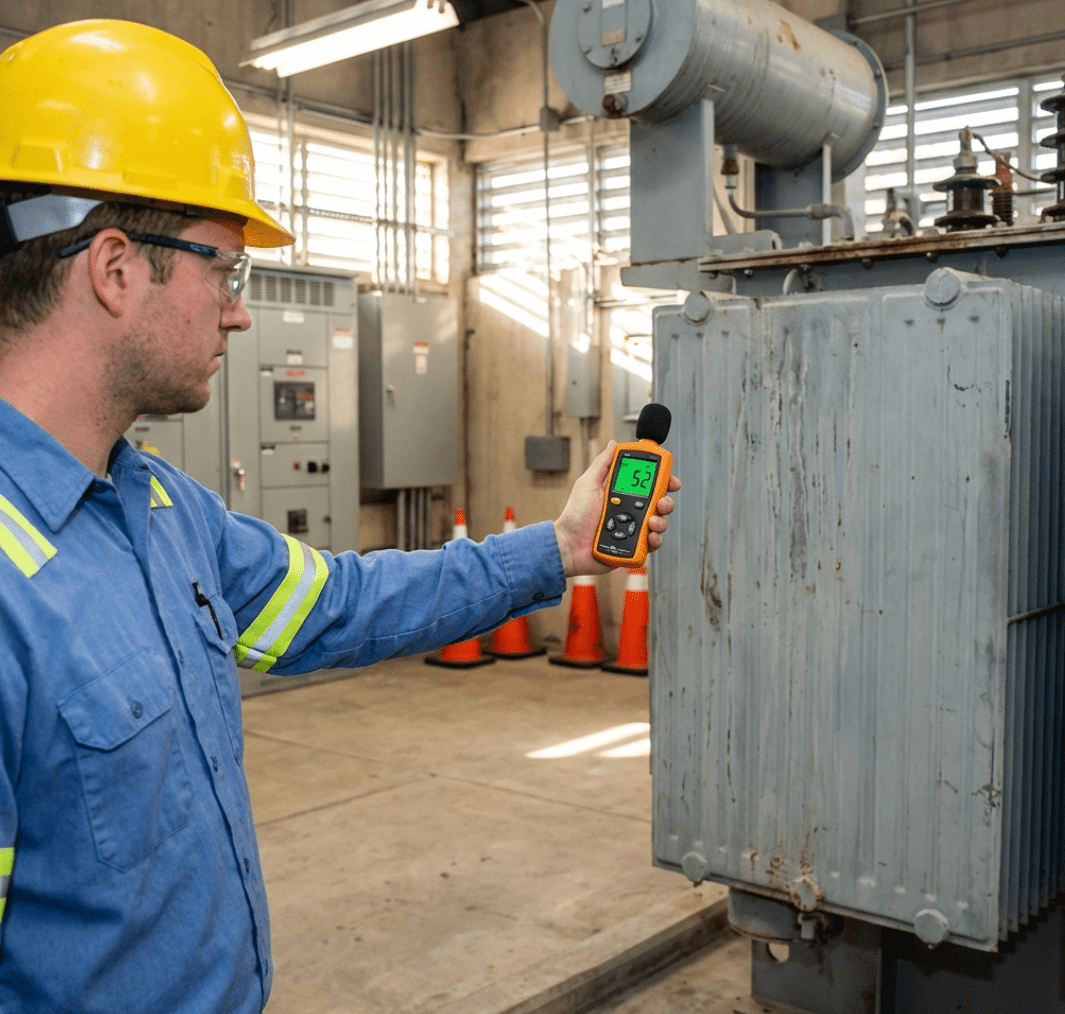
Last month, a facility manager called our factory in a panic. His new 500 kVA transformer was “humming like a swarm
of bees,” disturbing workers 50 feet away. After 15 years of manufacturing transformers at
Transformer4U, I’ve learned that transformer humming is perfectly normal — but
understanding why transformers hum helps you distinguish healthy operation from problems requiring
immediate attention.
⚡ Quick Answer: Why Do Transformers Hum?
Transformers hum primarily due to magnetostriction — a phenomenon where
the iron core physically expands and contracts twice per AC cycle (120 times per second at 60Hz). This creates
vibrations at 120Hz frequency, producing the characteristic humming sound.
A healthy transformer should emit a low, steady hum between 40-65 dB.
Louder, irregular, or rattling noises indicate potential issues like loose components, overload, or core
saturation.
Learn more about how transformers work and
their internal construction.
Understanding the Physics: Why Transformers Make Noise
The Science of Magnetostriction
Magnetostriction is the primary cause of transformer humming. Here’s what happens inside the transformer core:
The Physical Process:
- AC Current Creates Alternating Magnetic Field
As alternating current flows through the primary winding, it generates a magnetic field that constantly changes
direction (60 times per second in North America, 50Hz in most other regions). - Iron Core Expands and Contracts
The transformer’s iron core (made of silicon steel(laminations) physically changes dimensions in response to the
magnetic field:- When the field strengthens → Core expands (magnetostriction)
- When the field weakens → Core contracts back to original size
- 120Hz Vibration Frequency
The core expands and contracts twice per AC cycle:- At 60Hz power: 60 cycles/sec × 2 = 120 vibrations/second (120Hz)
- At 50Hz power: 50 cycles/sec × 2 = 100 vibrations/second (100Hz)
- Vibration Produces Audible Hum
These rapid dimensional changes (though microscopically small, ~0.001-0.01mm) create vibrations that radiate as
sound waves through:- The core itself
- The tank/enclosure (acts like a speaker)
- Mounting structures and surrounding air
The Classic Joke:
Q: Why do transformers hum?
A: Because they don’t know the words!
While amusing, the real physics is fascinating. According to Faraday’s law of
electromagnetic induction, the changing magnetic flux directly causes mechanical stress in ferromagnetic
materials.
The 120Hz Frequency: Why Not 60Hz?
Many people expect transformer hum to match the 60Hz power frequency. Here’s why it’s actually 120Hz:
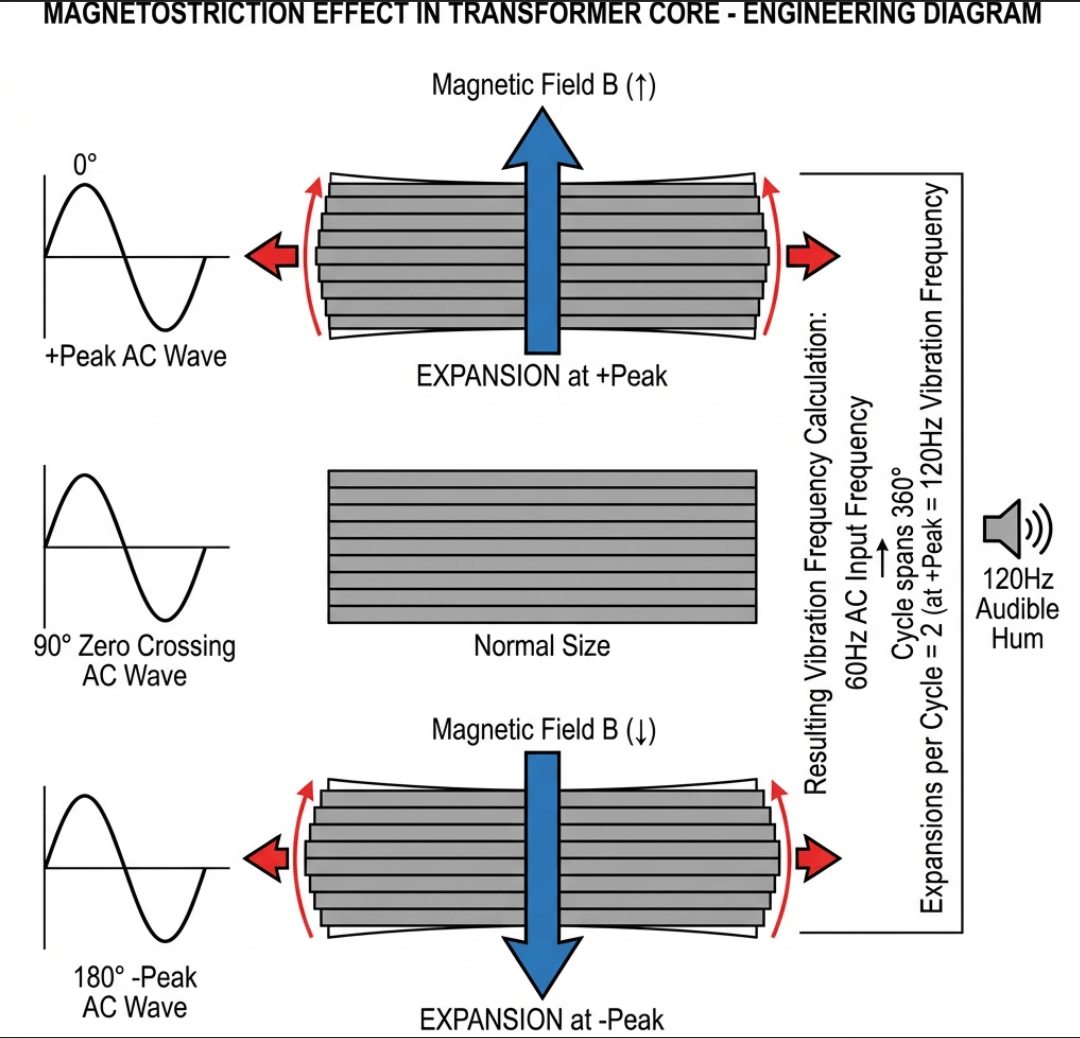
Magnetostriction physics: Iron core expands at BOTH positive and negative AC peaks, doubling the vibration frequency
| AC Cycle Phase | Magnetic Field Direction | Core Dimension |
|---|---|---|
| 0° (Positive Peak) | Maximum North | Maximum Expansion |
| 90° (Zero Crossing) | Zero | Returns to normal |
| 180° (Negative Peak) | Maximum South | Maximum Expansion (again!) |
| 270° (Zero Crossing) | Zero | Returns to normal |
Key Insight: The core expands at both positive and negative AC peaks, doubling the
vibration frequency from 60Hz to 120Hz.
Regional Frequency Differences
The hum frequency varies by power grid region:
| Region | Power Frequency | Hum Frequency | Sound Perception |
|---|---|---|---|
| North America | 60Hz | 120Hz | Higher-pitched hum |
| Europe | 50Hz | 100Hz | Lower-pitched hum |
| Asia (most countries) | 50Hz | 100Hz | Lower-pitched hum |
| Japan (East) | 50Hz | 100Hz | Lower hum |
| Japan (West) | 60Hz | 120Hz | Higher hum |
Practical Observation: When our factory ships transformers to Europe, customers sometimes report a
“different sound” compared to their North American counterparts — the 100Hz hum has a noticeably lower pitch than
the familiar 120Hz.
Normal Transformer Sound Levels: Industry Standards
Not all transformer humming indicates a problem. Industry organizations have established acceptable noise levels.
NEMA Standards for Liquid-Filled Transformers
Source: NEMA TR-1 Standard, Section 5.5 – Sound Levels
| Self-Cooled kVA Rating | Average Sound Level (dB) | Equivalent Sound |
|---|---|---|
| 0-50 kVA | 40 dB | Quiet library |
| 51-100 kVA | 45 dB | Quiet office |
| 101-300 kVA | 50 dB | Normal conversation (5ft away) |
| 301-500 kVA | 55 dB | Office with activity |
| 2001-3000 kVA | 60 dB | Normal conversation (3ft away) |
| 5001-10000 kVA | 64 dB | Normal office with activity |
(transformer energized but not carrying current). Under full load, noise can increase by 3-5 dB.
IEEE Standards for Dry-Type Transformers
Source: IEEE C57.12.01 Standard
| Insulation Class | Self-Cooled Rating (kVA) | Maximum Sound Level (dB) |
|---|---|---|
| Ventilated (VN) | 0-9 | 40 |
| Ventilated (VN) | 10-50 | 45 |
| Ventilated (VN) | 301-500 | 60 |
| Sealed/Encapsulated (GN) | 151-300 | 60 |
When Transformer Noise Becomes a Concern: Warning Signs
While a steady hum is normal, certain sounds indicate problems requiring immediate investigation.
⚠️ Abnormal Sounds You Shouldn’t Ignore
| Sound Description | Likely Cause | Severity | Action Required |
|---|---|---|---|
| Loud Crackling/Sizzling | Partial discharge, arcing | 🔴 CRITICAL | Power down immediately, investigate |
| Gurgling/Bubbling (oil-filled) | Gas bubbles in oil, overheating | 🔴 HIGH | Check oil level, test DGA |
| Loud Banging/Thumping | Loose windings or core | 🔴 HIGH | Power down, internal inspection |
| Rattling/Buzzing | Loose bolts/connections | 🟡 MEDIUM | Tighten all hardware |
How to Reduce Transformer Humming: 8 Proven Methods
If transformer noise exceeds acceptable levels or disturbs nearby areas, use these strategies:
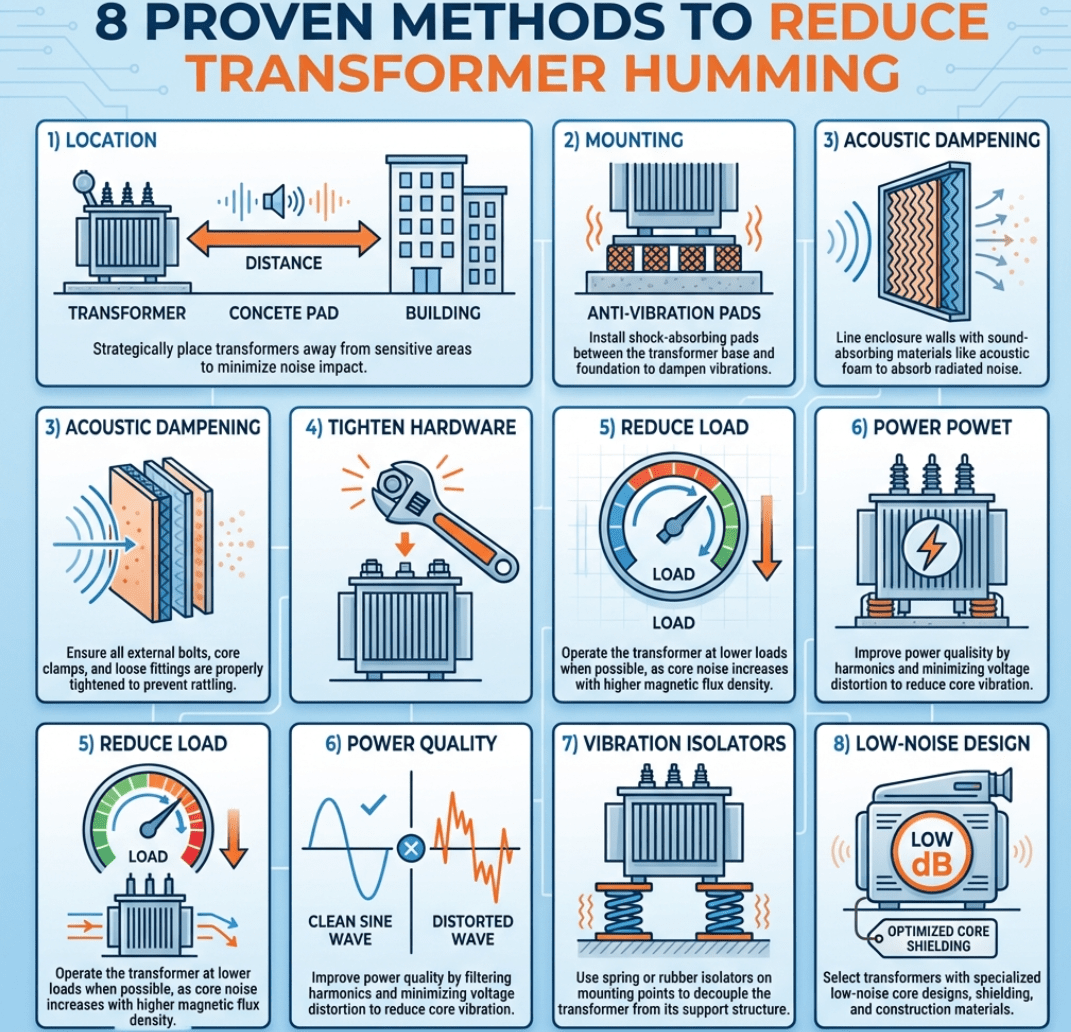
8 effective strategies to minimize transformer noise in residential and commercial installations
1. Choose the Right Installation Location
Avoid:
- ❌ Corners (reflect and amplify sound)
- ❌ Stairwells or enclosed corridors (echo chambers)
- ❌ Directly above occupied spaces
- ❌ Near conference rooms or sleeping areas
Prefer:
- ✅ Outdoor pads (sound dissipates freely)
- ✅ Dedicated electrical rooms with acoustic treatment
- ✅ Locations 10+ feet from occupied spaces
- ✅ Areas with heavy concrete walls that absorb sound
2. Use Proper Mounting Techniques
Ground-Mounted Transformers:
- Install on reinforced concrete pad 10× heavier than transformer weight
- Minimum pad thickness: 6-8 inches for <100 kVA, 10-12 inches for >100 kVA
- Anti-vibration pads: Use neoprene or cork isolators (1/4″ to 1/2″ thick)
- Ensure level mounting (within 1/4″ tolerance)
3. Apply Acoustic Dampening Materials
| Material | Noise Reduction | Cost | Best For |
|---|---|---|---|
| Acoustic foam tiles | -5-8 dB | $ | Room walls around transformer |
| Mass-loaded vinyl (MLV) | -10-15 dB | $$ | Wrapping transformer enclosure |
| Fiberglass insulation | -8-12 dB | $$ | Inside enclosure panels |
8. Specify Low-Noise Design (For New Purchases)
When ordering transformers, request:
- Low-flux-density core: 1.4-1.5 Tesla instead of 1.6-1.7T (reduces magnetostriction)
- Step-lap core joints: Better than butt joints (quieter)
- Enhanced clamping: Prevents winding movement
- Sound-deadened enclosure: Factory-applied acoustic treatment
Cost-Benefit Analysis: Low-Noise Design vs. Aftermarket Noise Reduction
| Item | Standard Transformer + Acoustic Treatment | Low-Noise Transformer |
|---|---|---|
| Initial Transformer Cost | $2,500 (100 kVA) | $2,875 (+15% = $375) |
| Acoustic Enclosure | $1,200-1,800 | $0 (not needed) |
| Anti-Vibration Pads | $150-250 | $0 (not needed) |
| Installation Labor | +8 hours ($800) | Standard (no extra) |
| Total Cost | $4,650-5,350 | $2,875 |
| ✅ Cost Savings | – | $1,775-2,475 |
💡 Bottom Line:
Specifying low-noise upfront saves 30-60% vs. aftermarket noise
reduction and avoids operational disruption.
FAQ: Transformer Humming Questions
Is it normal for a transformer to hum?
Yes, transformer humming is perfectly normal and expected. The hum is caused by
magnetostriction — the iron core physically vibrating at 120Hz (60Hz power × 2 cycles per AC wave)
as it expands and contracts with the alternating magnetic field. As long as the sound level is below NEMA/IEEE
standards (typically 40-65 dB depending on size) and the hum is steady and consistent, your transformer is operating
normally.
Why does my transformer hum get louder under load?
Transformer noise increases under load for two reasons:
- Winding Forces: Current flowing through windings creates electromagnetic forces (proportional
to I²) that cause additional vibration - Core Saturation: At high loads, voltage regulation may cause slight over-excitation, increasing
magnetostriction
Normal load noise increase: 3-5 dB from no-load to full-load
Concerning: >7 dB increase may indicate loose windings or tap setting issues
What does it mean if my transformer makes a crackling sound?
Crackling or sizzling sounds are serious warning signs:
- Partial Discharge: Electrical breakdown in insulation, creating small sparks
- Arcing: More severe electrical discharge between conductors
- Moisture Ingress: Water in insulation causing electrical tracking
(megger test, partial discharge test). Do not re-energize until the fault is identified and repaired.
How do you reduce transformer hum in a residential setting?
For transformers near homes or noise-sensitive areas:
- Relocate if Possible: Move 20+ feet away from living areas
- Install Anti-Vibration Pads: Neoprene or cork isolators
- Build Acoustic Enclosure: Use mass-loaded vinyl + fiberglass insulation, ensuring adequate
ventilation - Upgrade to Low-Noise Model: K-factor dry-type transformers with low-flux cores run 5-8 dB
quieter - Check Power Quality: High harmonic content increases noise — consider harmonic filters
Quick Fix: Acoustic blankets wrapped around dry-type transformers can reduce noise by 4-6 dB as a
temporary measure.
Conclusion: Key Takeaways on Transformer Humming
- ✅ Normal transformer humming is expected — caused by magnetostriction (core vibration at 120Hz)
- ✅ Sound levels should stay below NEMA/IEEE standards — typically 40-65 dB depending on
transformer size - ✅ The “120Hz buzz” is physics — iron core expands/contracts twice per AC cycle
- ✅ Abnormal sounds require investigation — crackling, gurgling, banging are warning signs
- ✅ Noise can be reduced — use anti-vibration mounts, acoustic dampening, proper installation
location - ✅ Low-noise designs are available — specify low-flux cores and step-lap joints when ordering
Understanding why transformers hum helps you maintain them properly and troubleshoot problems before they become
expensive failures. The next time someone asks “Why do transformers hum?” you can explain the fascinating physics of
magnetostriction while demonstrating your transformer expertise!
Need a Quiet Transformer Solution?
At Transformer4U, we manufacture low-noise toroidal and EI transformers designed for noise-sensitive
applications:
- Toroidal Transformers: 40-45 dB operation, ideal for audio equipment and medical devices
- Step-Lap EI Transformers: 5-7 dB quieter than standard designs
- Custom Acoustic Treatment: Factory-applied sound dampening for special applications
- Expert Consulting: 15+ years of experience reducing transformer noise in challenging
installations
Contact our engineering team for transformer selection guidance and acoustic analysis:
👉 Get Expert Transformer Consultation
Related Articles
- How to Test a Transformer: 8 Essential Tests
- Transformer Construction: Core Types & Winding Designs
- Distribution Transformer Losses: No-Load & Load Loss Explained
- Transformer Overheating: Causes,Effects & Solutions
References
- NEMA TR-1 Standard – Transformers, Regulators, and Reactors
- IEEE C57.12.01 – Standard for Dry-Type Distribution and Power Transformers
- IEEE C57.12.00 – General Requirements for Liquid-Immersed Distribution, Power, and Regulating Transformers
- Faraday’s Law of Electromagnetic Induction – Wikipedia
Written by Tan, Senior Transformer Technician at
Transformer4U with 15+ years of experience in transformer manufacturing, quality testing, and acoustic
optimization. Over 10,000 transformers tested and 500+ noise-related troubleshooting cases resolved.