
What Does CT Ratio Mean? (Current Transformer Ratio Explained)
When I first started working with current transformers in our manufacturing facility, the ratio number confused me too. Here’s the simplest explanation I’ve found after years of hands-on experience:
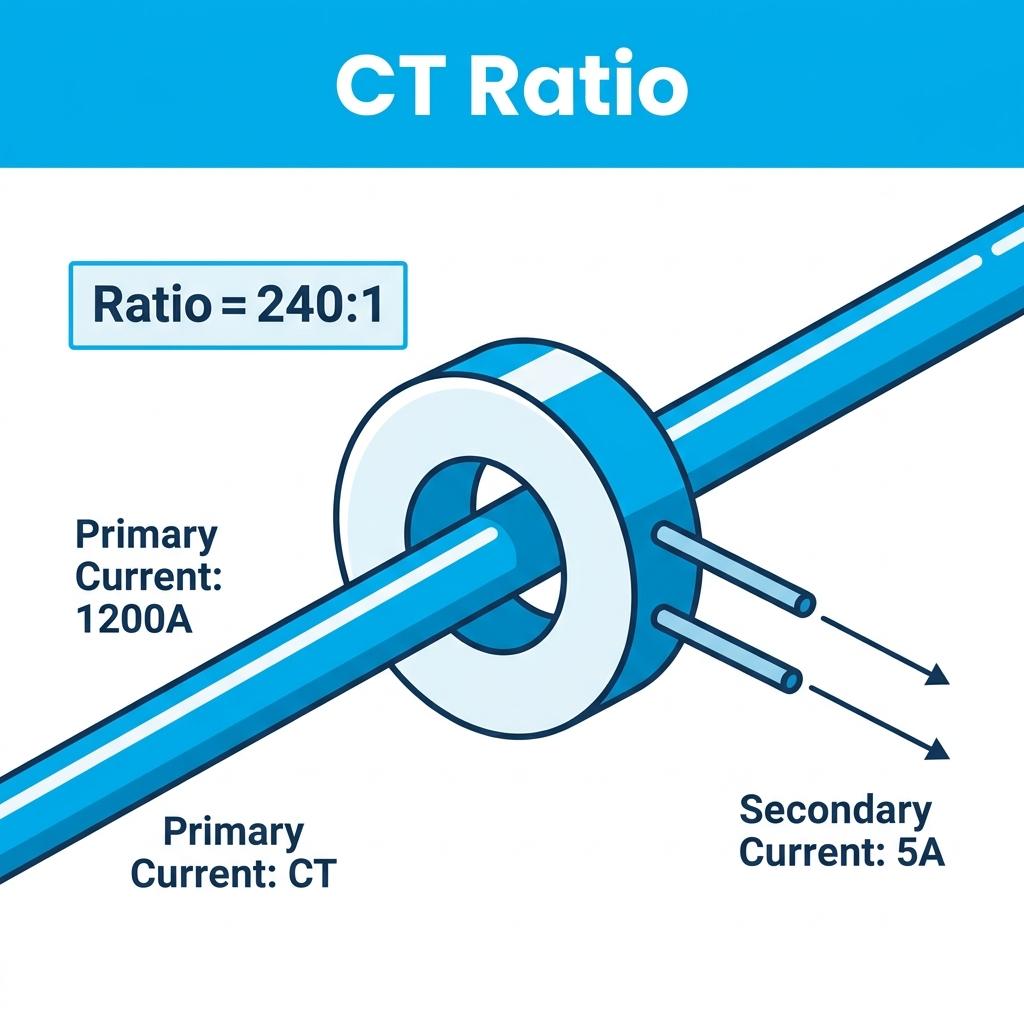
A CT ratio (current transformer ratio) is the relationship between the primary current flowing through the main conductor and the secondary current delivered to your meter or relay. It’s expressed as two numbers:
  CT Ratio = Primary Current / Secondary Current

  Example: 200/5 means:
  → Primary (main conductor): 200A
  → Secondary (to meter):       5A
  → Ratio factor:              40:1
The secondary winding has far more turns than the primary. By Faraday’s law of electromagnetic induction, increasing the number of secondary turns proportionally reduces the secondary current. A 200/5 CT has 40 times more secondary turns than primary turns.
Per IEEE C57.13, the standard secondary current ratings are 5A (most common in North America) and 1A (preferred for long secondary cable runs in Europe). This standardization means all your meters and protective relays are designed around these safe, manageable output values.
How to Read a CT Nameplate: Field-by-Field Guide
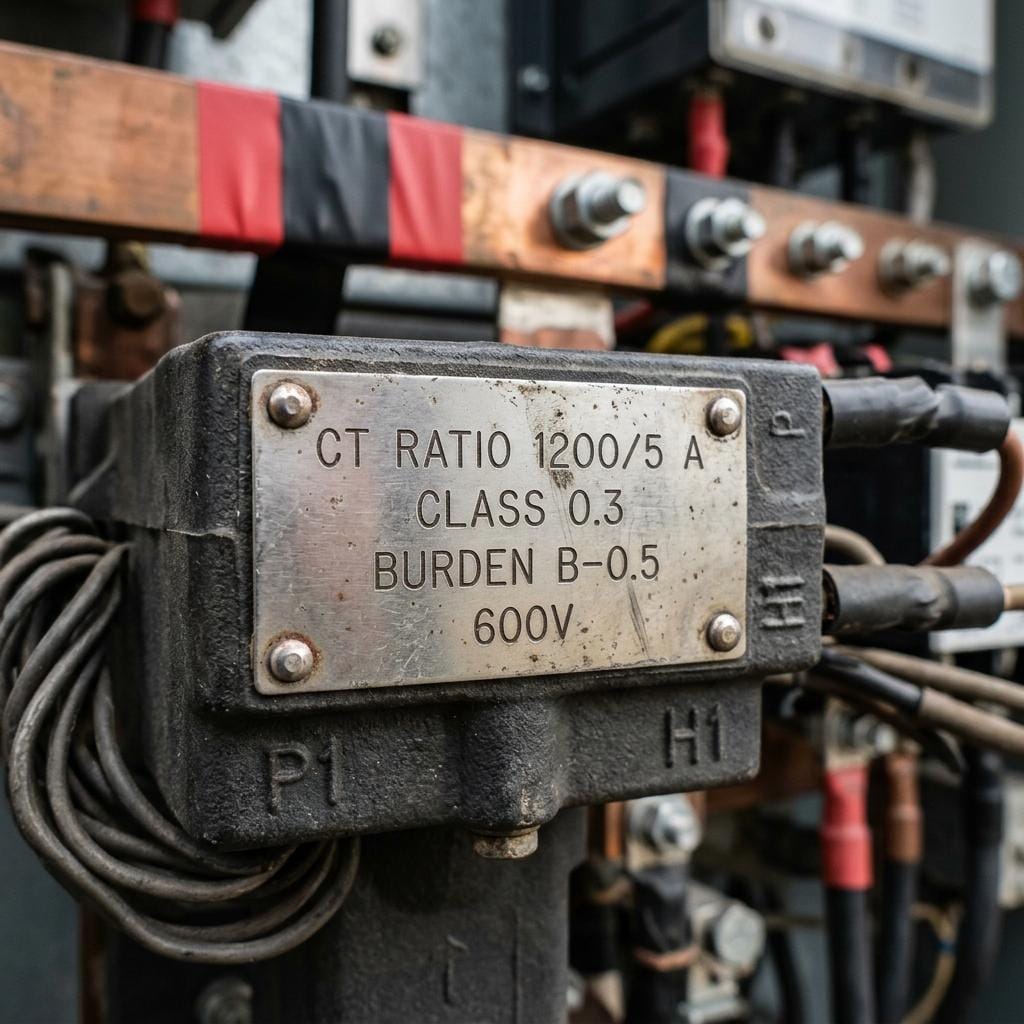
The CT nameplate is a small metal plate stamped or printed with everything you need to know about that specific unit. Here’s what each field means, using a real GE ITI 622-122 as an example:
| Nameplate Field | Example Value | What It Means |
|---|---|---|
| Ratio | 1200/5 A | Primary 1200A → Secondary 5A (240:1) |
| Accuracy Class | 0.3 B-0.5 | ±0.3% error, rated for 2.5Ω burden |
| BIL | 10 kV | Basic Insulation Level — max impulse voltage |
| Frequency | 60 Hz | Designed for 60Hz power systems |
| Thermal Factor (TF) | RF 2.0 | Can carry 2× rated primary (2400A) continuously |
| H1 / H2 | Primary terminals | H1 faces source; current enters H1 |
| X1 / X2 | Secondary terminals | X1 is polarity mark; current exits X1 |
One mistake I see constantly: engineers look only at the ratio and ignore the accuracy class. A 1200/5 CT rated class 0.3 B-0.5 and one rated class 1.0 B-1.0 are not the same — even though both say “1200/5.” For revenue billing, you need 0.3 or 0.5. For a panel indicator light, class 1.0 is fine.
CT Ratio Calculation: How the Math Works
The CT ratio is directly linked to the turns ratio of the secondary winding. The formula is:
CT Ratio = Np × Ip = Ns × Is (amp-turn balance)
For a 1200/5 CT with 1 primary turn:
→ Ns = 1200/5 × 1 = 240 secondary turns
→ At 800A primary: Secondary = 800 ÷ 240 = 3.33A
This is why running a 1200/5 CT at only 100A gives a secondary output of just 0.42A — well below the accurate measurement range. For systems regularly operating below 300A, a 400/5 or 600/5 CT is the right choice. See our CT ratio calculation guide for worked examples.
CT Ratio Selection Guide: 4 Steps to the Right Choice
After helping dozens of engineers spec CTs for industrial and utility projects, I’ve narrowed it down to four questions:
Step 1: What is your maximum primary current?
This is your starting point. Check the circuit breaker or service rating. A 1000A main breaker needs a CT with at least 1000A primary rating.
Step 2: What is your normal operating current?
Target 60–80% of the CT’s primary rating for best accuracy. If your load normally runs at 800A, a 1200/5 CT is ideal (800A = 67% of 1200A — right in the sweet spot). A 2000/5 CT on that same 800A load operates at only 40% — lower accuracy, higher cost.
| Normal Load | Recommended CT Ratio | % of Rating | Accuracy |
|---|---|---|---|
| 100–300A | 400/5 | 25–75% | Good |
| 400–600A | 600/5 | 67–100% | Excellent |
| 600–800A | 800/5 | 75–100% | Excellent |
| 800–1000A | 1200/5 ← common choice | 67–83% | Excellent |
| 1200–1600A | 2000/5 | 60–80% | Good |
Step 3: Metering or protection — or both?
- Revenue metering: Specify accuracy class 0.3 or 0.5 (IEEE C57.13). Never use a protection CT for billing.
- Protection relaying: Specify class C400 or C800. The “C” rating tells you the secondary voltage before saturation.
- Both on one CT: Use a dual-core CT with separate metering and protection cores.
Step 4: Check the burden
Burden is the total resistance of everything connected to the secondary: your meter, relay, and secondary leads. Your total burden must stay within the CT’s rated burden. Long cable runs add resistance fast — 12 AWG copper has 1.59 Ω per 1,000 ft; a 100-foot one-way run (200 ft total circuit) adds ~0.32Ω to your burden. See our CT burden calculation guide for the full formula.
Real Example: Reading a 1200/5 CT Nameplate
Here’s a scenario from our technical support work. A customer sent us a photo of a Crompton 300-122 they’d found in an old switchboard — no documentation, just the nameplate. Here’s what we decoded:
Nameplate reads: 1200:5 / Cl 0.5 / B-1.0 / 600V / 60Hz
Decoded:
→ Ratio: 1200/5 (240:1) — suitable for circuits up to 1200A
→ Accuracy: Class 0.5 — acceptable for sub-billing metering, not primary revenue
→ Burden: B-1.0 (5.0Ω at 5A) — plenty of headroom for most panel installations
→ Insulation: 600V — low-voltage panel only, not for MV switchgearOur advice: Suitable for monitoring. For utility revenue metering, upgrade to class 0.3.
Frequently Asked Questions
What does CT ratio mean?
CT ratio is the ratio of primary current to secondary current in a current transformer, expressed as primary/secondary (e.g. 200/5). It tells you how much the high primary conductor current is scaled down to the safe 5A or 1A secondary output used by meters and protective relays.
How do you read a CT ratio from a nameplate?
Find the two numbers separated by a slash or colon on the nameplate — for example “1200/5 A” or “1200:5”. The first number is the primary current rating, the second is the secondary output (5A or 1A). Also note the accuracy class and burden rating next to it — these are equally important.
How do I select the right CT ratio?
Match the CT primary rating so your normal load current is 60–80% of rated. For a 1000A load, a 1200/5 CT is ideal. Avoid oversizing — a CT operating at 20% of its rating loses accuracy significantly. Also check accuracy class (0.3–0.5 for billing, C400+ for protection) and ensure the burden stays within limits.
Is 1200/5 the same as 1200:5?
Yes — both notations mean a 1200A primary, 5A secondary CT. The slash and colon are interchangeable. You’ll see both on datasheets and nameplates from different manufacturers.
What happens if I use the wrong CT ratio?
All your meter readings will be wrong by the ratio mismatch factor. If you install a 1200/5 CT but program your meter for 600/5, every reading will be exactly half the true value. For revenue billing, utilities will reject this. Always verify CT nameplate ratio matches the meter configuration before energizing.
Related Articles
- CT Ratio Calculation — Complete Guide with Worked Examples
- CT Accuracy Class Explained: 0.2, 0.5, 1.0, C400 & C800
- CT Burden Calculation Guide with Formulas
- CT Knee Point Voltage — What It Means & How to Test
- Current Transformer Wiring & Polarity Connection Guide
- Current Transformer (CT) — Complete Beginner’s Guide
Need Help Reading Your CT Nameplate?
Send us a photo of your CT nameplate and we’ll help you decode the ratio, accuracy class, and burden rating — and confirm whether it suits your application.