
By Tan | Transformer4U Engineering Team | Updated February 2026
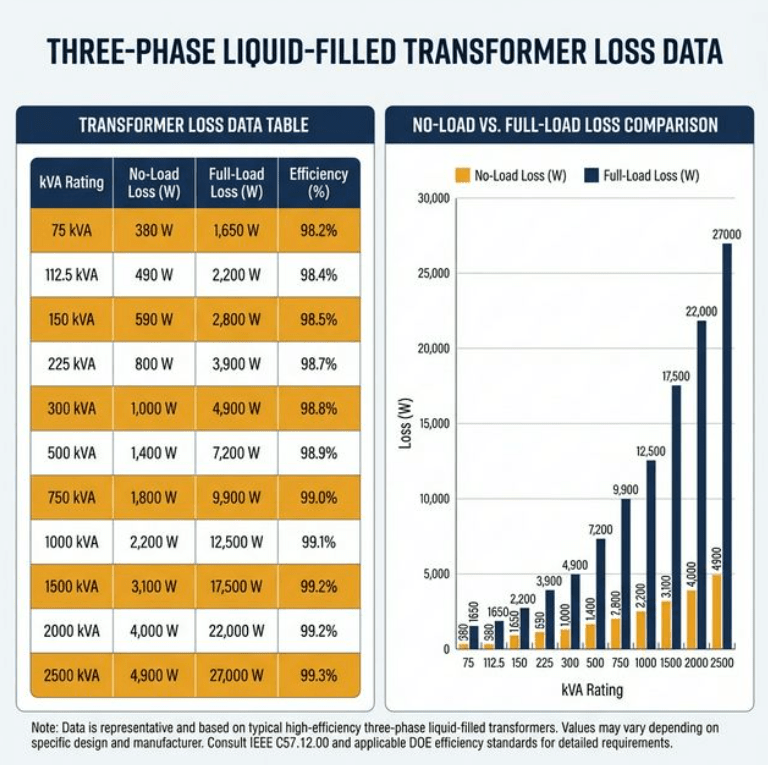
770–1,000 W no-load loss and 5,500–6,800 W full-load copper loss, with
~98.6% efficiency. At 50% average load, annual energy cost from losses is approximately
$2,000–$2,500/year at $0.10/kWh. See complete tables below for all kVA ratings.
Understanding transformer loss data is critical for calculating operating costs, selecting the right
efficiency class, and complying with DOE 2024/2029 standards. Unlike competitors who publish this data only
in PDFs, this page provides a complete, searchable transformer loss data table covering
no-load loss, load loss, efficiency, and annual cost — for dry-type and liquid-filled transformers from 15
kVA to 2,500 kVA.
- 1. Two Types of Transformer Losses Explained
- 2. Three-Phase Liquid-Filled Transformer Loss Table
- 3. Single-Phase Liquid-Filled Transformer Loss Table
- 4. Dry-Type Transformer Loss Table
- 5. DOE 2016 vs DOE 2024/2029 Efficiency Standards
- 6. Annual Loss Cost Calculator Table
- 7. Maximum Efficiency Point by kVA
- 8. Core Material Impact on No-Load Loss
- 9. Loss Calculation Formulas
- 10. FAQ
1. Two Types of Transformer Losses Explained
Every transformer has two fundamentally different loss mechanisms. Understanding both is essential for
accurate loss data interpretation:
| Characteristic | No-Load Loss (Core Loss) | Load Loss (Copper Loss) |
|---|---|---|
| Also Called | Iron loss, excitation loss | I²R loss, winding loss, short-circuit loss |
| When It Occurs | Whenever transformer is energized (24/7) | Only when current flows through windings |
| Varies With | Applied voltage (essentially constant) | Square of load current (I²) |
| Location | Magnetic core (hysteresis + eddy currents) | Primary & secondary windings |
| Typical % of kVA | 0.1–0.3% of rated kVA | 0.5–2.0% at full load |
| At 50% Load | 100% of nameplate value | 25% of full-load value (0.5² = 0.25) |
| Reduction Method | Better core material (amorphous, HiB CRGO) | Larger conductor cross-section, lower resistance |
| Reference Temp | 20°C (IEEE C57.12.90) | 85°C (IEEE C57.12.90) |
| Test Method | Open-circuit test (primary energized, secondary open) | Short-circuit test (rated current, secondary shorted) |
year life, even a small reduction in core loss has enormous cumulative value. A 100 W reduction in no-load
loss saves 876 kWh/year — worth $87.60/year at $0.10/kWh, or $2,190 over 25 years.
2. Three-Phase Liquid-Filled Transformer Loss Table
Data based on NEMA TP1 baseline values (referenced by IEEE C57.12.00) and typical
manufacturer data. Efficiency measured at 50% of nameplate-rated load per DOE/IEEE standard.
| kVA Rating | No-Load Loss (W) | Full-Load Loss (W) | Loss at 50% Load (W) | Efficiency @FL | Efficiency @50% | NEMA TP1 Baseline |
|---|---|---|---|---|---|---|
| 15 kVA | 60–90 | 350–450 | 148–315 | 97.5% | 98.5% | — |
| 25 kVA | 85–120 | 520–650 | 215–445 | 97.7% | 98.6% | — |
| 37.5 kVA | 110–155 | 700–880 | 285–595 | 97.9% | 98.7% | — |
| 75 kVA | 190–250 | 1,200–1,500 | 490–875 | 98.0% | 98.8% | 245 W / 1,000 W |
| 112.5 kVA | 260–340 | 1,600–2,000 | 660–1,100 | 98.2% | 98.9% | 345 W / 1,350 W |
| 150 kVA | 320–420 | 2,000–2,500 | 820–1,345 | 98.3% | 99.0% | 430 W / 1,625 W |
| 225 kVA | 430–560 | 2,800–3,500 | 1,130–1,935 | 98.4% | 99.0% | 525 W / 2,450 W |
| 300 kVA | 530–700 | 3,500–4,400 | 1,405–2,300 | 98.5% | 99.1% | 710 W / 3,200 W |
| 500 kVA | 770–1,000 | 5,500–6,800 | 2,148–2,700 | 98.6% | 99.1% | 1,025 W / 5,000 W |
| 750 kVA | 1,050–1,400 | 7,500–9,300 | 2,988–3,725 | 98.7% | 99.2% | 1,310 W / 6,800 W |
| 1,000 kVA | 1,300–1,700 | 9,500–11,800 | 3,675–4,650 | 98.8% | 99.2% | 1,650 W / 9,500 W |
| 1,500 kVA | 1,750–2,300 | 13,500–16,800 | 5,125–6,500 | 98.9% | 99.3% | 2,150 W / 12,500 W |
| 2,000 kVA | 2,100–2,750 | 17,000–21,000 | 6,350–8,000 | 98.9% | 99.3% | 2,450 W / 14,500 W |
| 2,500 kVA | 2,600–3,400 | 21,000–26,000 | 7,850–9,900 | 99.0% | 99.4% | 3,000 W / 18,000 W |
by manufacturer, core material, and voltage class. Always obtain nameplate loss data from the manufacturer’s
test report (IEEE C57.12.90 factory test).
3. Single-Phase Liquid-Filled Transformer Loss Table
Single-phase pole-mounted and pad-mounted transformers. Primary voltage typically
2.4–34.5 kV; secondary 120/240V.
| kVA Rating | No-Load Loss (W) | Full-Load Loss (W) | Efficiency @FL | Efficiency @50% Load | Typical Application |
|---|---|---|---|---|---|
| 5 kVA | 20–35 | 100–140 | 97.0% | 98.2% | Residential service |
| 10 kVA | 30–50 | 165–210 | 97.4% | 98.5% | Residential service |
| 15 kVA | 40–65 | 225–285 | 97.6% | 98.6% | Small commercial |
| 25 kVA | 55–85 | 330–420 | 97.9% | 98.8% | Small commercial |
| 37.5 kVA | 75–110 | 460–580 | 98.1% | 98.9% | Commercial/light industrial |
| 50 kVA | 95–135 | 580–730 | 98.2% | 99.0% | Commercial/light industrial |
| 75 kVA | 125–175 | 800–1,000 | 98.4% | 99.1% | Industrial |
| 100 kVA | 155–215 | 1,000–1,250 | 98.5% | 99.1% | Industrial |
| 167 kVA | 230–310 | 1,550–1,950 | 98.7% | 99.2% | Industrial/utility |
| 250 kVA | 320–430 | 2,200–2,750 | 98.8% | 99.3% | Utility distribution |
4. Dry-Type Transformer Loss Table
Dry-type transformers (ventilated or encapsulated) typically have higher no-load losses
than liquid-filled equivalents due to higher core flux density. Data for 480V secondary, Class 150°C or
220°C insulation.
| kVA Rating | No-Load Loss (W) | Full-Load Loss (W) | Loss at 35% Load* (W) | Efficiency @FL | DOE 2016 Min Eff. |
|---|---|---|---|---|---|
| 15 kVA | 100–150 | 520–650 | 163–213 | 96.8% | 97.0% |
| 30 kVA | 165–230 | 850–1,050 | 268–358 | 97.1% | 97.5% |
| 45 kVA | 220–300 | 1,100–1,380 | 354–468 | 97.3% | 97.7% |
| 75 kVA | 320–430 | 1,600–2,000 | 516–674 | 97.5% | 98.0% |
| 112.5 kVA | 430–580 | 2,100–2,600 | 687–908 | 97.7% | 98.2% |
| 150 kVA | 530–710 | 2,600–3,200 | 847–1,112 | 97.9% | 98.3% |
| 225 kVA | 720–960 | 3,500–4,300 | 1,143–1,505 | 98.0% | 98.5% |
| 300 kVA | 900–1,200 | 4,400–5,400 | 1,428–1,889 | 98.1% | 98.6% |
| 500 kVA | 1,200–1,600 | 6,500–8,000 | 1,999–2,780 | 98.3% | 98.7% |
| 750 kVA | 1,650–2,200 | 9,000–11,000 | 2,738–3,903 | 98.5% | 98.8% |
| 1,000 kVA | 2,000–2,700 | 11,000–13,500 | 3,303–4,789 | 98.6% | 98.9% |
| 1,500 kVA | 2,700–3,600 | 15,000–18,500 | 4,523–6,401 | 98.7% | 99.0% |
| 2,000 kVA | 3,300–4,400 | 19,000–23,500 | 5,628–8,104 | 98.8% | 99.0% |
*DOE measures low-voltage dry-type efficiency at 35% of nameplate-rated load (vs 50% for
liquid-filled).
high ambient temperatures (>40°C) can show 15–20% higher losses than nameplate values. We always
recommend derating dry-type units by one size when ambient exceeds 40°C — a 500 kVA unit becomes effectively
a 400 kVA unit thermally. Also note that voltage drop between the transformer secondary and
the load center adds additional I²R losses in feeder cables. We recommend keeping voltage drop below 3% to
avoid inflating effective copper losses.
5. DOE 2016 vs DOE 2024/2029 Efficiency Standards
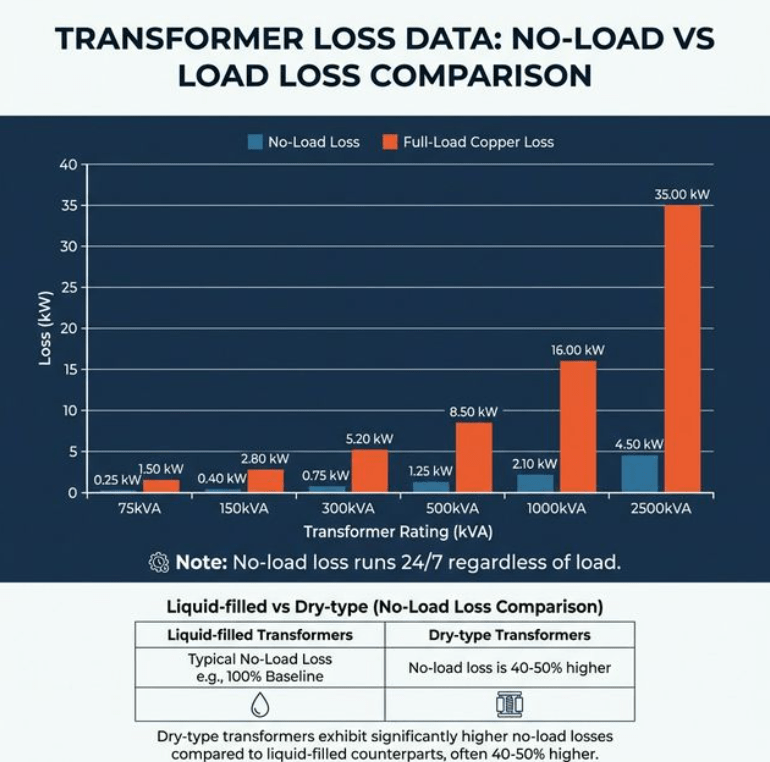
The U.S. Department of Energy finalized new efficiency standards in April 2024,
effective January 1, 2029. These represent the most significant update to transformer efficiency
requirements since 2016.
| Transformer Type & kVA | DOE 2016 Min Efficiency | DOE 2024/2029 Min Efficiency | Loss Reduction Required |
|---|---|---|---|
| 75 kVA, 3-Phase, Liquid | 98.36% | 98.60% | ~15% loss reduction |
| 150 kVA, 3-Phase, Liquid | 98.62% | 98.82% | ~15% loss reduction |
| 500 kVA, 3-Phase, Liquid | 98.91% | 99.06% | ~5% loss reduction |
| 1,000 kVA, 3-Phase, Liquid | 99.07% | 99.19% | ~5% loss reduction |
| 75 kVA, 3-Phase, Dry-Type LV | 98.60% | ~98.90% | ~20% loss reduction |
| 150 kVA, 3-Phase, Dry-Type LV | 98.83% | ~99.08% | ~20% loss reduction |
| 500 kVA, 3-Phase, Dry-Type LV | 99.14% | ~99.31% | ~20% loss reduction |
| Single-Phase LV Dry-Type (all) | Various | +30% loss reduction | 30% loss reduction |
| Medium-Voltage Dry-Type (all) | Various | +20% loss reduction | 20% loss reduction |
completing before 2029, you can still purchase DOE 2016-compliant units. However, for long-lived assets (25+
year life), the DOE 2024 efficiency gains often justify the premium. Run the annual cost calculator below to
determine your payback period.
What DOE 2024 Means for Core Materials
| Core Material | No-Load Loss vs CRGO Baseline | DOE 2024 Compliance | Cost Premium |
|---|---|---|---|
| Standard CRGO Silicon Steel | Baseline (0%) | ❌ May not meet 2029 requirements | Baseline |
| High-Grade CRGO (HiB) | −10 to −15% | ✅ Meets most liquid-filled requirements | +5–10% |
| Amorphous Metal (Metglas) | −70 to −80% | ✅ Exceeds all requirements | +25–40% |
| Nanocrystalline Core | −85 to −90% | ✅ Far exceeds requirements | +60–100% |
6. Annual Loss Cost Reference Table
Pre-calculated annual energy cost from transformer losses at $0.10/kWh, 50% average
load factor, 8,760 operating hours/year. Use the formula below to adjust for your electricity rate and load
factor.
// P_NL = No-load loss (kW) | P_LL = Full-load copper loss (kW)
// LF = Load factor (e.g., 0.50 for 50% average load)
// At 50% LF: copper loss contribution = P_LL × 0.25
| kVA | Type | No-Load Loss (kW) | FL Copper Loss (kW) | Annual Cost @50% LF | Annual Cost @75% LF | 25-Year Total @50% LF |
|---|---|---|---|---|---|---|
| 75 | Liquid 3Φ | 0.22 | 1.35 | $488 | $858 | $12,200 |
| 150 | Liquid 3Φ | 0.37 | 2.25 | $817 | $1,433 | $20,425 |
| 225 | Liquid 3Φ | 0.49 | 3.15 | $1,119 | $1,981 | $27,975 |
| 300 | Liquid 3Φ | 0.62 | 3.95 | $1,408 | $2,489 | $35,200 |
| 500 | Liquid 3Φ | 0.90 | 6.15 | $2,135 | $3,819 | $53,375 |
| 750 | Liquid 3Φ | 1.23 | 8.40 | $2,917 | $5,217 | $72,925 |
| 1,000 | Liquid 3Φ | 1.50 | 10.65 | $3,646 | $6,562 | $91,150 |
| 1,500 | Liquid 3Φ | 2.03 | 15.15 | $5,096 | $9,243 | $127,400 |
| 2,500 | Liquid 3Φ | 3.00 | 23.50 | $7,773 | $14,073 | $194,325 |
| 75 | Dry-Type 3Φ | 0.38 | 1.80 | $727 | $1,283 | $18,175 |
| 150 | Dry-Type 3Φ | 0.62 | 2.90 | $1,178 | $2,093 | $29,450 |
| 500 | Dry-Type 3Φ | 1.40 | 7.25 | $2,814 | $5,027 | $70,350 |
| 1,000 | Dry-Type 3Φ | 2.35 | 12.25 | $4,741 | $8,095 | $118,525 |
$0.10/kWh, a liquid-filled 500 kVA transformer costs $53,375 in losses vs
$70,350 for a dry-type equivalent — a $16,975 difference. This often
justifies choosing liquid-filled when installation conditions permit.
7. Maximum Efficiency Point by kVA
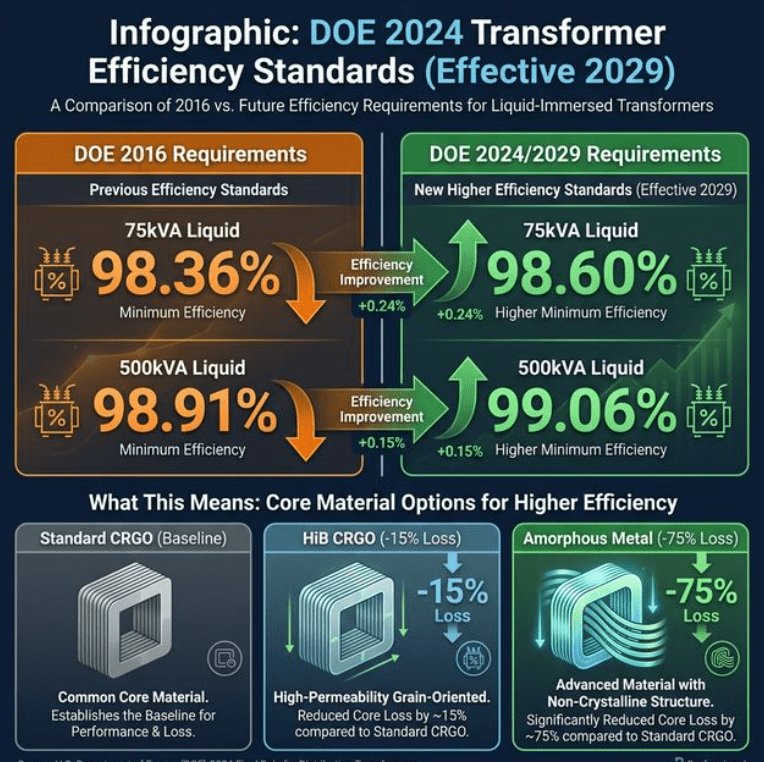
A transformer reaches maximum efficiency when copper losses equal core losses. This is the economic
loading point — the load level that minimizes energy waste per unit of power delivered.
// Example: 500 kVA, P_NL = 900 W, P_LL = 6,000 W
// Load% = √(900 ÷ 6000) = √0.15 = 0.387 = 38.7% of full load
| kVA | Type | No-Load Loss (W) | FL Copper Loss (W) | Max Efficiency Load% | Max Efficiency kVA | Peak Efficiency |
|---|---|---|---|---|---|---|
| 75 | Liquid 3Φ | 220 | 1,350 | 40.3% | 30.2 kVA | 99.05% |
| 150 | Liquid 3Φ | 370 | 2,250 | 40.5% | 60.8 kVA | 99.12% |
| 300 | Liquid 3Φ | 615 | 3,950 | 39.5% | 118.5 kVA | 99.18% |
| 500 | Liquid 3Φ | 900 | 6,150 | 38.3% | 191.5 kVA | 99.22% |
| 1,000 | Liquid 3Φ | 1,500 | 10,650 | 37.5% | 375 kVA | 99.28% |
| 2,500 | Liquid 3Φ | 3,000 | 23,500 | 35.7% | 893 kVA | 99.36% |
| 75 | Dry-Type 3Φ | 375 | 1,800 | 45.6% | 34.2 kVA | 98.65% |
| 500 | Dry-Type 3Φ | 1,400 | 7,250 | 43.9% | 219.5 kVA | 98.92% |
| 1,000 | Dry-Type 3Φ | 2,350 | 12,250 | 43.8% | 438 kVA | 99.03% |
at 40–50% of full load — because real-world average loading in commercial buildings is typically 30–60% of
nameplate. We’ve seen many facilities install oversized transformers “for future growth” that then run at
15–20% load, far from the efficiency peak, wasting energy for decades. Right-sizing matters enormously for
lifetime operating costs. Use our transformer
sizing calculator to find the optimal kVA for your load profile.
8. Core Material Impact on No-Load Loss
| Core Material | Relative No-Load Loss | Saturation Flux Density | Typical Application | DOE 2029 Suitability |
|---|---|---|---|---|
| Standard CRGO (M4/M5) | 100% (baseline) | 1.7–1.9 T | General distribution | ⚠️ Borderline |
| High-Grade CRGO (HiB, M2/M3) | 85–90% | 1.7–1.9 T | Premium distribution | ✅ Meets most |
| Domain-Refined CRGO (laser) | 75–85% | 1.7–1.9 T | High-efficiency units | ✅ Meets all liquid |
| Amorphous Metal (Metglas 2605SA1) | 20–30% | 1.56 T | Ultra-low loss distribution | ✅ Exceeds all |
| Nanocrystalline Alloy | 10–15% | 1.2 T | High-frequency, specialty | ✅ Far exceeds |
• Standard CRGO no-load loss: ~900 W → $788/year
• Amorphous core no-load loss: ~200 W → $175/year
• Annual savings: $613/year
• Amorphous premium (typical): ~$3,000–$5,000
• Simple payback: 5–8 years — well within the 25-year transformer life
9. Loss Calculation Formulas Reference
Core Loss Formulas
// Kh = hysteresis constant | f = frequency (Hz) | Bmax = max flux density (T) | n
≈ 1.6–2.0
Eddy Current Loss: Pe = Ke × f² × Bmax² × t² (Watts)
// Ke = eddy current constant | t = lamination thickness (m)
Total Core Loss: Pcore = Ph + Pe
Copper Loss Formulas
At Any Load: Pcu(x) = Pcu(FL) × (x)²
// x = load fraction (e.g., 0.5 for 50% load)
// At 50% load: Pcu = Pcu(FL) × 0.25 (only 25% of full-load copper loss!)
Efficiency Formula
// Pout = kVA × Load% × Power Factor × 1000 (Watts)
// At unity PF, 100% load: Pout = kVA × 1000
All-Day (24-Hour) Efficiency
Energy Input = Energy Output + (Pcore × 24) + Σ(Pcu(x) × hours at load x)
// Example: 500 kVA, 8h @100%, 8h @50%, 8h @0%
// Core loss: 0.9 kW × 24h = 21.6 kWh
// Copper loss: 6.0×1²×8 + 6.0×0.25×8 + 0 = 48 + 12 = 60 kWh
// Output: 500×8 + 250×8 = 6,000 kWh
// η_all-day = 6000/(6000+21.6+60) = 98.67%
Temperature Correction for Copper Loss
// T = actual winding temperature (°C)
// Copper losses increase ~0.4% per °C rise above reference temperature
// At 105°C: Pcu increases by ~(105-85)×0.4% = +8% vs nameplate
10. Frequently Asked Questions
What is a typical no-load loss for a 500 kVA transformer?
A typical 500 kVA three-phase liquid-filled transformer has a no-load loss of 770–1,000 W
(NEMA TP1 baseline: 1,025 W). Under DOE 2024 standards effective 2029, this is reduced by approximately 5%
compared to DOE 2016 values. Dry-type equivalents typically show 1,200–1,600 W no-load loss due to higher
core flux density. Always verify against the manufacturer’s factory test report (IEEE C57.12.90).
What is the difference between no-load loss and load loss?
No-load loss (core loss) occurs whenever the transformer is energized — it runs 24/7
regardless of whether any load is connected. It is caused by hysteresis and eddy currents in the magnetic
core and is essentially constant. Load loss (copper loss) only occurs when current flows
through the windings and varies with the square of the load current: at 50% load, copper loss is
only 25% of its full-load value. This is why right-sizing matters — an oversized transformer wastes constant
core loss energy with minimal copper loss benefit.
How do you calculate annual transformer loss cost?
Use: Annual Cost = (P_NL × 8,760 + P_LL × LF² × 8,760) × $/kWh. Example: A 500 kVA
transformer with 0.9 kW no-load loss and 6.15 kW load loss at 50% average load factor costs: (0.9 × 8,760 +
6.15 × 0.25 × 8,760) × $0.10 = ($7,884 + $13,481) × $0.10 = $2,135/year. Over 25 years:
$53,375 in energy losses alone.
At what load does a transformer operate at maximum efficiency?
Maximum efficiency occurs when copper losses equal core losses: Load% = √(No-Load Loss ÷ Full-Load
Copper Loss). For most distribution transformers, this is 35–45% of rated load. A 500 kVA unit
with 900 W core loss and 6,000 W copper loss reaches peak efficiency at 38.7% load (~194 kVA). This is why
distribution transformers are intentionally designed for peak efficiency at partial load — matching typical
real-world loading patterns.
What are the DOE 2024 transformer efficiency requirements?
The DOE finalized new efficiency standards in April 2024, effective January 1, 2029. Key requirements vs DOE
2016: Liquid-filled ≤500 kVA: 5% loss reduction; Liquid-filled ≥500 kVA: 20% loss reduction; Low-voltage
dry-type single-phase: 30% reduction; Low-voltage dry-type three-phase: 20% reduction; Medium-voltage
dry-type: 20% reduction. These standards effectively mandate higher-grade CRGO or amorphous steel cores for
most product lines.
How much does core material affect no-load loss?
Core material has a dramatic effect: Standard CRGO silicon steel is the baseline. High-grade CRGO (HiB)
reduces core loss by 10–15% with a 5–10% cost premium. Amorphous metal cores (Metglas) reduce core loss by
70–80% but cost 25–40% more upfront. For a transformer running 24/7, amorphous cores typically pay back
their premium in 5–8 years through energy savings — well within the 25-year transformer life.
Need Custom Loss Data for Your Project?
Our engineering team can provide factory test reports with actual no-load loss, load loss, and efficiency
data for any kVA rating. We manufacture dry-type and oil-filled transformers with CRGO and amorphous core options.