

⚡ Quick Answer
For a 100 kVA, 480V–208Y/120V three-phase transformer: Primary current = 120A → Primary
fuse = 150A (at 125%) or 300A (at 250% with secondary protection).
Secondary current = 278A → Secondary fuse = 350A (at 125%). Use Class T time-delay
fuses for 480V applications.
📋 Table of Contents
- Why Transformer Fuse Sizing Matters
- NEC 450.3(B) Rules Explained
- Fuse Calculation Formula & Quick Steps
- Single-Phase Transformer Fuse Chart (120V–600V)
- Three-Phase Transformer Fuse Chart (208V–600V)
- Control Transformer Fuse Chart (25VA–1000VA)
- Class CC vs Class T: Which Fuse to Choose?
- Factory Tips: 5 Common Fuse Sizing Mistakes
- FAQ
Download: Transformer Fuse Size Chart PDF
2-page A4 reference · NEC 450.3(B) · Single-phase & Three-phase · 25VA-1000 kVA
1. Why Transformer Fuse Sizing Matters
Every distribution
transformer needs overcurrent protection, and sizing the fuse correctly is one of the most critical
steps in any electrical installation. Size too small, and nuisance tripping during transformer inrush will
cost you downtime. Size too large, and a fault could go undetected until the transformer burns — you’ll know
something went wrong when you smell that distinctive acrid scent of overheated insulation varnish.
When I worked with a contractor on a 480V–120/240V, 75 kVA single-phase bank installation, they had selected
a 400A primary fuse — far too large. The transformer
nameplate showed a rated primary current of only 156A. Per NEC 450.3(B), the maximum allowed primary
fuse (with no secondary protection) was 200A. The oversized fuse offered almost no protection against a
bolted fault. We could feel the heat radiating from the fuse block even at 60% load — a clear sign it had
never been engineered for the job. We corrected it on the spot.
Every top-ranking result for “transformer fuse size chart” is a PDF from Schneider Electric, Eaton, or
Mersen. PDFs are not searchable, not mobile-friendly, and require a download. This article puts all the data
directly in your browser — no PDF needed.
2. NEC 450.3(B) Rules Explained
The National Electrical Code (NEC) Article 450.3(B) governs overcurrent protection for transformers
rated 1000V or less. The rule differs depending on whether you have primary-only protection or both
primary and secondary protection.
| Protection Scenario | Primary Fuse Maximum | Secondary Fuse Maximum | When to Use |
|---|---|---|---|
| Primary-only (I ≥ 9A) | 125% of primary FLA | Not required | Simple installations; feeder breaker acts as backup |
| Primary-only (2A ≤ I < 9A) | 167% of primary FLA | Not required | Small control transformers (100–500VA) |
| Primary-only (I < 2A) | 300% of primary FLA | Not required | Very small transformers (<25VA at 120V) |
| Primary + Secondary (I ≥ 9A) | 250% of primary FLA | 125% of secondary FLA | Recommended for 15 kVA and larger |
| Primary + Secondary (<9A sec) | 250% of primary FLA | 167% of secondary FLA | Small control transformers with protected output |
If the calculated fuse size does not match a standard rating, NEC 450.3 allows you to round
up to the next standard size. Standard fuse ratings follow the sequence: 15, 20, 25, 30,
35, 40, 45, 50, 60, 70, 80, 90, 100, 110, 125, 150, 175, 200, 225, 250, 300, 350, 400, 450, 500A.
3. Fuse Calculation Formula & Quick Steps
- Read the transformer nameplate — confirm
kVA, primary voltage, and secondary voltage. - Calculate rated primary current using the formula above.
- Decide: primary-only protection (125%) or both primary + secondary (250%/125%).
- Multiply primary FLA by the allowed percentage to get maximum fuse size.
- Round up to the next standard fuse size from NEMA ST 20 list.
- Calculate secondary FLA and apply 125% if secondary protection is required.
- Select fuse class: Class CC for ≤30A, Class T or RK5 for >30A at 480V/600V.
Need this chart on the job site? Download the Transformer Fuse Size Chart PDF (2 pages) — includes all NEC 450.3 tables for single-phase, three-phase, and control transformers. Print it, laminate it, keep it in your toolbox.
4. Single-Phase Transformer Fuse Size Chart
The tables below cover the most common single-phase distribution transformer ratings. Primary fuse values are
given at 125% (primary-only) and 250% (with secondary protection). All
values are rounded up to the next standard fuse size per NEC 450.3(B).
4a. Primary at 480V, Secondary at 120/240V (Most Common)
| kVA | Primary FLA (480V) | Primary Fuse 125% | Primary Fuse 250% | Secondary FLA (240V) | Secondary Fuse 125% |
|---|---|---|---|---|---|
| 5 kVA | 10.4A | 15A | 30A | 20.8A | 25A |
| 10 kVA | 20.8A | 25A | 60A | 41.7A | 50A |
| 15 kVA | 31.3A | 40A | 80A | 62.5A | 80A |
| 25 kVA | 52.1A | 70A | 150A | 104.2A | 125A |
| 37.5 kVA | 78.1A | 100A | 200A | 156.3A | 200A |
| 50 kVA | 104.2A | 125A | 250A | 208.3A | 250A |
| 75 kVA | 156.3A | 200A | 400A | 312.5A | 400A |
| 100 kVA | 208.3A | 250A | 500A | 416.7A | 500A |
| 167 kVA | 347.9A | 450A | 800A† | 695.8A | 800A† |
| 250 kVA | 520.8A | 600A† | 1200A† | 1041.7A | 1200A† |
† Values above 600A require current-limiting fuses or
high-interrupting-capacity circuit breakers. Consult AHJ.
4b. Primary at 240V, Secondary at 120V
| kVA | Primary FLA (240V) | Primary Fuse 125% | Primary Fuse 250% | Secondary FLA (120V) | Secondary Fuse 125% |
|---|---|---|---|---|---|
| 5 kVA | 20.8A | 25A | 60A | 41.7A | 50A |
| 10 kVA | 41.7A | 50A | 110A | 83.3A | 100A |
| 15 kVA | 62.5A | 80A | 175A | 125.0A | 150A |
| 25 kVA | 104.2A | 125A | 300A | 208.3A | 250A |
| 50 kVA | 208.3A | 250A | 500A | 416.7A | 500A |
| 75 kVA | 312.5A | 400A | 800A† | 625.0A | 800A† |
5. Three-Phase Transformer Fuse Size Chart
Three-phase transformer fuse sizing uses the same NEC 450.3(B) multipliers, but primary/secondary currents
are divided by √3 (1.732). These tables cover the most popular configurations used in commercial
and industrial distribution.
5a. Primary 480V, Secondary 208Y/120V (Most Common Commercial)
| kVA | Primary FLA (480V) | Primary Fuse 125% | Primary Fuse 250% | Secondary FLA (208V) | Secondary Fuse 125% |
|---|---|---|---|---|---|
| 15 kVA | 18.0A | 25A | 45A | 41.6A | 50A |
| 30 kVA | 36.1A | 45A | 90A | 83.3A | 100A |
| 45 kVA | 54.1A | 70A | 150A | 124.9A | 150A |
| 75 kVA | 90.2A | 110A | 225A | 208.2A | 250A |
| 112.5 kVA | 135.3A | 175A | 350A | 312.4A | 400A |
| 150 kVA | 180.4A | 225A | 450A | 416.4A | 500A |
| 225 kVA | 270.6A | 350A | 700A | 624.6A | 800A† |
| 300 kVA | 360.8A | 450A | 900A† | 832.7A | 1000A† |
| 500 kVA | 601.4A | 700A† | 1500A† | 1387.8A | 1600A† |
| 750 kVA | 902.1A | 1100A† | 2250A† | 2081.7A | 2500A† |
| 1000 kVA | 1202.8A | 1500A† | 3000A† | 2775.7A | 3500A† |
† Above 600A: use low-voltage power circuit breakers or
current-limiting fuse assemblies. Check local AHJ requirements.
5b. Primary 600V, Secondary 208Y/120V (Industrial)
| kVA | Primary FLA (600V) | Primary Fuse 125% | Primary Fuse 250% | Secondary FLA (208V) | Secondary Fuse 125% |
|---|---|---|---|---|---|
| 15 kVA | 14.4A | 20A | 35A | 41.6A | 50A |
| 30 kVA | 28.9A | 35A | 70A | 83.3A | 100A |
| 75 kVA | 72.2A | 90A | 175A | 208.2A | 250A |
| 150 kVA | 144.3A | 175A | 350A | 416.4A | 500A |
| 300 kVA | 288.7A | 350A | 700A | 832.7A | 1000A† |
| 500 kVA | 481.1A | 600A† | 1200A† | 1387.8A | 1600A† |
6. Control Transformer Fuse Chart (25VA–1000VA)
Control transformers (used in machine tool circuits, PLC panels, HVAC controls) operate at much lower VA
ratings. NEMA ST 20 and Schneider Electric’s 9070 series define specific fuse recommendations. These
typically use Class CC time-delay rejection-style fuses (1-1/2″ × 13/32″).
| VA Rating | Primary Voltage | Primary FLA | Primary Fuse (NEC) | Secondary (120V) FLA | Secondary Fuse (NEC) | Fuse Class |
|---|---|---|---|---|---|---|
| 25 VA | 480V | 0.052A | 1/4A (300%) | 0.21A | 1/4A | Class CC |
| 50 VA | 480V | 0.10A | 1/4A (300%) | 0.42A | 1A | Class CC |
| 100 VA | 480V | 0.21A | 1/2A (167–300%) | 0.83A | 1A | Class CC |
| 150 VA | 480V | 0.31A | 1A (167–300%) | 1.25A | 2A | Class CC |
| 250 VA | 480V | 0.52A | 1A (167%) | 2.08A | 3A | Class CC |
| 500 VA | 480V | 1.04A | 2A (167%) | 4.17A | 6A | Class CC |
| 750 VA | 480V | 1.56A | 2A (125%) | 6.25A | 8A | Class CC |
| 1000 VA | 480V | 2.08A | 3A (125%) | 8.33A | 10A | Class CC |
| 500 VA | 120V | 4.17A | 6A (125%) | 4.17A | 6A | Class CC |
| 1000 VA | 120V | 8.33A | 10A (125%) | 8.33A | 10A | Class CC |
For control transformers with primary currents below 2A (very common at 480V primary, <1 kVA), NEC allows
up to 300% primary fuse sizing. However, in our factory, we always recommend using the smallest available
standard fuse that won’t cause nuisance tripping during inrush — typically 2–3× the rated primary current
for time-delay fuses. When a control transformer on a machine tool panel blows its 1A Class CC fuse
repeatedly, nine times out of ten it’s because someone replaced a time-delay fuse with a fast-blow type. The
tell-tale sign: the fuse looks physically intact but measures open — fast-blow fuses can fail cleanly at
impulse currents without visible damage.
7. Class CC vs Class T: Which Fuse to Choose?
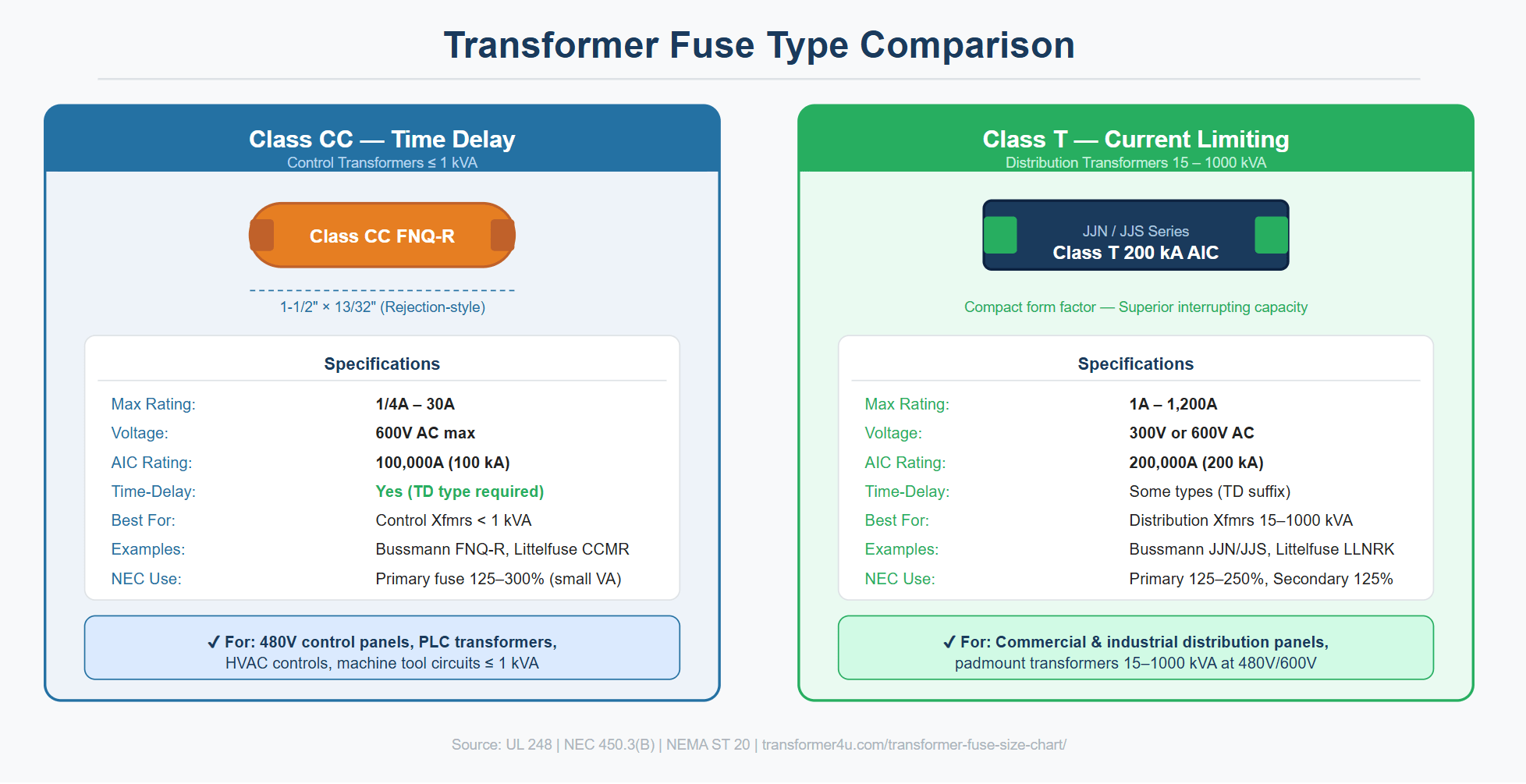
🔵 Class CC — Time Delay (for Control Transformers)
- Size: 1-1/2″ × 13/32″ (midget)
- Rating: 1/4A to 30A, 600V
- Type: Time-delay, rejection-style
- AIC: 100,000A (UL Listed)
- Use: Control Xfmrs ≤1 kVA at 480V
- Examples: Littelfuse CCMR, Bussmann FNQ-R
🟢 Class T — Fast-Acting (for Distribution Transformers)
- Size: 1-1/16″ (compact), 200kA AIC
- Rating: 1A to 1200A, 300V or 600V
- Type: Fast-acting, current-limiting
- AIC: 200,000A (superior protection)
- Use: Distribution Xfmrs 15 kVA–1000 kVA
- Examples: Bussmann JJN/JJS, Littelfuse JLLN
| Feature | Class CC | Class T | Class RK5 | Class L |
|---|---|---|---|---|
| Max Rating | 30A | 1200A | 600A | 6000A |
| Voltage | 600V | 300V/600V | 250V/600V | 600V |
| AIC (kA) | 100 | 200 | 200 | 200 |
| Time-Delay? | Yes | Some | Yes | Some |
| Best Use | Control Xfmrs | Distribution | Distribution | Large Power |
| Typical kVA Range | <1 kVA | 15–500 kVA | 15–1000 kVA | 500+ kVA |
| Physical Interlock | Rejection clip | Compact | Standard | Bolted |
8. Factory Tips: 5 Common Fuse Sizing Mistakes
A 100A feeder breaker does NOT mean you need a 100A primary fuse. The fuse protects the transformer, not the
feeder. Calculate from the transformer’s own rated primary current — which might be only 36A for a 30 kVA,
480V transformer. Installing a 100A fuse here provides effectively no transformer protection.
Transformers draw 6–12× rated current for 100ms during energization. Always use time-delay
fuses for transformer primary protection. A fast-acting fuse sized at 125% will blow on every
switching. The time-delay characteristic allows inrush to pass while still interrupting sustained fault
current.
NEC 450.3(B) only allows 250% on the primary fuse when separate secondary overcurrent
protection is installed. Without it, the maximum is 125%. I’ve seen inspections fail because
contractors assumed 250% was always allowed — it isn’t.
When sizing a transformer, customers often use load kW to select kVA. A 100 kW load at 0.8 power factor
requires a 125
kVA transformer — not 100 kVA. Undersizing the transformer means the primary fuse may nuisance-trip
during peak demand.
A fuse size table for a 480V primary transformer is completely different from one at 208V or 240V. Primary
FLA at 208V is 2.3× higher than at 480V for the same kVA. Always verify the actual primary
voltage on the nameplate before selecting fuse size.
All the tables on this page in a printer-friendly 2-page format: Download Transformer Fuse Size Chart PDF (NEC 450.3). Perfect for field engineers and electricians.
9. Frequently Asked Questions
65.1A → round up to 70A. With both primary and secondary protection: primary fuse =
52.1 × 2.5 = 130.3A → round up to 150A. Use a time-delay Class T or RK5 fuse.
2–9A), ≤300% (if <2A). With primary + secondary protection: primary fuse ≤ 250%, secondary fuse ≤
125% of secondary rated current. Always round up to the next standard fuse size.
time-delay fuses (Bussmann JJN or equivalent). For 480V control transformers below 30A: use
Class CC rejection-style time-delay fuses (Bussmann FNQ-R or Littelfuse CCMR). Both
types provide 100–200kA AIC interrupting capacity required at 480V.
are the same. However, fuses are generally preferred for transformer primary protection because they
clear fault currents faster and have higher AIC ratings, reducing through-fault damage to the transformer
windings.
secondary protection, primary fuse at 250% = 300A. Secondary FLA at 208V = 100,000 ÷ (208 × 1.732) =
277.5A. Secondary fuse at 125% = 350A. This is among the most common configurations in US commercial
buildings.
at 125% is code-compliant. However, secondary protection provides better fault isolation and allows a
larger (250%) primary fuse that avoids nuisance tripping. For transformers above 112.5 kVA, secondary
protection is strongly recommended. Consult the AHJ and your transformer
protection engineer.
Related Resources
- Transformer
Full Load Amps Chart — Complete FLA Reference - Transformer
Sizing Chart — Complete kVA Selection Guide - Distribution
Transformer Sizing Calculator - kVA
to Amps Calculator - How to
Read a Transformer Nameplate - Transformer
Protection Systems Guide - Oil-Filled
Transformer Full Load Amps Chart - Distribution
Transformer Complete Guide
Standards Referenced:
NEC 2023 Article
450.3(B) |
NEMA ST 20 —
Transformers, Dry-Type |
UL 248 —
Low-Voltage Fuses